


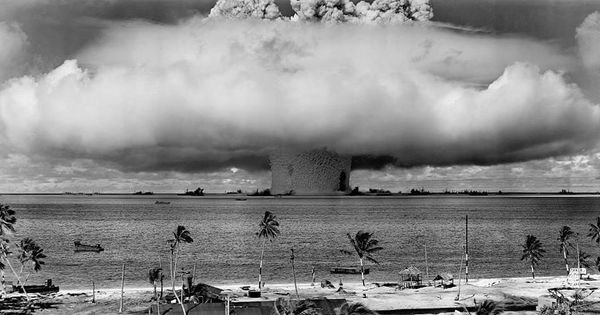
When Army Air Forces officer Claude Eatherly piloted the plane Straight Flush in support of Enola Gay’s mission to obliterate the city of Hiroshima, his tasks were little different from those of past flights. It was just another flight requiring the twenty-six-year-old’s technical acumen, but it also involved wiping 70,000 people off the face of the earth. Eatherly would later feel anguish over his role: He repeatedly attempted suicide and was eventually institutionalized. At the time, though, he saw it as just another job.
How had this convergence of routine activity and unprecedented catastrophe become possible, and what did it mean? For the philosopher Günther Anders, this was the defining question of the twentieth century, and of the final epoch of man that he saw unfolding around him. Only by answering it—by bringing our self-knowledge up to the level of our monstrous new technological powers—would humanity be able to forestall its self-destruction.
“Anders’s question resonates anew today.”
Anders’s question resonates anew today, as the employees of frontier labs tell us that the machines they are building pose an existential threat to humanity. AI’s increasingly remarkable technical feats are accompanied by ever louder warnings of impending doom from within the industry. For most observers, the contrast is jarring to the point of absurdity; but for Anders, it would have come as no surprise.
In the crowded field of German, and especially German Jewish, thinkers who probed the catastrophes of the twentieth century—Walter Benjamin was Anders’s cousin, and Hannah Arendt his first wife—Anders therefore deserves better than his obscurity in the English-speaking world. Amid mounting prophecies of self-induced Armageddon, and the tech industry’s escalating talk of the end-times, it isn’t too late to learn from the man known as the Atomphilosoph.
Anders grew up in the heady climate of early-twentieth-century German thought, absorbing the phenomenological methods of Husserl and Heidegger, befriending Bertolt Brecht, and marrying Arendt, whom he had met in Heidegger’s seminar. Over a decade before the atom bomb, Anders experienced the end of his own world with Hitler’s rise to power, which forced him to flee Germany for Paris, where he attended Alexandre Kojève’s lectures on Hegel and the end of history. He later moved to the United States, where he divorced Arendt, lived for a time with Herbert Marcuse, tutored Irving Berlin, failed in an attempt at scriptwriting for Charlie Chaplin, and attended seminars with Max Horkheimer and Theodor Adorno. After World War II, he returned to Europe and settled for good in Vienna, where he died in 1992 at the age of ninety.
In his long life, one event stood as the Archimedean point for Anders and, he believed, for all of humanity. On August 6, 1945, the “day zero” that the bomb fell on Hiroshima, “a New Age began”: the age in which it is in our power to destroy the entire world. The New Age of the bomb was also the “Last Age,” in which the bomb would hang over the earth like a cosmic sword of Damocles, always threatening a shift from “the time of the end” to a final “end of time.” For Anders, the existence of the bomb created a permanent state of emergency in which every moment brings with it the possibility of the final disaster. This bleak vision of a common global eschatological condition, transcending the geopolitical rivalries and mutual threats that concerned other observers of the nuclear age, might be dubbed SAD—self-assured destruction.
One of Anders’s most important concepts was the “Promethean gap”: the “growing asynchronicity between the human and the world of their own products.” It is the difference, today widening into a chasm, “between our action and our imagination.” Our technological prowess has grown stupendously, enabling us to incinerate millions in a moment; but our mental and moral capacity to contemplate the significance or meaning of our actions has not grown proportionately. The scope and consequences of our powers over the earth are now simply too great for our petty imaginations. The cause of this gap is not humans’ short-sightedness or moral deformity, but rather the basic and previously unproblematic limits on our capacity to contemplate our actions.
The result is an inability to comprehend the evils we can now perform. One might imagine terrible crimes to offer a kind of malevolent sublime before which, like Joseph Conrad’s Kurtz, we gasp in awe. But, Anders argues, our imaginative limits instead prompt us towards the opposite reaction: a retreat to cold calculation, turning mass slaughter into a matter of Strangelovian pseudo-rationality. We understand the immensity of killing a single human in cold blood; but our minds freeze up at the thought of the death of a hundred thousand, such that Eatherly could assist in the dropping of Little Boy with no more perturbation than any other task.
Anders was so taken by this disturbing puzzle that he began a years-long correspondence with Eatherly, collected in the book Burning Conscience. The Promethean gap, by which man’s technological reach increasingly exceeds his grasp, gives phenomenological depth to the remark attributed to Stalin that one death is a tragedy but a million deaths are a statistic. As Anders put it in one letter to Eatherly, “How should one repent 200,000?”
The resort to analytical detachment rather than stupefied horror was not unique to the bomb. He saw a similar apathy of the imagination in another atrocity that was coming to be widely known at the same time: the Nazi death camps. As Anders insists in his essay “Reflections on the H Bomb,” it was reductive calculation that made such evils possible. “The mass exterminations under Hitler could be carried out,” he says, “because they absolutely transcended the moral imagination of the agents,” thereby making “possible a new, truly infernal innocence.”
The possibility of such a reduction does not occur only at the extremes of mass murder. Rather, it lies latent across our modern technical society. Many techno-optimists today will grant that a new technology might seem scary right now, but assure us that eventually everyone will get used to it. For Anders, this possibility was precisely what was so terrifying: that through our nondeliberative submission to the reality of our expanding technological abilities, we would sleepwalk into disaster. Without a concerted effort to confront the awesome powers we have attained, even the atom bomb and Zyklon-B would come to be seen as merely another “normal technology” that we would no more gape at than we do now at the light bulb.
Anders’s argument complements his more famous ex-wife’s “banality of evil” thesis, laid out in her 1963 book Eichmann in Jerusalem. By virtue of what Anders dubbed “mediality,” the interposition of technologies and chains of command between our actions and ourselves has served to break down the distinction between activity and passivity. Severed from direct contact with our own actions, we come to forget our culpability for the deeds that we, and not anyone else, are after all performing. Just as the bureaucrat Adolf Eichmann had managed the simultaneously remarkable and all-too-human feat of not thinking about what he was doing as he orchestrated the Final Solution, so might a pilot lackadaisically deploy the weapon to destroy a city; and so now, as many fear, might an engineer deploy the AI model that turns against its creator. As the title of Anders’s own commentary on Eichmann, We, the Sons of Eichmann, indicates, he feared that all of us were today susceptible to the intermediation, and thus the banalization, of evil.
Much of Anders’s writing is an exercise in the very thinking through horror that he himself recognizes is so difficult to perform. On the page, the reader witnesses Anders struggling to make sense of the “historically supraliminal” significance of the bomb and the era it ushered in.
“Our failure to think is the natural consequence of the modern worship of progress.”
He would have been the first to admit the inadequacy of his own efforts. “Most thought-provoking,” Anders’s teacher Heidegger observed in his book What Is Called Thinking?, “is that we are still not thinking—not even yet, although the state of the world is becoming constantly more thought-provoking.” For Anders, this was not accidental: Our failure to think is the natural consequence of the modern worship of progress. Once one adopts the pious faith that the world must continually get better, the end of the world is ruled out as a matter of course.
What’s more, when modern man does attempt to contemplate the apocalypse, he simply inverts his progressivism and succumbs to a nihilism that also forecloses the possibility of effective action. As Anders summarizes such thinking, “The bomb is OK because there is no point to us anyway, and because the bomb is here, we are no good for anything anymore anyway.” Disillusionment here becomes the mirror image of optimism; for both, determinism forestalls the recognition of human agency, and therefore the assumption of responsibility.
Anders was also a careful observer of how technology can warp us in less obviously insidious ways. The possibility of banal evil for Anders exists not merely at the edge of human conduct, but across our everyday lives, especially in our engagement with new media. Long before Neil Postman and David Foster Wallace, he was dissecting the ways that television in particular could be an agent of social atomization.
He feared that our mounting dependence on novel technologies was forming us into a mass of indistinguishable automatons, identical in our consumption, our loneliness, and our parasocial relationships with the products we consume. In the essay “The World as Phantom and Matrix,” Anders detects in our media-addled getting and spending a deep, if unspoken, yearning to resemble our products: pristine and, by virtue of their constant updating and perpetuation through the production of endless copies, ageless and impervious to the ravages of time.
This desire to be more like our flawless products and less like the error-prone creatures we are is but the commodified form of a phenomenon captured in another of Anders’s coinages: “Promethean shame.” Long before Deep Blue defeated Kasparov, he took note of humanity’s feeling of humiliation in the face of technologies that seemed to surpass us in various abilities and exceed our understanding. The realization of inferiority before the machine calls up, even as it seems to justify, a latent disgust at one’s nature as a created being. Unlike the tool built to our specifications to achieve our ends, we come into and persist in the world encumbered by conditions and constraints antedating our desires.
“Mass objects, through their identical multiple existences, attain a kind of ersatz immortality.”
The experience of Promethean shame occurs most obviously at the frontier of technology, but even the unassuming mass-produced trinket, Anders avers, can serve as a reminder of our finitude, and therefore as a goad toward our own obsolescence. Mass objects, through their identical multiple existences, attain a kind of ersatz immortality precisely through their lack of individuality. Under this regime of “industrial Platonism,” the constant presence of replaceable identical parts thus both reminds us of our mortality and holds out the false promise of escaping it by merging with the machine. Counterintuitively, Anders suggests that we are ashamed because we are not replaceable.
Today, the prophets of the Singularity do not express disgust with the human as, say, fallen sinner, but with the human as human. Anders’s emphasis on shame as both revealed and heightened by modern technology helps account for this feeling: We feel inadequate before the machine because we have not been created as it has; transcending humanity through our own self-creation thus becomes the only way to escape an intolerable shame. A mere machine, however extraordinary, will, as long as it remains distinct from man, humiliate him. But the machine that takes the leap into the domain of the human and allows us to fuse with AI, as some futurists promise, offers us a path into the splendor of inhuman self-optimization.
“Humanity must debase itself totally in order to escape its debasement.”
Put another way, Anders’s account of shame suggests a startling interpretation of the posthumanist project: We must build greater and greater machines, further degrading ourselves in comparison and bringing our Promethean shame to its lowest depths, until the moment that the Singularity hits, at which point the attainment of posthumanism will cause the source of our shame to finally dissipate. Humanity must debase itself totally in order to escape its debasement.
Underlying our shame and sense of finitude, however, is a cosmic arrogance. “The ‘human engineer,’” Anders writes, is “both ‘overconfident’ and ‘self-deprecating,’ both hubristic and humble. His attitude is one of ‘arrogant self-degradation’ and ‘hubristic humility.’” In his essay “The Pathology of Freedom,” Anders calls attention to the words Nietzsche puts into the mouth of Zarathustra: “If there were Gods, how could I endure not to be a God!” Today, the closer the posthumanist gets to building his own god, the less he can endure it; but once the artificial god exists, man need endure no longer, for he will have become that god.
There is a great difference between Anders’s time and our own, however. For him, “‘To be ashamed’” meant “Not being able to do anything about the fact that it is not one’s fault.” Today, our finitude looks to be rapidly becoming optional. Biohacking, artificial wombs, radical life extension, polygenic screening, cloning, and more hold out to the transhumanists the promise of finally escaping their heretofore ineradicable shame. One need not even be an extreme AGI accelerationist to exhibit this shame at our mortality. Plastic surgery, gender reassignment, “looksmaxxing,” and other cultural trends all betoken an attempt to avoid the decay that comes from being a singular, living thing—an attempt pursued by means of the artifice-granting technologies which themselves mock that singular life. As one Anders-influenced thinker, Jean-Pierre Dupuy, has put it, “the natural and ineliminable finiteness of the human condition is now perceived as a form of alienation rather than a source of meaning.”
Here, as with our new tools of carnage, Anders recognized that at the extremities of modern man’s engagement with technology, one could witness the purest—that is, the basest—instance of maladies that bore the chance of afflicting all of us. Then, the bomb and the concentration camp revealed the depths of a complacency and conformity that he saw in a weaker form in the average workplace; today, the transhumanists’ promise of the singularity reveals the same terror of human frailty that is exposed, again in attenuated fashion, in the average manipulative influencer stream or fashion advertisement. What Anders warns of is not only the end of the world as such, then, but the end of the human world—the world inhabited by proper humans, in all their fragility and glory, and not by some perfect but lifeless successor.
For Anders, the only way to reconcile ourselves to our new capacities for self-destruction and self-replacement was to enlarge our moral imagination. His reasoning here is simple: Our survival depends on closing the Promethean gap between capability and comprehension; but there is little chance of doing so by reining in the former. The atom bomb’s existence—today one might add the existence of artificial intelligence—is simply a brute fact; no unlearning or wishing away is possible by which we might revert to a prior epoch, except perhaps through the very civilization-ending catastrophe we need to prevent. It followed, then, that whatever hope we might grasp at must lie in the possibility of expanding our moral imaginations to compass the same gambit that our technologies can now reach.
“This was not cosmopolitan sentimentalism.”
Such a moral broadening would entail conceiving of all inhabitants of the earth as, if not a single community, at least a single victim, which might now perish entirely and at once. This was not cosmopolitan sentimentalism, but a coming to terms with a universality that has already become the case, for the bomb “has turned us into one humanity. What has the power to affect everyone is everyone’s concern.” It is the universality of the “girls of Hiroshima” who once wrote to Eatherly, “We have learned to feel towards you a fellow-feeling, thinking that you are also a victim of war like us.”
Any such moral expansion to encompass the whole world must necessarily seem ludicrous until it happens—after all, it is only those who have made the leap who then have the capacity to comprehend what they have done. But, Anders might counter, the apocalypse itself is barely fathomable—how can one think of a timeless nothingness?—but no less possible for that. It is man’s curious task, as he clutches to his eroding creatureliness, to hold back that which he can scarcely imagine, but which he can all too easily usher in.
As Anders presents it in his essay “Commandments in the Atomic Age,” man’s new and now-permanent mission would be to forestall the earth’s final destruction, every day striving against his own powers of megadeath: “The apocalyptic danger is not abolished by one act, once and for all, but only by daily repeated acts.” This task—to “make the end times endless”—is one that can never cease as long as we are to live. Anders’s atomic man thus has something of both Sisyphus, condemned to perpetual toil, and the Pauline katechon, responsible for holding back the end of the world.
For all his pervasive pessimism, Anders points us, out of the shadow of the obsolescence of the human, to a new, final, and distinctly human task for man to carry out. His strength and calculative powers might be overwhelmed by the machine; but, in a final reminder of our ineradicable moral powers, man and man alone can perform the eternal feat of rising above his own capacity for self-annihilation, whether by kinetic devastation or technological supersession. Perhaps in that meek but stark task of making it to another day as yet still a human, he can overcome his shame and find in a new form the “grandeur” to which Pope Leo called the world’s attention earlier this year.
The continually imminent end of the world might be approaching, but there is still time; the apocalypse need not come today, if only we can cease our thoughtlessness. Here, philosophy can aid in our task by opening our eyes, but it is left to every man to then look and see what he is doing. “The final word,” Anders wrote, “does not belong to the metaphysician, but solely to the friend of humankind.”