


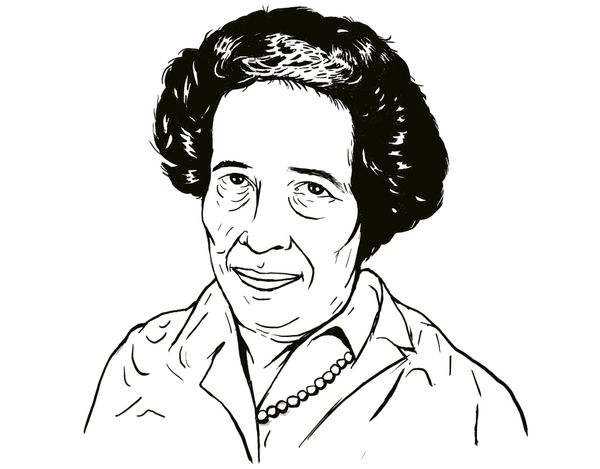
In 1944, when Hannah Arendt sat down to compose the notes for what would become The Origins of Totalitarianism, not two years had passed since news of the Nazi death camps had reached America. American troops were on their way to the beaches of Normandy to sledgehammer into Europe, but the streets of Paris were still under German control. After moving to Manhattan’s Upper West Side in 1941, Arendt had begun working for a German-Jewish weekly called Aufbau, for which she wrote many of the essays that would become The Origins. As she described it, the project sought to explain a vague but widely shared agreement that “the essential structure of all civilizations is at a breaking point.” More specifically, Arendt set out to answer how death camps and a World War could be set in motion by “so small (and, in world politics, so unimportant) a phenomenon as the Jewish question.”
In order to do this, Arendt addressed two theses on the source of antisemitism, both of them held widely among the Jewish organizations lobbying Washington for European intervention, and equally among the impoverished emigrant Jews who were scrambling to rebuild their lives in the new world.
The first was the thesis of “eternal antisemitism”: the idea that “mankind has insisted on murdering Jews for more than two thousand years” in a historical chain reaching back to the sack of Jerusalem, the blood libels, and the Crusades. The second thesis, which she called the scapegoat theory, held that Jews had become the sacrificial lamb of totalitarian fascism almost by accident: that when a machinery of violence like the Nazis’ spins out of control, anyone could become the target of the bloody cleansing.
“Arendt argued that both theories were wrong.”
Arendt argued that both theories were wrong—indeed, they were facile ways for Jews to “escape the seriousness of antisemitism” by waving away the political conditions of European society with psychological explanations that veered into the mystical. With regard to the scapegoat theory, she noted that before the Jews were the victims of Nazi terror, they were the center of Nazi ideology, and an ideology that must convince people to mobilize cannot choose its victims arbitrarily. As for “eternal antisemitism,” she didn’t deny the long history of Jew hatred among the peoples of Europe, but she argued that modern antisemitism, of the variety produced by the Nazis, was categorically different from what had come before. The Origins of Totalitarianism presented her alternative view.