


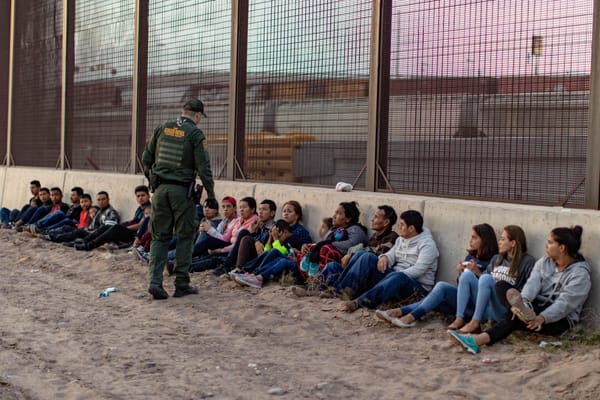
Before dawn on March 10, 2014, a group of roughly thirty migrants awoke in Tijuana, Mexico, packed their belongings, and ate one final meal before attempting to cross into the United States. Some were Mexican nationals who had previously been deported. Others were Central American women and children hoping to reunite with family members who had migrated north years earlier.
There was nothing unusual about their intentions. For decades, foreign nationals with similar hopes had arrived at Mexican border cities to prepare for the journey into the United States. What distinguished this group was not why they wanted to cross, but how they intended to do it. Rather than hiring a smuggler to attempt the dangerous trek through the desert, they planned to walk the pedestrian bridge at the Otay Mesa Port of Entry and present themselves directly to US Customs and Border Protection (CBP) officers. There, they would ask for permission to enter.
To many of the migrants, the idea sounded implausible, even absurd. For decades, impoverished migrants had understood that there was no meaningful legal pathway for them to enter the United States. Immigration reforms had expanded visas for highly skilled workers and some agricultural laborers, but poor migrants seeking low-wage jobs had no comparable avenue. Up to that point, those who wanted to enter the country generally did so clandestinely, hoping to avoid detection by CBP agents. Yet in the weeks leading up to that Monday morning, a small group of American immigration activists had been meeting with deportees and newly arrived families in shelters in Tijuana, urging them to try something different. Like many observers within immigration advocacy circles at the time, I was watching the experiments of this small group of activists closely because their earlier political organizing had already led to the creation of the Deferred Action for Childhood Arrivals program.
The activists sought to connect two little-known elements of US immigration policy. The first involved the “credible fear” screening process, which requires immigration officials to interview migrants who claim they fear returning to their home countries. If an asylum officer determines that a migrant has a credible fear of persecution, the individual can present his or her asylum claim before an immigration judge. The second component relied on the discretionary enforcement guidelines issued by the Obama administration, which allowed migrants who were not considered a flight risk or public safety threat to be released from detention while their cases continued. The activists intended to use it as leverage to pressure the administration to release the migrants from detention while their cases proceeded.
For the strategy to work, the activists sat with the families to prepare them for their interviews. To pass, the migrants needed to explain not why they wanted to enter the United States, but why they could not return home. For many, that required little rehearsal. Extortion by criminal gangs, threats of violence, and political instability were already part of their daily life. The activists informed the migrants that they would be detained. But this was part of the plan. The activists would organize public pressure campaigns and media attention to compel the Obama administration to parole and release them into the United States. They had reason to be confident that the strategy would work because it had succeeded at least twice the previous year, once in Nogales and once in Laredo in actions known as the Dream 9 and the Dream 30.
For the activists organizing the protests, the point was not simply to help a small group of migrants enter the country. The intended goal was to highlight what they considered a broken immigration system that separated families and to pressure the Obama administration and Congress to pass comprehensive immigration reform.
But this third action had begun to raise concern inside the administration. Word of the earlier crossings appeared to be circulating among migrant communities and criminal smuggling networks along the border. Cartels that controlled the crossing routes seemed to recognize that the tactic could open a new market for families with children who had previously been deterred by the more perilous desert crossing their male relatives had attempted years before.
Republican members of Congress had already begun asking questions. At a December 2013 House hearing that examined the sudden spike in credible-fear claims at the border—which had jumped from 13,000 in 2012 to 36,000 in 2013—the Virginia Republican Bob Goodlatte made direct reference to the earlier actions and raised the question of whether these political demonstrations were teaching migrants to exploit the system. Representative Trey Gowdy pressed Department of Homeland Security (DHS) officials on the dramatic increase of credible-fear claims. “Is the world twice as dangerous in 2013 as it was in 2012?” he asked. Or had it simply become understood that “if you just utter this talismanic phrase, you are going to be better off?”
“Obama administration officials felt pressure to comply a third time.”
And yet, despite the mounting signs that these political actions were encouraging other migrants to attempt the same approach, Obama administration officials felt pressure to comply a third time. They appeared to believe that granting the activists’ demands could help build momentum for immigration reform legislation that had stalled in Congress. The calendar mattered as well. The closer it came to the 2016 election, the more valuable an immigration victory seemed, particularly in the Democratic Party’s effort to solidify its Hispanic voter base. (Indeed, one of the migrants who participated in the March crossing later attended a town hall with Obama at Florida International University, where the president highlighted the need to pass immigration reform to provide a path to citizenship for undocumented immigrants with American loved ones.) Against this political backdrop, the risk that another round of mass processing might trigger a wider migration response seemed to be treated as a secondary concern.
The Obama administration’s decision to approve a third round of processing would prove to be a turning point. What had previously been a narrow procedural safeguard within immigration law had been turned into a broad pathway whereby migrants could enter the country.
In the weeks that followed, word spread rapidly across migrant networks throughout Mexico and Central America. Spanish-language media coverage accelerated the process. One of the participants was the prominent immigration activist Elvira Arellano, who had become a national symbol of the deportation debate in the mid-2000s after taking sanctuary in a Chicago church. Images of Arellano crossing the border with her children splashed across televisions, sending a powerful signal to Central Americans that it was now feasible to present oneself at the border and enter the country. That message was especially resonant for the thousands of women with children in the region who had been discouraged from attempting the dangerous desert journey.
“A narrow procedural safeguard within immigration law had been turned into a broad pathway.”
Border officials soon began observing a new pattern. Increasing numbers of migrants started arriving at ports of entry and attempting to present themselves to officers using the same language activists had encouraged the earlier cohort to use. By mid-April 2014, reporters were documenting the unusual scenes unfolding along the border. The New York Times described migrants—many of them women with children and unaccompanied minors—being dropped off during daylight hours on the US side of the border to be picked up by agents. The Times reporter quoted a Border Patrol agent describing the sudden change in migrant behavior. “Word has gotten out that we’re giving people permission and walking them out the door,” said the agent, Chris Cabrera. “So they’re coming across in droves.”
The numbers soon began to reflect the shift. In early 2014 the system was processing roughly 3,500 credible-fear cases per month. By the end of the year that figure had climbed to nearly 6,800. Meanwhile, the number of unaccompanied minors arriving at the border surged from 24,000 in 2012 to more than 68,000 in 2014. These figures signaled a broader shift in how migrants were attempting to enter the United States. Instead of crossing clandestinely, families and unaccompanied children were presenting themselves to border officials and asserting humanitarian claims to enter the country.
In the months that followed, the Obama administration would make some efforts to stem the growing crisis, including attempting to hold families in detention centers while their asylum claims were adjudicated. But political and legal opposition proved strong. The ACLU and other liberal legal groups used federal litigation to curtail the administration’s nascent deterrence efforts. In announcing the lawsuit RILR v. Johnson in late 2014, the ACLU argued that “locking up families … in order to scare others from seeking refuge in the United States is inhumane and illegal.” The court ultimately sided with the plaintiffs, ruling in 2015 that the government could not detain asylum-seeking families primarily to deter future migration. Further court rulings and legal settlements ultimately helped streamline the process by which asylum seekers received expedited release from detention and work authorizations, further incentivizing arrivals from Central America and other regions around the world. By the end of the Obama administration, credible-fear referrals had risen from roughly 36,000 in 2013 to more than 94,000 in 2016—an increase of about 160 percent.
Ironically, the political maneuvering intended to advance comprehensive reform ended up undermining it. By constructing a de facto legal pathway into the United States out of a complex array of discretionary actions and policies, the administration eroded the political conditions necessary to pass reform for the millions of undocumented immigrants already living in the United States, while simultaneously encouraging the arrival of millions more migrants.
The decade-long migration crisis that unfolded between 2014 and 2024 was widely portrayed as a crisis that caught policymakers off-guard and left them with few meaningful tools to stop it. Yet the events that preceded the 2014 surge suggest a more complicated story. The decision to process and release the initial activist-advised groups in 2013 and 2014 revealed a viable pathway into the United States that migrants would eventually follow at scale. In short, a discretionary policy choice made in response to domestic political pressure helped set in motion one of the largest migration waves in modern American history. Recognizing that possibility would not simply revise the historical understanding of a single administration’s decisions. It would also challenge a deeper assumption that has shaped the immigration policy debates for much of the past decade.
Liberal advocates and policymakers have long argued that migration flows toward the United States are primarily the result of “push factors” in migrants’ home countries: violence, poverty, corruption, political instability, even climate change. In this view, migration is fundamentally driven by forces outside the control of American policymakers. US immigration policy may influence how migrants are processed once they arrive, but it does not meaningfully determine whether migration waves occur in the first place.
This assumption carries powerful implications for policymaking. If migration flows are mostly the product of structural conditions abroad, then the United States has limited ability to prevent them. The role of government is management rather than enforcement or deterrence. And when that is the case, it becomes easier to justify policies aimed at facilitating migration flows, such as streamlining humanitarian processing and creating new pathways for migrants to enter the country
Yet the origins of the decade-long mass migration crisis show that this assumption is wrong. Violence, poverty, and political instability can explain why individuals want to leave their countries. But they do not explain why migration toward the United States accelerates suddenly at specific moments in time. For decades, migration from Mexico and Central America was dominated by individual adult men who crossed the border illegally in search of work. Despite billions of dollars invested in border security, healthy and able-bodied adults can and do find ways to cross the nearly 2,000-mile southern border undetected. But the costs of paying cartel smugglers and the physical dangers of the journey traditionally discouraged any but prime-age men from making the crossing. What emerged beginning in 2014 was a massive surge of a new class of migrants—unaccompanied minors and families with children—who were taking advantage of an emergent process created by the gradual accumulative effect of various discretionary policies and legal precedents interacting with one another.
The effect of US enforcement policy on migrant flows was obvious long before the 2014 surge began. When Brazilian migrants began crossing the southern border in significant numbers in 2005, for instance, DHS implemented what it called Operation Texas Hold ‘Em, which prioritized detention and rapid removal for that population. Word of the enforcement effort quickly spread through smuggling networks. Within two months, crossings had dropped by nearly 90 percent.
The surge that began in 2014 unfolded differently than the Brazilian surge in 2005 and other waves not because deterrence tools stopped working, but because the Obama administration did not have the political appetite to apply them before the migrants reached the southern border. Facing mounting criticism from liberal advocates and social justice groups, the administration instead allowed the wave to build. By the final months of Obama’s presidency, federal district court decisions had established precedents favoring the quicker release of asylum-seeking families and faster processing of work authorization permits that made the incentive structure even more favorable for foreign nationals. Larger numbers of migrants from across the world began making their way toward the southern border. Elevated migration levels persisted into the first Trump administration, as federal courts blocked or curtailed several of the administration’s efforts to impose more restrictive asylum policies.
The Biden administration provided the clearest example of how regarding mass migration as inevitable encourages crossings. During his first year in office, the administration issued nearly 300 immigration-related executive actions, including roughly 90 that reversed or began dismantling Trump-era restrictions. The early moves sent a clear signal that the United States was shifting away from the deterrence framework that had emerged at the end of the previous administration.
In its place, policymakers adopted an approach centered on managing migration flows rather than attempting to prevent them. Humanitarian processing systems were expanded, detention was deemphasized, and new administrative pathways were developed through which migrants could present claims for entry. At the same time, international organizations—including several funded by USAID—spent billions of dollars across the western hemisphere hiring staff to guide migrants toward the border and, in some cases, providing financial assistance to those making the journey north.
To many observers, the relationship between these developments and the growing surge at the border appeared glaringly obvious, as encounters rose from roughly 977,000 in fiscal year 2019 to nearly 2.5 million in 2023. Yet among many progressive groups, legal advocates, and many staffers within the Biden administration, a different interpretation persisted. Migration, they argued, was driven primarily by structural conditions abroad and therefore would have occurred regardless of the policies adopted by the administration. As a result, Biden officials viewed these programs and aid money not as causes of the surge, but as humanitarian responses to it.
“The Obama and Biden administrations tended to view mass migration as a force of nature.”
This logic was reflected in the Biden administration’s effort to construct a regional system for managing migration across the Western Hemisphere. On June 10, 2022 President Biden signed the “Los Angeles Declaration on Migration and Protection,” an informal agreement among governments across the region that emphasized “shared responsibilities on managing migration and protection.” Under the agreement, participating countries committed to expanding legal migration pathways and improving the processing of migrants. The US commitment to the agreement was followed by policies that accelerated the processing of asylum claims at the southern border and expanded new administrative entry pathways. Among them was the parole program for Cubans, Haitians, Nicaraguans, and Venezuelans (CHNV), which allowed more than half a million migrants from these countries to apply from abroad and fly directly to the United States in just two years.
President Trump’s return to office in early 2025 and his rapid move to close the southern border made clear that policy choices matter. Migration flows that had reached historic levels in the preceding years quickly collapsed once the pathway into the United States closed. Border authorities had recorded 3,201,144 migrant encounters in fiscal year 2024, but by end of fiscal year 2025, the annual total had fallen to 237,538—a 93 percent decrease. When a president decides to narrow the pathway into the United States, migration flows fall just as quickly as they rose.
Both the Obama and Biden administrations tended to view mass migration as a force of nature outside their control. But as the history of the last ten years shows, it was to a great degree a phenomenon of their own making.