


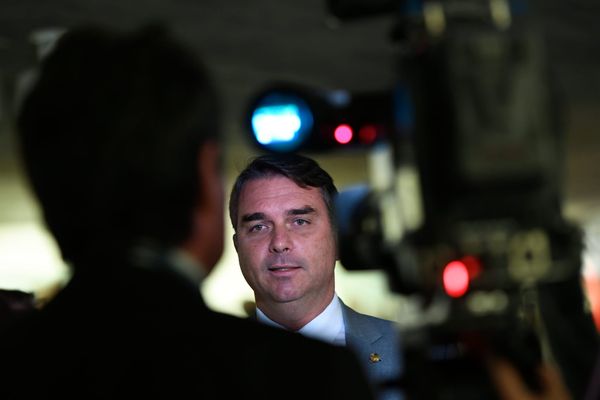
This year, Lula da Silva, Brazil’s incumbent president, will run for a fourth term. The man he defeated in 2023, Jair Bolsonaro, is in prison, so the former president’s son, Senator Flávio Bolsonaro, is running in his stead. An indication of how tightly contested the election will be came on June 24, when Jair’s wife, former first lady Michelle Bolsonaro, released a video on Instagram declaring she wouldn’t support her stepson because he was rude to her on a phone call.
The quarrel was covered as a political soap opera, but it had real implications for the election’s outcome. Lula’s first administration (2003-2006) produced a political backlash that gave rise to its own ideology: antipetismo (“anti PT-ism”), defined by its opposition to Lula’s Workers Party (PT). At the time, the archetypal antipetista was an upper middle-class person who complained about Lula, an uneducated former metalworker, being rude and ignorant. Antipetistas expressed nostalgia for the presidency of the polyglot sociologist Fernando Henrique Cardoso. When Bolsonaro assumed office in 2019, Antipetismo began its evolution into Antibolsonarismo. The same upper middle-class people who read the same newspapers now began to complain about Bolsonaro being rude and ignorant. The hatred went so deep that many right-wing Brazilians campaigned for casting null votes in 2022 instead of choosing between Lula and Bolsonaro.
Persistent elite nostalgia for the Cardoso years points to something more essential than the former president’s polished manners and language skills. In 1999, Cardoso instituted a policy regime known as the Macroeconomic Tripod, which remains in force. It consists of three things: inflation targeting, which usually leads the Central Bank to increase interest rates to lower inflation; a floating exchange rate, in which the value of Brazil’s currency is determined by market value instead of national policy; and primary surplus targeting, meaning the Brazilian state must collect more revenues than it spends, without taking into account the interest on national debt.
In order to achieve a primary surplus, Cardoso’s administration sold state companies and weakened public services. In practical terms, this meant firing public officials in favor of private contractors, while reining in spending to pay the public debt. Although Cardoso also introduced income redistribution policies, his platform was unpopular, which is why he failed to secure a successor. An economic crisis during his second term paved the way for Lula’s first successful run for the presidency in 2001. While criticizing aspects of Cardoso’s economic program from the left during the campaign, Lula also published a famous “Letter to the Brazilian People,” in which he reassured the public that he would maintain his predecessor’s prudent approach.
In Lula’s first and second presidential terms, he maintained Cardoso’s Tripod, helped by an influx of dollars from the growing Chinese market for Brazilian agricultural goods. By combining fiscal probity with redistributionist policies, Lula earned the love of both the people and the bankers. In addition, he paid off the IMF debt by selling government bonds at an interest rate of 12 percent. At the time, the IMF interest rate stood at 4 percent, but what mattered was the anti-imperialist performance of independence from the Washington Consensus.
Bolsonaro defeated PT candidate Fernando Haddad to win the presidency in 2018, but like his predecessor, he preserved the Tripod. To be sure, the administrations of Lula and Bolsonaro had important differences. Bolsonaro privatized state companies, while Lula’s administrations have a history of plundering them, thereby strengthening the allegation that Brazil cannot have good state companies. No matter how much Lula denounces privatization in his speeches, his administration has never bought back the assets sold under Cardoso and Bolsonaro.
Given that both administrations continued to favor bankers’ interests, it is hard to understand why some bankers sought to undermine both Lula and Bolsonaro. One answer is that they would prefer an unpopular president, like Cardoso or Michel Temer, who was in office between 2016 and 2019. Unlike Lula and Bolsonaro, old school politicians who want to be loved by the people, such leaders do elites’ bidding without much concern for approval ratings.
This year, the bankers’ favored presidential candidate was São Paulo governor and Bolsonaro ally Tarcísio de Freitas. He sold off São Paulo’s water company while the state was already suffering the bad consequences of its energy company privatization, and kept the police officers understaffed and underpaid while crime soared. Michelle Bolsonaro was mentioned as a possible running mate who would help him gain Bolsonarista support. But then, Flávio Bolsonaro became his father’s stand-in, leaving Tarcísio without a path to the presidency. It was in this context that Michelle’s family feud with Flávio became an exploitable resource for elites who would prefer a weak president over Lula—or Lula over a Bolsonaro loyalist.
“A more interesting feud is emerging around economic policy.”
But a more interesting feud is emerging around economic policy. While the mainstream right espouses standard free-market views, there is a small dissenting group centered around the Youtube channel 5º Elemento. One leading figure in this milieu is Arthur Machado, a banker who has recently been attacked by leading Bolsonaristas like the economist and former banker Rodrigo Constantino. Machado, with fewer than 40,000 followers on X, is far less influential than Constantino, who has nearly a million X followers and writes for the two major right-wing Brazilian outlets, Revista Oeste and Gazeta do Povo. But Constantino has devoted considerable effort to attacking Machado, accusing him of being a follower of the Putin-aligned Russian philosopher Aleksandr Dugin and even a worshiper of the African deity Eshu. While Machado enthusiastically supports Flávio’s candidacy, Constantino is aligned with Michelle.
Why has Machado attracted such ire? One explanation is that the Brazilian right’s internal disputes are about the future of the Macroeconomic Tripod—which Lula promises to maintain, but some in the right-wing camp are beginning to question. When I contacted Machado to ask him about the Tripod, he told me the economic conditions assumed by its architects—the globalizing world of the 1990s—have given way to a world defined by rising economic nationalism and tariff wars. The United States and Europe are adapting themselves to this new scenario with selective tariffs. The new landscape, Machado says, may require Brazil to take a new approach, involving “tariff barriers and increasing government spending in order to develop the productive sector.” This spending, he adds, “should be done at the expense, not of government size, or of basic things, but rather of the banking system. That is our big problem.”
Constantino declined to speak to me. Adolfo Sachsida, a well-respected economist who served in Bolsonaro’s first administration, was less reticent. When I asked him about the future of the Tripod, he told me that “many on the right would like to see a national project added to this economic framework” in response to the shifting global landscape. The event that triggered this ideological evolution, he adds, was Russia’s invasion of Ukraine, which he says made clear that “access to secure markets close to the production base has become increasingly important.” While Sachsida continues to believe the Tripod must be maintained, he also sees a transition toward a “a national vision that places greater emphasis on geopolitics” as a natural evolution.
Facing resistance from those in the political and financial establishment who are dead set on preserving the status quo, Flávio may find himself drawn closer to those who seek to formulate a new paradigm. If so, a second Bolsonaro presidency might look quite different from the first one.