


In 2014, GOP House Majority Leader Eric Cantor lost his primary to Dave Brat, a radical libertarian economics professor who had never held political office. Brat went on to win the seat and served two terms in Congress as a member of the Freedom Caucus before losing to liberal Democrat Abigail Spanberger in 2018, after his constituency was significantly altered by redistricting.
After a decade plus of political upsets, Brat’s victory isn’t well-remembered. But it was a crucial harbinger of Donald Trump’s hostile takeover of the GOP. One of the issues on which Brat attacked Cantor was illegal immigration. It had emerged as a crucial dividing line between the party establishment, which felt it needed to accept comprehensive reform after Mitt Romney’s 2012 loss, and the restive base, which was increasingly radicalized on the subject. Cantor was ostensibly a conservative Republican, but his donor-class stance on this and other issues doomed him.
Democrats seemed to be having their own “Brat summer” in June 2018, when Alexandria Ocasio-Cortez won a surprise victory over Joe Crowley, going on to win his seat in the fall. Like Cantor, Crowley was a well-connected incumbent of over a decade’s tenure in Washington and a high-ranking figure in his party’s caucus; like Brat, AOC was a political neophyte relying on an upwelling of grassroots support.
“The paths of the two parties diverged after these upsets.”
But the paths of the two parties diverged after these upsets. The GOP’s inability to keep Cantor in his seat was repeated on a massive scale two years later, when Trump racked up state after state in the primaries despite a near total lack of support from the party establishment and widespread repudiation from its media grandees. In contrast, despite losing a few primaries in progressive districts, the Democratic establishment handily fended off the populist left. The same year AOC picked off Crowley, Sex and the City actress Cynthia Nixon challenged Andrew Cuomo for the New York governorship, calling herself a socialist. She lost by thirty points, roughly the same margin as Cuomo’s previous left-wing challenger, the attorney Zephyr Teachout, four years earlier. The Democrats also fended off robust challenges from Bernie Sanders, ensuring Barack Obama’s handpicked successors got the presidential nomination both times.
The Party Decides was the title of a 2008 political study of presidential primaries, whose authors argued that the real determining power remained largely in the hands of internal party elites. Trump’s rise rendered this thesis obsolete eight years later when it came to the GOP, but it still described the Democrats right through Kamala Harris’s campaign in 2024. The party establishment retained control over the primary process. But its decisions proved catastrophic for Democrats’ political fortunes, both in the short and the long term. The one candidate it managed to get into the White House, Joe Biden, was enough of a liability during his ultimately successful campaign that he was already kept off the trail; once in office, he proved barely fit to perform most of the functions of the presidency, a glaring fact that was strenuously denied right up until it couldn’t be anymore.
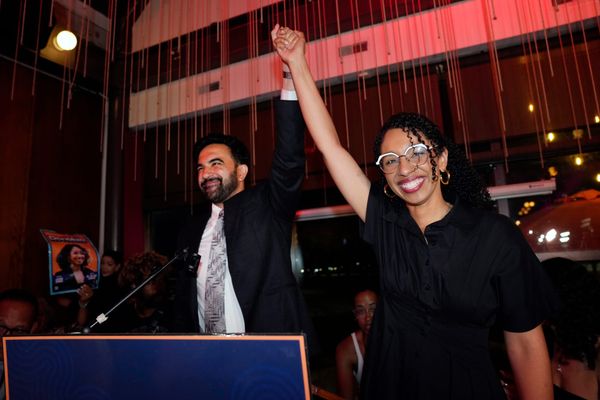
In Democratic primaries, it can no longer be said that “the party decides”: That is the takeaway of Zohran Mamdani’s mayorship, of Graham Platner’s victory in Maine’s senatorial primary, and now, of the victory of three “mini-Mamdanis” in New York City congressional primaries. Two of the latter, like Brat and AOC last decade, defeated incumbents; the third defeated sitting Brooklyn Borough President Antonio Reynoso, himself a decidedly progressive figure, but not enough of one to avoid losing by double digits to left-wing challenger Claire Valdez. What Brat and then Trump showed could be done on the right is now being done on the left.
When Trump ran roughshod over the GOP, the issue was immigration, where there was a clear rift between party leadership and voters; today, the issue behind the Democratic coalition’s crack-up is support for Israel, where a fracture has opened up between establishment and base. These conflicts might seem quite different, but they manifest a similar populist formula. In both cases, the salient objection is that resources meant for “us” are ostensibly going to a disfavored foreign group; in both cases, this objection is sometimes, but not always, framed in terms of ethnic antagonism. This inflammatory nature of the charge ensures perpetual outrage and controversy—an asset in attention-economy conditions. In this situation, the attempt to forbid or shut down particular lines of discussion with accusations of bigotry and “hate” also seems to be largely counterproductive. Those hoping to defeat Mamdani and his fellow insurgents with charges of antisemitism will likely be no more successful in the end than those who tried to use charges of racism as a battering ram against Trump’s restrictive immigration agenda.
The Democrats have spent the past decade promising to “save democracy” while also repeatedly exerting tight control over all the parts of the electoral process they could. That effort gave us a series of leaders who looked like a parody of hereditary monarchy—a succession of mediocre and senile placeholders loved by no one. Trump, whatever his musings about kingship, won his popular mandates against the odds; he is now at perhaps the most vulnerable point in his political career in part because he seems to have given up on that and settled into his new position at the helm of the establishment, perpetuating many of its mistakes.
“Mamdani is the first Democrat to have truly taken Trump’s lessons in populist politics to heart.”
Mamdani is the first Democrat to have truly taken Trump’s lessons in populist politics to heart; the president’s surprising affection for his left-wing nemesis can be read as a sort of paternal recognition. Where exactly the Trumpification of the Democrats will lead will likely take a decade or more to find out. In terms of substance, I find some of the positions taken by New York City’s socialist upstarts—one of whom will likely be my own representative—reasonable, and others bizarre and repellent. Regardless, I view the Democratic Party’s waning ability to predetermine electoral outcomes as a welcome development, just as I regard Trump’s taking a wrecking ball to the GOP a decade ago as fundamentally salutary. Democracy lives, despite the best efforts of its self-proclaimed defenders.