


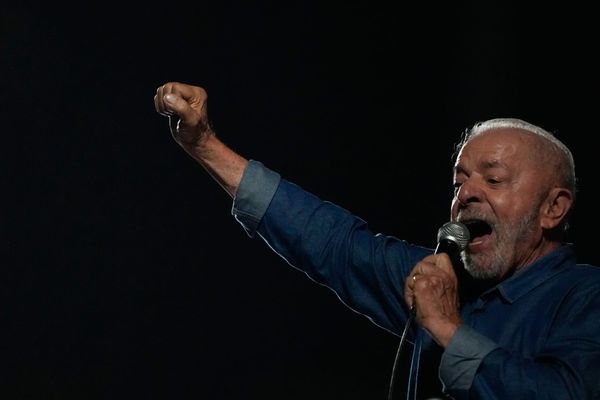
On October 25, Brazil’s President Lula da Silva bucked the global anti-incumbency trend to win the most hard-fought election since Brazil returned to democracy in 1985. The election’s first round occurred amid widespread apathy. Lula came in second. But then his campaign went into overdrive, bringing millions onto the streets and ending the right’s decade-long advantage online.
A decisive moment came in the final debate on Friday night. Debates count for little nowadays as televised events, but clippable and shareable moments are worth quite a lot. Lula’s opponent, Senator Flávio Bolsonaro, made mocking reference to the incumbent’s nine fingers. In response, Lula underlined his connection to working people. “If there’s someone who knows about work it’s me,” he said. “If there’s someone who lost a finger at seventeen it was me. … He never worked in his life.” Another factor was the Workers Party’s (PT) ability to bring people onto the streets in the lead-up to the vote. The largest left-wing demonstration in São Paulo’s history took place on October 11, only to be exceeded when up to half a million people occupied Avenida Paulista on election eve, in perhaps the largest demonstration ever held in Brazil.
This mobilization was matched online, thanks largely to André Janones, a federal deputy from Minas Gerais who gained fame as one of the leaders of a huge truckers strike in 2018. Janones’s “Lula’s Army” WhatsApp channel had 3 million members at the start of the election but now totals over 10 million members—a staggering 7 percent of the electorate.
Sunday’s vote was marked by voter suppression in some municipalities as anti-PT mayors ran reduced bus services. This plus heavy rains in some Bolsonaro-supporting areas led both camps to petition the electoral court to delay the shutting of polling stations. A justice nominated by former President Jair Bolsonaro refused to act, but then a Lula-appointed Justice of the Supreme Court mandated a two-hour extension, fifteen minutes after polls had closed. This created electoral chaos and generated the basis for litigation. Still, Lula’s margin of 4.3 million votes will make it difficult to mount a viable challenge to the result.
“Lula’s biggest strength is also his biggest weakness.”
Lula’s biggest strength is also his biggest weakness. He has an incredible record of winning the presidency. He won two terms in the 2000s, then managed to get his little-known handpicked successor Dilma Rousseff elected twice, and now has won two more consecutive mandates. But these victories have been achieved through alliances with centrist establishment figures that have often hurt down-ballot candidates and demobilized Lula’s own base. The result is that the PT is hollowed out and dependent on its charismatic leader, who due to age and a limit on consecutive terms will enter office as a lame duck. Lulismo has cannibalized Petismo (PT-ism), leaving the party’s post-Lula future uncertain.
The president will face a hostile congress. The Bolsonaro-dominated Liberal Party (PL) has ballast in the Chamber of Deputies and control of the Senate, and holds governorships up and down the country. This reverses the pattern that held for decades, where the PT was one of the largest parties and one of the few with a recognizable ideological identity. Bolsonarismo has become comparably large and cohesive, even if not altogether ideologically coherent. If Flávio had won, he could have remade—or unmade—the republic. Now, Brazil’s progressive constitution has a stay of execution.
When Lula won in 2022 on a “save democracy” ticket, I argued that instead of positioning itself as a defender of the status quo, the left needed to wage its own holy war to compete with the apocalyptic fervor of evangelical-tinged Bolsonarismo. At minimum, a viable left needs a national project, something to tie together collective destiny with individual advancement. On this front, Lula didn’t deliver. His third government rested on democratic restoration, rebuilding institutions, and a set of piecemeal reforms.
Some of these were valuable. For instance, he granted those earning under $1,000 a month (84 percent of the population) exemption from income tax. Other moves followed as the election neared: the reduction of the working week from six to five days, a ban on betting—which had rapidly become a social plague—debt relief for microenterprises, an increase in Bolsa Família welfare payments. But for many Brazilians, life remained difficult. Although inflation had abated, prices remained high, and debt had increased. This is why the polls remained tight.
Despite eking out another win, Lulismo today is a pale version of what it was—because of the PT’s complacency and its many compromises, because of a difficult Congress, and above all because there was no growth to redistribute. Its national project was always more centered on individual social mobility than class uplift or social transformation. In his third term, Lula became what the center-right used to be: an appeal to individuals and families on pocketbook issues twinned with the promise of stability, over and against the chaos of Bolsonarismo.
This time, that message proved adequate. Flávio, Jair Bolsonaro’s first-born, presented himself as a moderate version of his father, but that would mistake style for substance. Bolsonaro senior is from a humble background and was formed by the military. He has charisma of a sort, and rode a wave of raucous anti-politics to the presidency in 2018. In contrast, Flávio was raised in gated condominia as the son of a federal representative; his first employment was a phantom job in Congress—a fact the former shoeshine boy and metalworker Lula mocked extensively.
Many progressives voted for Lula as a means to avoid thinking about politics for another four years. But the next four years will not be smooth sailing. The PT has lost direction, relying now on a broad front with the anti-Bolsonarista center, and Lula still has no successor in sight. But for now, that is just about enough. In the words of Lula’s 1989 campaign song, sung loudly across Brazil on Sunday night, Lula lá (“Lula is there”). A star confirmed itself in the firmament, and good-vibes progressivism will hold out for a little longer.