


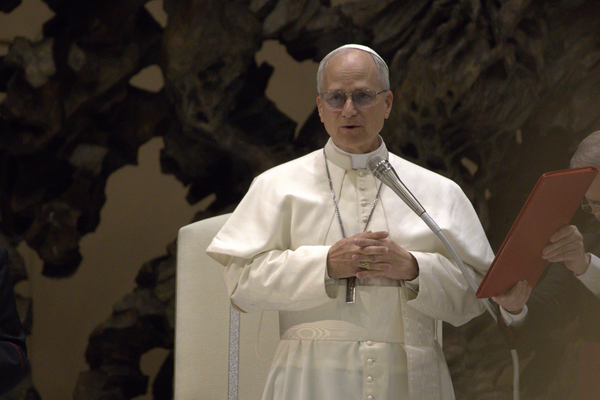
Across two papacies, the Vatican has built up a rich and multifaceted framework for discussing artificial intelligence, rooted in historic Catholic teaching. As yet, the Holy See has placed little emphasis on the catastrophic risks of the corporate race to AI systems that can replace humans in their work, relationships, and decision-making. With these risks coming into focus, Pope Leo XIV’s first encyclical could provide not just theological insights, but practical help for humanity.
The most recent Vatican document on the subject, from the International Theological Commission, focused on transhumanism and posthumanism. This document, called Quo Vadis, Humanitas? (Which way, humanity?), contained the first substantial mention of artificial general intelligence (AGI) in Magisterial teaching. “AGI,” it read, “refers to a future, pervasive technology capable of replacing all computational and operational aspects of human intelligence thanks to extremely high computing speeds... Where specific aspects of human intelligence are consciously weakened or abandoned, AGI could have profound consequences that risk escaping human control.”
The anthropological questions posed by artificial intelligence extend beyond today’s widely available tools, to the underlying project behind these systems: the aim of building superintelligence. Pope Francis’s AI advisor, the Franciscan ethicist Fr. Paolo Benanti, has now made his own view clear that we must not proceed in building superintelligence. The notion of superintelligence is a contested concept, and the Vatican will not want to speak too soon and find itself contradicted by later developments. It is rightly wary of leaning too much on any one of the many competing secular narratives about this technology.
But, as Quo Vadis? put it: “Whether it is a distant dream or an imminent innovation, this form of general AI stimulates the search for a deeper understanding of the nature of human intelligence, its uniqueness among living beings, its irreplaceability, especially in relation to moral responsibility and its intrinsic openness to transcendence.” The questions AI accelerationists are raising deserve better answers than they can give. Conversely, while religious leaders cannot provide technically detailed definitions of such systems, or rigorous predictions of how far away they might be, they can speak to these deeper human questions.
Papal encyclicals have on several occasions offered such wisdom on ongoing technological developments. Pope Leo has already cited Leo XIII’s Rerum Novarum, as an inspiration for his choice of papal name, and many expect it will inform the forthcoming encyclical. That earlier document, and the tradition of Catholic social teaching it initiated, proved a durable guide for navigating the socio-political challenges of the century that followed it, influencing social democracy as a middle way between communist revolution and laissez-faire capitalism.
The Church has taken moral stances on other developing technologies. It was one of many institutions to decide early on that human cloning was beyond the pale. At the turn of the millennium, this was new terrain, and a combination of Vatican documents, campaigns, domestic laws and non-binding multilateral statements rose to the occasion to quell human cloning. Twenty years later, the resulting taboo has largely restrained governments, entrepreneurs, and scientists.
“The harms of AI supplanting human agency are already plain to see.”
Something similar could, and should, be achieved with superintelligence. The harms of AI supplanting human agency are already plain to see. A recent US government statement saw the first state confirmation of a civilian being killed by a fully autonomous weapon, and there are reports that the girl’s school in Iran was selected as a target by AI. The Church has opposed lethal autonomous weapons since at least 2013, and more recently called for a global moratorium on them.
AI has also caused deaths far from the battlefield. The year 2025 might be termed the AI Summer of Love: the moment the world started to understand the full extent of the chatbot revolution we were living through and all that it might entail for human relationships. The original Summer of Love in 1967 held much that was less sweet than the name implied, and its dark irony only grew as the implications unfolded in the subsequent decades. The consequences of the AI equivalent are sometimes similar, only this time it is chatbots prodding users into psychosis and suicide, rather than drugs.
In response, the Church can listen both to the majority—which wants AI regulation and safety testing—and to its own historic teaching on the dignity of the human person. The Pope can follow the logic of his arguments and address the developments we appear to be approaching. In so doing, His Holiness, and the Church with him, can lead the world in pronouncing the evil of the transhumanist vision, and the need to take the wheel from the minds currently steering AI development, who claim their “machines of loving grace” can save humanity—by usurping it. Both in the political sphere, with the strength of its moral conviction, and the personal, with the sensitivity of its pastoral and spiritual aid, the Church can show the world the true meaning of loving grace.