


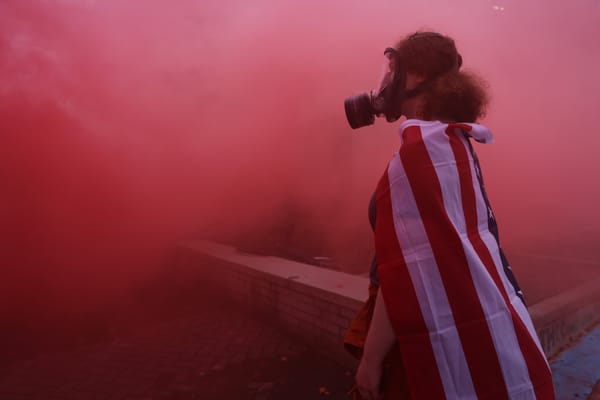
Like countless others, I was shocked by the news of Renee Good’s shooting by an ICE agent in Minneapolis. But I was not surprised. I had warned months before that something like this would happen, having watched the troubling evolution of rapid response networks, a form of activism I helped pioneer during Donald Trump’s first term. Once focused on providing legal services to immigrants, rapid response networks now frequently promote a dangerous pattern of social-media-fueled confrontations with authorities.
For me, Trump’s victory in 2016 came as a shock. I was particularly worried about what his presidency would mean for immigrants. A first-year lawyer in New York City, I began working with immigration attorneys and community organizers to set up what would come to be known as rapid response networks. The goal was to confirm and document arrests, dispatch attorneys to detention centers, assist families, and raise funds to pay immigration bonds when possible. We channeled the energy of eager volunteers into concrete support for people detained by ICE.
Over the course of two years, I trained a steady stream of volunteers. The groups they worked with varied in size and effectiveness. Some secured grants and built formal programs with dedicated legal staff. Others operated informally, arranging rides for immigrants to court or check-ins with ICE. But certain features were consistent. All relied on small bodies of trained volunteers and nonprofit coordinators. All focused on supporting immigrants after arrest. Most notably, throughout the years these networks operated, I did not encounter a single instance in which local police or ICE agents arrested observers for their presence at the scene of an operation. This reflected a simple fact: Our efforts were not aimed at interfering with authorities.
“Our efforts were not aimed at interfering with authorities.”
Another distinguishing feature of our work was its relative anonymity. Providing legal aid to migrants does not lend itself to dramatic scenes. No one has gone viral by posting bond for a detainee. In terms of its tactics and visibility, our work had little in common with the large-scale demonstrations that defined liberal protest during the first Trump administration, like the Women’s March in 2017 and the George Floyd summer protests of 2020.
Over time, these rapid response networks declined. Toward the end of Trump’s first term, the COVID pandemic reduced ICE enforcement activity. Immigrants needed economic assistance more than legal help. Biden’s election made rapid response even less relevant. ICE interior removals fell to a historic low of 28,204, a 70 percent decrease from 2018. By his second year in office, most networks had gone dormant or pivoted to providing assistance to migrants who arrived as asylum seekers at the US-Mexico border.
What has reemerged during Trump’s second term bears little resemblance to the rapid response networks I once worked with. The emphasis is now on following and obstructing authorities, with an eye, at least for some participants, toward generating viral content. Sometimes described as ICE Watch, these new groups use the pretense of legal observation to place predominately white and college-educated urbanites into hostile confrontation with ICE agents. One of these people was Renee Good.
The transformation of rapid response networks cannot be explained by any change in the needs of immigrants. Most detainees still go through deportation hearings without an attorney. A large number are unable to afford bonds. These people would benefit from the sorts of assistance rapid reponse networks were once focused on providing. Unfortunately, many activists seem less concerned with the needs of migrants than with staging dramatic confrontations with an administration they despise.
Renee Good’s fateful decision to pursue armed federal agents and disrupt their operations did not occur in isolation. It was shaped by a broader political climate in which progressives have embraced more extreme and confrontational tactics as legitimate forms of protest. This shift was visible during the George Floyd protests in the summer of 2020, when rallies across the country descended into unrest and destruction. It continued more quietly during President Biden’s term, when activists established encampments on elite college campuses to protest US support for Israel, and could be observed in online celebrations of the killing of a health insurance CEO and the attempted assassination of Donald Trump.
When Trump returned to office, that latent energy was no longer confined to the campus and internet. As ICE conducted enhanced enforcement operations in cities such as Los Angeles and Chicago, progressives discovered that they could channel their anger into action by responding to the scene of arrests and streaming their activity. Facebook pages and groups chats were formed, on which people were encouraged to follow agents and respond to arrest scenes.
Initially, I thought this was a continuation of the kind of immigrant-aid work I had engaged in during Trump’s first term. But one of the earliest signs that things had changed was the adoption of whistles by people responding to ICE arrests. Groups that employ this tactic generally describe it as a warning signal for immigrants, but it also attracts crowds, whose members may be untrained. It thus sets the stage for dramatic—and potentially dangerous—confrontations. (Renee Good’s partner can be seen wearing a bright orange whistle in video of the incident.)
As ICE Watch took off in 2025, the line between monitoring enforcement and obstructing it was routinely crossed. Protesters circulated license plate information and followed ICE vehicles through city streets, which on occasion triggered dangerous car chases involving multiple pursuers. During the first Trump administration, rapid response networks maintained a clear boundary between lawful observation and interference. In the second, however, the viral appeal of these tactics among disaffected progressives, combined with the absence of organizational structure to provide proper instruction or discipline, created a series of dangerous situations.
“The Chicago Chief of Patrol told police officers en route to help the ICE agents to stand down.”
In Chicago, things culminated on October 4, when more than 200 protesters and bystanders encircled roughly a dozen ICE agents in the dense Latino neighborhood of Brighton Park. The agents became trapped near the scene of an incident in which an ICE agent shot a protester named Marimar Martinez. DHS alleges she rammed her vehicle into an ICE vehicle. Like Renee Good, Martinez was part of a caravan of cars, assembled by individuals responding to alerts shared in social media groups. As more people converged on the scene, conditions deteriorated. Protesters confronted individual agents, shouted at them, and used their vehicles to block the agents from leaving the area. An audio recording would later reveal that the Chicago Chief of Patrol told police officers en route to help the ICE agents to stand down, citing city laws that limit their ability to assist ICE. The crowd was eventually dispersed by reinforcements of federal agents using tear gas.
One can trace the evolution of rapid response networks through changing descriptions in media. A 2018 piece in The New York Times described the rapid response model in terms that match my own experience. “The network, the first of its kind in the country, maintains a 24-hour hotline where residents can call to report a raid or suspected ICE presence in their neighborhood,” the article says. “From there, volunteers are dispatched to document the incident peacefully, gathering evidence to protect immigrants’ rights in a form of civilian oversight.” By contrast, a 2026 New York Times article describes rapid response networks as “the tactic of following ICE and C.B.P. vehicles with whistles and being as loud as possible to warn people nearby.” The activity is no longer framed as service for immigrants, but as a politically normalized way for participants to obstruct federal enforcement activities.
As more people have taken up these confrontational tactics, established immigrant-rights organizations have warned that some methods may be causing more harm than good. On January 17, a group of Hispanic and immigrant-serving non-profits in Maryland released a joint statement warning local protestors to stop using whistles. “This is not an action movie. You are not in a one-on-one fight with ICE. And you are not the center of this situation,” the statement said. The immigration groups also noted that anti-ICE activism may be doing more for the protestors themselves than it is for immigrants: “When tactics center the responder instead of the impacted person, harm follows even when good was intended.”
“This is not an action movie.”
Activism evolves as political conditions change, and it is reasonable to expect a model like ICE Watch to become bolder in response to a more polarized political environment. Indeed, by nearly any measure, President Trump’s second-term immigration enforcement agenda has proven far more effective than his first, with almost as many immigrants deported from the interior of the country in the first year of his second term as during his entire first term before the onset of Covid-19. This has led his opponents to conclude that traditional forms of resistance are no longer sufficient.
That sense of urgency helps explain why protest tactics have escalated. But it cannot excuse the choice by Democratic elected officials, along with the nonprofit and media ecosystems that surround them, to downplay the inherent danger of this kind of activism, one that places civilians in direct confrontation with armed federal agents. Despite the warnings of some immigration groups, a growing number of Democratic elected officials have endorsed and even participated in rapid response networks. In Chicago, several Democratic elected officials and candidates participated in direct action protests to block ICE cars using their bodies outside the Broadview Processing Center, where DHS brings many immigrants. In Minnesota, at least four state and local elected officials actively participate in ICE patrols themselves. And in the aftermath of Renee Good’s death, Gov. Tim Walz encouraged protesters to continue their activism, saying “You have an absolute right to peacefully film ICE agents as they conduct their activities. So carry your phone with you at all times. And if you see ICE in your neighborhood, take out that phone and hit record.”
This dynamic has been exacerbated by sanctuary laws that limit local law enforcement assistance of ICE operations. Many local Democratic officials have stretched their laws’ interpretation to bar police from aiding ICE even when protests physically obstruct enforcement operations or create clear safety risks for agents or the public. Protestors may make the dangerous assumption that because local police have not been called, they are free to conduct themselves how they wish—even if it involves breaking the law.
This has created a tinderbox environment in cities like Los Angeles, Chicago, and Minneapolis, as protesters adopt increasingly aggressive tactics without a clear understanding of the dangers involved. This dynamic is captured in the anguished question Renee Good’s partner asked in the immediate aftermath of her death: “Why did they have to be real bullets?” How did an entire city’s political leadership and public institutions lead participants to believe that impeding and obstructing the operations of federal law enforcement agents was fundamentally safe?
In the immediate aftermath of Good’s death, critics have argued that her shooting reflects the violent and aggressive tactics the administration has used to terrorize immigrant communities, and as such, sweeping reforms must be made to curb excesses and abuses. Indeed, there are a growing number of credible allegations of ICE using excessive force and violating the rights of immigrants. Based on these reports and my own work with detainees, I believe a wide-ranging review of the agency’s treatment of immigrants during arrest and detention is needed. But broader conclusions about ICE’s routine practices and procedures when arresting immigrants cannot be drawn from this tragic incident, because the conduct captured in the videos largely reflects the new tactics ICE agents have been forced to adopt to manage protesters who disrupt their operations in progressive cities where local police cannot be relied upon to intervene. In the videos, ICE agents are seen recording Good’s license plate while attempting to arrest her for blocking traffic—actions that would ordinarily fall within the scope of local police work
In order to break out of the destructive dynamic seen in Minneapolis, Democratic leaders also need to engage in soul-searching. Local law enforcement should be allowed to respond when confrontations between protestors and ICE agents become dangerous. Fear of aiding ICE cannot be allowed to trump basic concerns of public safety. Democratic officials must also seriously consider rolling back sanctuary-city laws that prevent local law enforcement from transferring detainees to ICE based on the agency’s determination of removability under immigration law. One possibility is coming to an agreement with the Trump administration to ease access to jail data in exchange for cancelling enhanced enforcement operations. In the absence of such cooperation and with ICE operations fully funded until 2029, the administration will continue to surge at-large arrest operations in major cities, a far more disruptive and volatile form of ICE enforcement for immigrant communities.
A model for how cooperation can function in a Democratic-controlled city does exist. Last year, when the Trump administration selected Memphis for enhanced enforcement operations, Democratic mayor Paul Young chose not to resist. Instead, he coordinated with the thirteen federal agencies, including DHS, involved in Memphis Safe Task Force to prioritize the removal of the most dangerous offenders. By working with DHS, Young was able to focus enforcement on serious criminals, thereby lessening disruption in the community. The results appear to have been significant. In 2025, overall crime in Memphis fell by 41 percent, and murders declined by 47 percent compared to 2023. When protestors do show up to the scene of arrests, they are allowed to observe. But local police are called in if they become disruptive. In Memphis, the absence of serious confrontation with ICE has not prevented community groups from raising civil-liberties concerns or supporting immigrants, but has allowed them to do so without the distraction of street conflict.
“Crime in Memphis fell by 41 percent.”
Unfortunately, the Memphis model is unlikely to be taken up where both city and state governments are controlled by Democrats. Unlike Mayor Young, who can deflect criticism from progressive activists by pointing to pressure from Republican state leadership, these elected officials lack a similar political shield. In states like Illinois, California, and Minnesota, progressive mayors are effectively locked into the dynamic of escalation, as the supporters of ICE Watch are also the voters who keep them in office.
As the next presidential election approaches, there will be a heightened incentive for Democratic elected officials to allow confrontations around ICE operations to escalate. Stand-offs generate negative media attention, rally the base, and create opportunities for Democratic leaders to stand against Trump.
But there are risks in pursuing this strategy. Any Democratic candidate who hopes to win a majority must contend with the fact that immigration remains one of the issues on which voters trust the party the least. Polling following Good’s death shows that while support for Trump’s enforcement tactics may have fallen, voters still rate Republicans as more credible on immigration overall. Further protest escalation against ICE could hurt the already damaged credibility of Democratic Party on public safety—while placing more people in harm’s way.