


In 2017, the British Marxist scholars Robert Fine and Philip Spencer warned of “the return of the Jewish question.” A decade later, that warning looks remarkably prescient. Across the ideological spectrum, we are witnessing the resurgence of a political logic that casts Jewish collective existence as an obstacle to human emancipation.
On the far right, conspiratorial portrayals of Israel as a malign force in global politics, along with invocations of a shadowy, omnipotent “Jewish lobby,” recycle older suspicions in updated geopolitical language (a phenomenon discussed by David Azerrad in these pages). Meanwhile, left-wing opponents of Israel at times approach what Holocaust historian Saul Friedländer described as a vision of redemption through annihilation. Just weeks after the Hamas massacre on October 7, 2023, Manolo De Los Santos of The People’s Forum, a left-wing “movement incubator” in New York City, declared to a rapt audience: “When the State of Israel is finally destroyed and erased from history, that will be the single most important blow that we can give to global capital and to imperialism in our lifetime.” The logic is eerily familiar: the elimination of Jewish collective existence is imagined as a purifying act in world history.
As at previous historical junctures, anti-Judaism functions today as a kind of political superglue, binding otherwise fragmented camps within the left and the right. More telling still, elements of the far left and the far right increasingly echo one another. As left-wing media personality Cenk Uygur recently told his right-wing nationalist “brother” Tucker Carlson: “I also want to break down the barriers of Republicans and Democrats, right-wing versus left-wing … I think it has been used to divide us.” Anti-Jewish tropes thus construct a bridge across ideological extremes.
“Anti-Judaism functions today as a kind of political superglue.”
In the aftermath of World War II and the defeat of National Socialism, antisemitism came to be associated primarily with reactionary forces. The communist philosopher Alain Badiou declared that “there could be no such thing as a far-left antisemitism—an absurd oxymoron.” But Badiou blithely overlooked the long history of anti-Jewish sentiment on the left, including its substantial intellectual and political lineage in his own country. Figures such as Fourier, Leroux, Proudhon, and Blanqui nimbly combined left-wing concerns—social justice, anti-capitalism, equality—with more traditionally right-wing elements such as nationalism and visions of class harmony, all while demonizing Jews.
In the nineteenth century, Jewish existence was presented as an obstacle to national renewal on the right, and to emancipation on the left. The disagreement was often not whether a “Jewish question” existed, but on how it should be resolved: through subjugation, expulsion, and extermination, or through absorption and digestion.
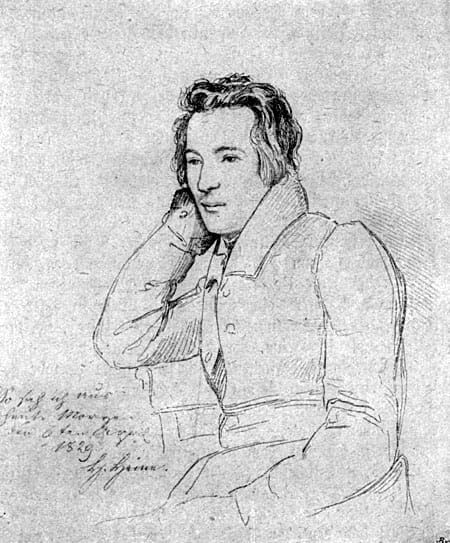
Few observers grasped this dual danger more clearly than the poet and essayist Heinrich Heine, one of the most perceptive interpreters of modern European politics and culture. Heine converted from Judaism to Protestantism in 1825, hoping to ease his integration into German society at a time when Jews were excluded from many professions, but soon came to regret the decision, lamenting in a letter: “Now I am hated by both Christians and Jews.” He became one of the German language’s greatest poets, but spent much of his later life in France.
From his Parisian exile, Heine relentlessly attacked what he called the Germanomaniacs, those who fused ethnic chauvinism, cultural obscurantism, and political authoritarianism into a redemptive vision directed against perceived enemies: the French abroad and the Jews within, both cast as carriers of an alien, un-German spirit of liberalism, subversion, and cosmopolitanism.
But he did not confine his critique to the reactionary right. Much of the European left in his lifetime was also hostile to Jews and Judaism, routinely equating them with money-grubbing, usury, and exploitation. One of the most important instances of this could be found in the writing of Heine’s friend, distant cousin, and admirer Karl Marx.
Even before the disillusionment that marked his later years, Heine’s faith in progress and human emancipation was tempered by a sense of looming catastrophe. His 1835 essay On the History of Religion and Philosophy in Germany concludes with a chilling warning that
when you hear crashing, as it has never crashed before in all of world history, you will know, German thunder has finally reached its goal. With this sound, eagles will fall dead from the sky, and lions in the most distant desert in Africa will put their tails between their legs and crawl into their royal caves. A play will be enacted in Germany which will make the French Revolution look like a harmless idyll.
Likewise, in 1838 he warned, with startling prescience, that “a storm of persecution will gather over the heads of the poor Jews, one that will far surpass all their previous sufferings.” This was not a fear of a relapse of Christian antisemitism, but an anticipation that secular political idealism might generate forms of persecution more total than religious intolerance.
For this reason, Heine could never embrace an idyllic view of diasporic existence. He intermittently entertained both Jewish national longing and the aspiration of return. In Romanzero, he echoes the medieval poet Yehuda Halevi’s yearning for Jerusalem: “Yes, he became a great poet, the star and torch of his age, the light and beacon of his people / a wondrous, mighty pillar of fire of song, which moved ahead of the caravan of Israel’s suffering through the wilderness of exile.” Here, the poet anticipated the more famous proto-Zionism of his contemporary Moses Hess. What inspired both thinkers and visionaries, needless to say, were not colonial ambitions, as anti-Zionist literature might have us believe, but the hope of redemption from an existence depriving Jews of the right to live in the world, proudly, securely, on equal footing with other nations.
The left has mostly failed to grasp the significance of Heine’s vision of Judaism. In 1935, the Hungarian-Jewish Marxist critic Georg Lukács published a long, admiring essay on Heine. But even after the National Socialist seizure of power in Germany, Lukács proved incapable of recognizing the significance of the poet’s Jewish identity, claiming that Heine’s “isolation has nothing to do with his Jewish descent.” Instead, Lukács attributes this sense of homelessness to his failure to align with a major class in German society, as his contemporary Ludwig Börne did with the “radical petty bourgeoisie” and Marx with the German proletariat. Yet neither option would have satisfied Heine, given both his liberal outlook and his acute awareness of the Jewish predicament.
“He presented Mosaic law as a realistic form of socialism. ”
Börne and Marx cast off Jewish identity as an old garment, an ugly and disagreeable one at that, whether for the nation or for humanity. But Heine regarded the left, in its liberal-national and socialist variants, as prone to utopianism, demagoguery, and fanaticism. His own form of liberal radicalism was imbued with a desire for improving social and political institutions and bettering the condition of the working masses, but he was also realistic in his expectations, and he detested political extremism and virtue-signaling cruelty fueled by the notion that the end justifies the means. On these grounds, he condemned Börne’s Jacobinism, his “terrorist” admiration for Robespierre and Marat, his populist contempt for constitutionalism, and his readiness to sanctify the lie as a political weapon.
Moreover, such politics, Heine saw, easily slid into anti-Jewish resentment. One of the driving forces of antisemitism, then as now, was the attack on Jews as wealthy allies of exploitative elites. During the Hep-Hep riots of 1819, this logic erupted into violence. As the historian Sander L. Gilman has shown, Börne, though shocked by the pogroms, shared elements of their underlying creed, especially in his attacks on the Rothschilds. Heine’s position, as we shall see, was markedly different. That Heine could not make his home in Börne’s populist abode should, therefore, not surprise us.
Many of Heine’s reservations about petty-bourgeois radicalism apply equally well to the nascent socialist thought of the era. Consider the poet’s skeptical account of the utopianism of Pierre Leroux, one of the main figures of French socialism in the 19th century, held in great esteem by Marx:
Leroux … wishes to build a colossal bridge, consisting of a single arch and resting on two pillars—one made of the materialist granite of the previous century, the other fashioned from the dreamed moonlight of the future; and for the foundation of this second pillar he assigns some as yet undiscovered star in the Milky Way. Once this gigantic work is completed, we shall report on it.
The same combination of hard-headed materialism and groundless idealism would become a trademark of all communist futurisms. Leroux, unsurprisingly, wholly shared the anti-Jewish sentiments of other radicals, equating the Jews with an “egoism” that militated against “the social good.”
Marx, deeply indebted to Heine, retained an ambivalent appreciation of capitalism’s dynamism. Heine went further. For all his disdain at many features of capitalist reality, from the drive to extract profit at all costs to the subjugation of art and culture to market imperatives, he also lauded modernity for relieving “industry” of “its former ignominy,” and welcomed the emergence of a bourgeois order grounded in prudence and comfort. “Humanity,” he affirmed with satisfaction, “does homage today to the system of earthly utility; it thinks seriously about a prosperous bourgeois order, about a sensible household budget, and about comfort for its old age.”
But Heine rejected the idea that a future utopia could miraculously redeem the present and espoused a politics of moderation and reform informed by Jewish moral philosophy. In his Confessions, he presented Mosaic law as a realistic form of socialism. “Moses,” he wrote, “did not wish to abolish property; rather, he wanted everyone to possess it, so that no one, through poverty, might become a servant with a servile disposition. Freedom was always the ultimate thought of the great emancipator.”
In this light, Heine offered a different view on the much-maligned “Judaization” of Europe. Where Marx treated it as a symptom of alienation, Heine saw in it a sign of civilizational advance. Europe, he argued, was rising toward principles long embedded in Jewish tradition. “Not only Germany bears the physiognomy of Palestine,” he wrote. “The rest of Europe, too, is rising toward the Jews. I say rising, for the Jews already carried within themselves, from the very beginning, the modern principle that is only now becoming visibly developed among the European peoples.”
In the face of Börne’s tirades against the Rothschilds, Heine defended the famous dynasty as agents of the historical transformation that undermined the power of the landed aristocracy. Such an apologia for the most famous dynasty of wealthy Jews must be understood as integral to his broader premonition of an emerging—and deadlier—form of Judenhass. His chilling warning of unprecedented Jewish suffering, cited above, appears in the context of a sympathetic portrayal of the archetypal “money Jew” of European literature: Shakespeare’s Shylock, whom he imagines emitting “sounds of pain such as could only come from a breast that held within it all the martyrdom that an entire tormented people has endured for eighteen centuries.”
Heine did not seek to shield some supposedly virtuous, progressive Jew set apart from his sinful kin, but rather Shylock himself—just as he had defended Rothschild. The truly radical move against the Bruno Bauers of the world was not that of Marx, who accepted their premises only to tinker with their application, but Heine’s willingness to challenge the anathemas of his age: those directed against industry and trade.
Heine also discerned in Judaism a restraint on the self-deifying tendencies of modern radicalism. In his later writings, he warned against the modern human temptation to assume divine authority. “I was young and proud,” he wrote, “and it pleased my arrogance when I learned from Hegel that it was not—as my grandmother believed—the dear God who resides in heaven, but I myself here on earth who was the dear God.” Later, he came to see the Jewish belief in a God beyond humanity as an essential restraint on cruelty and a check on inhumanity.
In a remarkable passage, Heine reclaims his place as a human being and declares himself an “ex-god.” He urges his radical friends, Marx among them, “these godless self-deifiers,” to do the same, lest they suffer the fate of “that Babylonian king who believed himself to be the dear God, but who fell miserably from the heights of his arrogance, crawled on the ground like an animal, and ate grass.” Here, Heine emerges as a critic of revolutionary as well as reactionary excess. While he preferred communism to proto-fascism, he feared both: not only the hammer of Thor, but also the one that would cross with the sickle.
As in Heine’s day, much contemporary radical discourse casts Jewish collective existence as uniquely illegitimate. Left-wing anti-imperialism singles out Jewish nationalism for abolition as the decisive act in the struggle against imperialism and capitalism. Meanwhile, the right has revived conspiratorial motifs depicting Jews as hidden manipulators of global affairs whose influence must be countered to cleanse the nation. Increasingly, these extremes mirror one another, fraternize, and converge.
“On the left, Jews are once again cast as a force of reaction.”
As Heine helps us recognize, this pattern is not new. What unites these otherwise opposed camps is the transformation of politics into an eschatological project in which the Jew—or the Jewish state—appears as the primary obstacle to be removed to enable emancipation or absolution.
On the left, Jews are once again cast as a force of reaction, linked to capitalism, imperialism, and racism. For example, left-wing historian Enzo Traverso, in his 2016 book The End of Jewish Modernity, argues that Judaism has moved from revolution to reaction. Trotsky, the “Jew as revolutionary,” Traverso argues, has been supplanted by Kissinger, “the Jew as imperialist.” This supposed shift produces a new political myth. Traverso concedes that Jews were never uniformly revolutionary, but doesn’t ask why they, alone among nations, should be expected to be. The urge to essentialize proves too strong. He thus assigns a fixed political value to an entire people—the one that has been essentialized with such tragic consequences.
Reductive anti-capitalism has also rendered parts of the left susceptible to alliances with illiberal forces, including radical Islamist movements and open antisemites. The late Marxist scholar Moishe Postone long warned of the dangerous logic of fetishized anti-imperialism, but he did so largely in vain. The explanatory simplicity of that logic, along with its moralizing force and its capacity to bind disparate actors, has proven all too seductive.
A great poet and prophet of modernity, Heinrich Heine was the rare figure of his era who was capable of defending progress without succumbing to eschatology, and of balancing the demands of the universal and the particular. At a time when the Jewish question has returned, his work remains a vital intellectual resource and a powerful dissolver of ideological glue.