


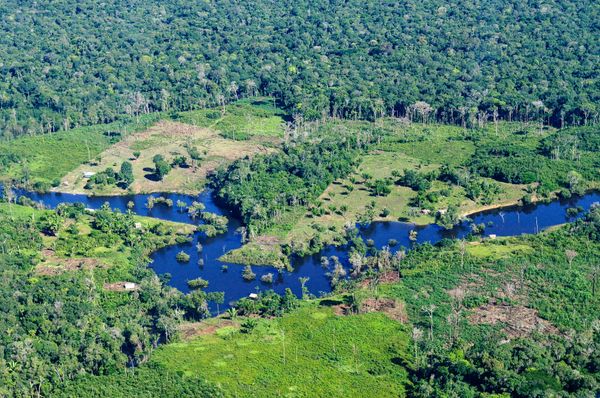
In the verdant green of the Amazon, we can glimpse the color of money. Apuí is a rural municipality in the southern Amazonas state of Brazil, with a population of 20,647. The town was founded in 1989, in a broad stretch of coffee country beyond the reach of telephone service, television, or paved roads. But as Brazil developed, so did Apuí. The roads were built, the town expanded, and Apuí became a fixture on Brazil’s mighty agribusiness frontier. Now, the “Coffee Capital of the Amazon” hosts a large agricultural fair, attracting bullriders and vaqueiros from states across the north, while local waterfalls and rivers draw a steady flow of tourists. Here, by all accounts, is a thriving frontier town confident in its trajectory.
But this modest prosperity could hardly explain why, a few years ago, the municipality held $8.5 billion in assets being actively traded on the São Paulo stock market. This tremendous fortune was derived from a carbon offset project hosted on a farm calling itself Fazenda Floresta Amazônica. Since 2022, a plot of land about the size of greater Los Angeles had been the site of an investment scheme linked to some of Brazil’s leading banks and asset managers. Apuí had made them a lot of money, very quickly. One of the companies holding the carbon tokens was founded as a haberdashery in 2020. Four years later, it touted a net worth of $5 billion.
“Carbon credits are a very particular type of asset.”
Carbon credits are a very particular type of asset. Though their value is ostensibly tethered to the carbon dioxide sequestered in a living ecosystem, these tokens are essentially a form of speculative capital. Indeed, it is hard not to feel that this near-trillion dollar global market is rooted in an elaborate conjuring trick. Through the magic of the carbon offset, an ordinary forest or swamp is transformed into a tradeable financial asset, capable of redeeming the emissions of polluting companies from Hamburg to Hangzhou.
The wealth of Apuí was not only speculative, but entirely fictitious. Fazenda Floresta Amazônica did not exist. Sixty-eight percent of the estate’s alleged area was in fact public land, designated as a farming cooperative in 2005. The deeds marshaled by the owner, Marco Antônio de Melo, were blatantly fraudulent. The oldest dated miraculously to 1841, before Brazil even possessed a legal architecture for private land ownership. Another deed, dated 1963, references Apuí, a municipality that would not exist for another 26 years.
The carbon scheme became the subject of multiple federal investigations which implicated some of the most powerful corporations in the country. Behind Apuí’s phantom carbon loomed Brazil’s largest asset management firm, Reag, and the Master Group, a rising young bank whose CEO boasted of having “friends in all branches of government.” By January of this year, neither Master Bank nor Reag would exist. Their much-publicized collapse would expose a dark money hydra stretching from the Amazon to the capital, implicating even the son of President Lula da Silva.
Phantom carbon is not an aberration, but the culmination of a decade of land policies advanced by the Brazilian state. This transformation of land into cash is a national project, pushed forward by the policies of agribusiness-friendly right-wing governments as well as the Lula administration’s drive to establish Brazil as an ecological superpower. Apuí stands at the center of a perverse marriage of speculative capital and ecological extraction.
How did a financial conglomerate whose owners had never set foot in the Amazon conjure a fortune from this remote stretch of jungle? The carbon grift has two components. First, you need land; then, you need the financial architecture to coin carbon tokens and ratify them as legitimate assets. The aim is to generate cheap assets—the tokens themselves—and surreptitiously inflate their value by shuffling them through a maze of shell companies, “selling” them for higher prices each time. Ultimately, a compliant accounting firm ratifies the final balance sheet, endorsing the value of the tokens sitting on your books.
In the case of Apuí, the process began 1,400 miles to the southeast in Faria Lima, São Paulo’s glittering business district. From these air-conditioned towers, Reag orchestrated the elaborate web of shell corps and clandestine transactions required for the carbon scheme. The money involved was the Master Group’s, just as the inflated credits were destined to work their way back onto Master’s books.
As for Global Carbon and Golden Green, the two companies who actually held the carbon credits, these were little more than convenient sockpuppets. The former started life in 2020 masquerading as the “Pereira and Silva Haberdashery Store,” before a few changes in name and address heralded the birth of Global Carbon. There was little attempt to present a legitimate face. Both companies shared the same shareholders and controlling directors, and all could be traced back to Master Bank and its CEO, the now-imprisoned Daniel Vorcaro.
Inflating assets and hiding them in closed funds is the easy part. But without an official title to the 360,000 acres of forest from which they were generated, Master’s carbon credits were fairy dust. The scheme therefore depended on convincing Brazil’s land reform agency, Incra, that the Fazenda Floresta Amazônica possessed a legitimate claim to the land in question, which was actually the site of the farming cooperative. Incra could then “regularize” the farm’s title, endorsing its ownership of the property it already claimed that it occupied.
However, suspecting fraud, a federal investigation dubbed Operation Greenwashing blocked the farm’s attempt to regularize its title in 2024. With billions in assets tied to Apuí, Master Group shunted de Melo aside and attempted to rebrand its existing scheme by partnering with the legitimate claimant to the land: the cooperative. The problem was that none of the forty-six families living on the land had the slightest knowledge of the scheme’s existence. With the end of Apuí’s phantom carbon scam, the Master Group’s broader empire of fraud would now be chewed up in court.
The Brazilian Amazon is rife with this sort of ecological fraud. Operation Greenwashing, which put paid to the Apuí scheme, found that over a million acres of land had been illegally seized for carbon offset scams across the southern Amazon. One project in Apuí’s neighboring municipality of Novo Aripuanã saw tiny urban lots “transformed” into sprawling rural properties of over 80,000 acres, from which carbon credits were generated and traded on international markets. Other schemes implicate some of the largest cartels in Latin America, whose coffers are swelling from trade in illicit timber.
“The scale of these crimes is owed first to brute geography.”
The scale of these crimes is owed first to brute geography. The Amazon is twice the size of western Europe, most of it unsettled and innavigable by road. Here, on the hemisphere’s last true frontier, huge swathes of territory exist beyond the effective reach of the state. However, it is a mistake to see land fraud as a consequence of the state’s absence. On the contrary, it is fueled by state policies and serves the imperatives of powerful political actors.
To some degree, these imperatives transcend the divisions between Brazil’s political factions. Both Lula and his far-right predecessor, Jair Bolsonaro, have aimed to transform land from the raw basis for mining and agriculture into a tradeable asset class incorporated into global circuits of speculative capital. Where the right triggered a land boom by removing barriers to coining new rural properties, Lula has given the boom a new impetus by way of the green economy. His government now spearheads the creation of a green-financial nexus designed to plug Brazil’s ecological “assets” into international finance markets.
It is a strategy with obvious appeal for landed elites seeking to transform their holdings into currency. And those holdings have never been greater. With the right’s accession to power in 2016, rural property expanded by around 628 million acres—nearly a quarter of the area of Brazil—in just two years. The boom was triggered, quite simply, by scrapping most of the checks required to earn a formal land title. Even passing legal requirements against illicit logging and slave labor became an easy matter of self-reportage. Loosening the rules led, predictably, to a surge in land-grabbing. Between 2017 and 2020, the state duly issued more land titles than it had over the previous decade.
The titling wave aimed to undermine the land-owning elite’s longstanding rural opponents: the landless, indigenous, and ecological movements. Bolsonaro was none too keen to restrain prospective landowners from seizing territory from these groups, even by fraudulent or violent means. While the Master Group’s attempts to carve up the Apuí settlement never amounted to violence, others have resorted to murder. In 2024, two landless activists were killed in São Paulo when they refused to cede title to a prospective developer.
If the right made land that much easier to seize, Lula’s policies have provided land-grabbers with a major source of added value. What we are seeing now is land-grabbing with a green face.
Lula’s efforts to brand Brazil an ecological superpower are central to his mandate. As with so much of Lulismo, the process is fraught with contradiction. Moves to establish nature reserves and expand clean energy are paired uneasily with increased oil and mining concessions in the Amazon. This tension between the imperatives of capital and ecology is visible in the core thrust of Lula’s climate policy: the creation of a nationwide green-finance infrastructure of sustainable bonds, carbon offsets, biodiversity credits, and other instruments designed to leverage the country’s prodigious natural inheritance into global markets.
The strategy has proven lucrative. Among developing countries, Brazil is second only to China as a destination for sustainable energy investment, and is the world’s third largest market for wind and solar. Its carbon offset potential has no rivals anywhere, with Bloomberg estimating that Brazil could generate more offsets “than the next three largest countries combined.” Who said global warming was bad for business?
The result is that big banks, corporate agribusiness, and rural oligarchs—none of them especially lauded for their ecological commitments—are now lining up to board the climate train. Even Brazil’s agribusiness lobby has proven aware of the need to establish its environmental bona fides, backing laws to regulate the burgeoning carbon offset sector. With the allure of green finance mounting, we are witnessing something of a split in the landed classes. While conservative contingents continue to resist environmental protections, much of the agricultural sector’s corporate wing is eager to profit from the green boom.
“This marriage of speculative capital and loose land markets bodes ill for Brazil.”
If the Master case is anything to go by, this marriage of speculative capital and loose land markets bodes ill for Brazil. Given how much of the Amazon remains beyond the remit of the state, and the anemic recovery of Brazil’s land agencies from their Bolsonaro-era gutting, Lula’s push into green finance is providing a new basis for land expropriation and fraud. The legacy of the green finance boom may well be to provide a sheen of legitimacy for new modes of sucking up land into rich men’s portfolios.