



The US fertility rate hit yet another new record low in 2025, according to the most recent CDC data. This is barely news, as we have heard it almost every spring for nearly two decades. What is notable is that women in their 30s have significantly higher fertility rates than women in their twenties, marking the thirties as the new peak childbearing decade.
The mainstream media’s reaction has been sanguine. “Women in their 20s may not be having babies, but by 45 most probably will,” says The New York Times. Falling teen birth rates are cited as the culprit behind why US fertility is hitting record lows.
However, a closer look at the data tells a different story. The drop in births among women ages twenty to twenty-nine accounts for 78 percent of the overall decline in the total fertility rate since 2007, the last year the United States was at replacement-level fertility. The fertility news around teens and women in their forties, however prominent in the media coverage, is just noise.
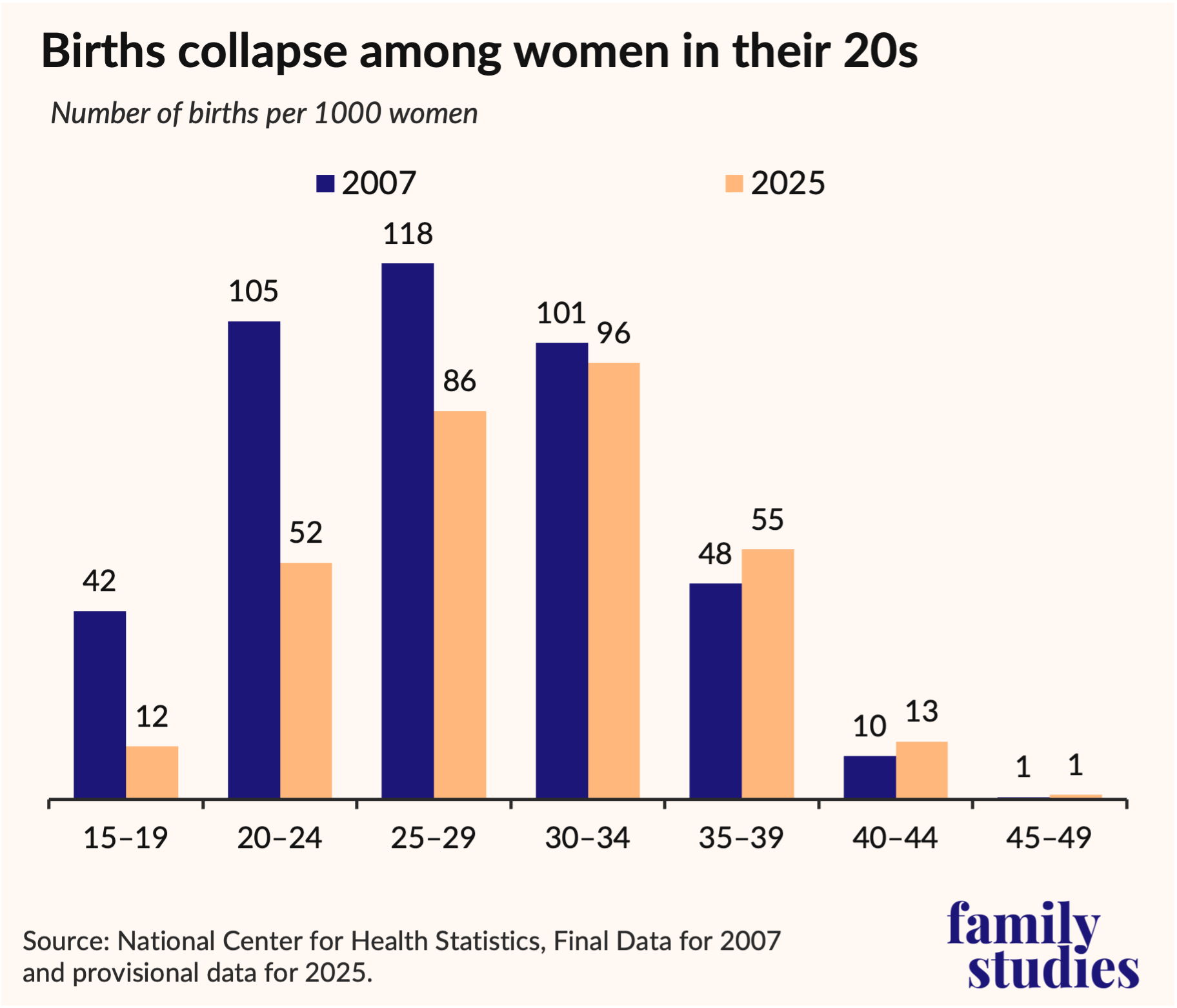
In eighteen years, the US total fertility rate (TFR) took a steep dive from 2.1 children per woman to a record low of 1.57, and the data for age-specific fertility rates (which is what TFR is based on) shows why.
Since 2007, the fertility rate for women ages twenty to twenty-four has been cut in half, from 105 births to 52 births per 1,000 women. The drop among women ages twenty-five to twenty-nine fell by about a quarter (28 percent). Taken together, the fertility rate among women in their twenties has declined 38 percent, and that collapse is the direct cause of the overall fertility decline.
The decline in fertility rates among women in their twenties is not as dramatic as the drop among teens, where rates have fallen 72 percent between 2007 and 2025 (from 42 to 12 births per 1,000 women ages fifteen to nineteen). But a steep percentage drop matters far less when it is a smaller group to begin with. This is simple math. Women in their twenties have carried far more weight in determining the overall fertility trend, and their decline is driving the national numbers.
Optimists often look at a different measure of fertility, what demographers call the complete fertility rate (CFR), which is the average number of children born to women by the end of their reproductive years around age 45. This measure is good for understanding what a generation of women actually did, but it is nearly useless for understanding what is happening right now.
The popular claim that “most women eventually have two children” is based on the CFR. Women who currently finish their reproductive years are having about two children, but these are women who were born in the 1980s. The data is at least twenty years behind the current trend. That is why demographers rely on the total fertility rate (TFR) to track the fertility changes. Given today’s TFR, it is not realistic to assume that Millennial and Gen Z women will follow the paths of Gen Xers and have two children by the end of their childbearing years.
“Women’s fertility peaks in their twenties, not their thirties.”
As a matter of biology, women’s fertility peaks in their twenties, not their thirties. Women in their thirties are only about half as fertile as they were in their early twenties. Retrospective demographic data also supports this: the odds of a childless woman ever having a child are 70 percent at age twenty-five, about 50 percent by age thirty, and only 7 percent by age forty.
Some may think that modern reproductive technology can step in and reverse this trend; after all, we now have IVF, egg freezing, and other tools to help women achieve their fertility goals. Although these technologies have done wonders for individuals who struggle with infertility, they have clear limits when it comes to affecting the fertility rate at the population-wide level.
For those who expect women in their forties to close the fertility gap, the demographic data offers little support. The decline is not merely a delay, it is a shift from having children during women’s prime fertility window to a period when the odds of becoming a mother significantly drop. For women hoping to start families later in life, it is an uphill battle against biology. For a society counting on the next generation to flourish, it is a demographic crisis.