


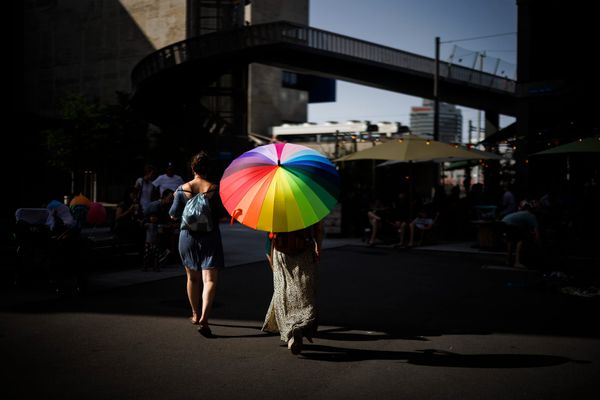
New York City Pride, June 2026. A sea of men wearing “Call me Daddy” T-shirts, pushing strollers, carrying babies. In gay subcultures, a “daddy” describes a dominant, authoritative figure who is often paired with a “twink,” a much younger, slight “boy-like” male as a sexual partner. Over in Seattle, fully nude male bicyclists rode past children with their genitalia on full display. Pride in Salt Lake City was teeming with men dressed as “slutty” women while others—dressed up in animal costumes—flaunted their “pup fetishes.” Minneapolis just lifted its 1988 ban on bathhouses to commemorate the Holy Season of Pride. The ban had been put in place in the early 1980s, during the AIDS crisis, to reduce high-risk anonymous sex.
Is it any wonder that ordinary heterosexual—as well as many lesbian and gay—citizens are getting tired of the so-called queer community? The truth is that the once-proud lesbian and gay liberation movement has run its course. Across the West, gays and lesbians like myself have achieved legal parity with heterosexuals in one of this century’s most successful campaigns for equality.
Increasingly, sexual minorities are not only tolerated but objects of civic reverence. Across Great Britain and the United States, they are honored in around eighteen calendar days per year calling for awareness, visibility, remembrance, and Pride. Many of these focus on the transgender, nonbinary, and asexual.
Nevertheless, a number of public figures have recently declared that LGBTQ rights are under threat and facing a backlash. What they are really talking about, for the most part, are not the hard-won civil rights of gays and lesbians, who now face their biggest threat from within what used to be their movement.