


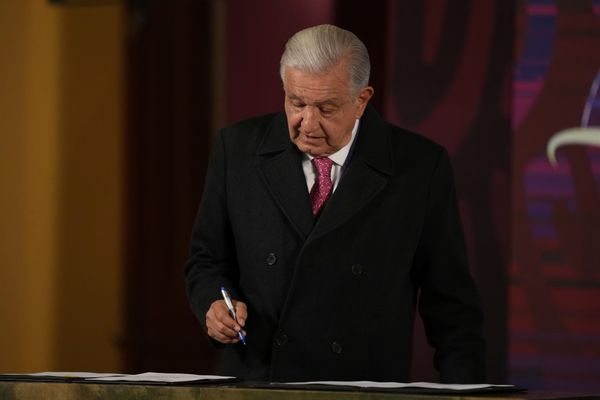
Allegations of fraud in government-subsidized childcare centers have engulfed Minnesota, leading Governor Tim Walz to drop his reelection campaign. At the same time, he and his Democratic allies have insisted that these programs need to be preserved and denounced right-wing critics. But a similar controversy in Mexico shows that concerns over childcare fraud are not the exclusive province of the right. State funding of childcare programs assumes that children should be cared for out of the home to maximize labor force participation. An alternative, pursued successfully by Mexico’s left-wing former president, is to replace subsidies for childcare centers with direct payments to families.
“AMLO didn’t just defund the childcare centers; he sent money directly to families.”
In 2019, citing corruption and inefficiency, former Mexican President Andrés Manuel López Obrador (AMLO) ended the Programa de Estancias Infantiles (PEI), which began in 2007 under President Felipe Calderón, of the right-wing National Action Party (PAN). The program offered childcare services for children aged one to four, with the objective of “increasing the possibility that [working mothers and single parents] will participate or continue to participate in the labor market.” The elimination of this program was in line with AMLO’s program of “republican austerity,” an attempt to decrease government spending by eliminating programs, consolidating departments, decreasing salaries, and optimizing existing processes—instead of increasing taxes on the working class.
AMLO didn’t just defund the childcare centers; he sent money directly to families. “All support will be personalized,” he said. “We will not give resources to social or civil organizations. There will be no intermediaries.” Members of the opposition, as well as national and international organizations like the National Human Rights Commission (CNDH) and UNICEF, were quick to criticize the new system, arguing that childcare standards were sure to drop and that the proposed amount was insufficient to meet the needs of working mothers. Daycare center workers and their allies mounted protests outside Mexico’s Presidential Palace.
Mexican media were incredulous. In their eyes, accusations of corruption and fraud by teachers and caregivers amounted to blasphemy. Government-subsidized daycare was widely seen as a necessary element in a broader egalitarian society, a way to free women to enter the workforce. AMLO’s program was a threat to this vision of society. It set back progress by subsidizing mothers who chose to care for their children at home, rather than enter the labor force. As one academic critic put it, sending money directly to families risked “reinforcing the notion that the best care is provided by mothers and grandmothers within the household.”
In America, left-populists are often more progressive on economic as well as social issues. Under AMLO, left-populism had a different meaning—it was opposed to the billionaire class and was unconcerned with the priorities of social justice. On childcare subsidies and other issues, AMLO broke with modern progressivism, judging that Mexican families should be trusted to make their own decisions about childcare. If a mother wants to stay home to raise her children, there is no reason she should be denied that choice. At the same time, AMLO’s program has also allowed working women to pay for outside childcare.
Anyone on the American left who cares about helping working families should be ready to support a similar approach. Some on the right may balk at the idea of providing direct financial support to families. But whatever one makes of this idea in the abstract, it is certainly more efficient than providing subsidies to a sprawling network of daycare centers staffed by Democratic-aligned constituencies. In order to solve its childcare controversies, America should copy Mexico’s left-populist president.