


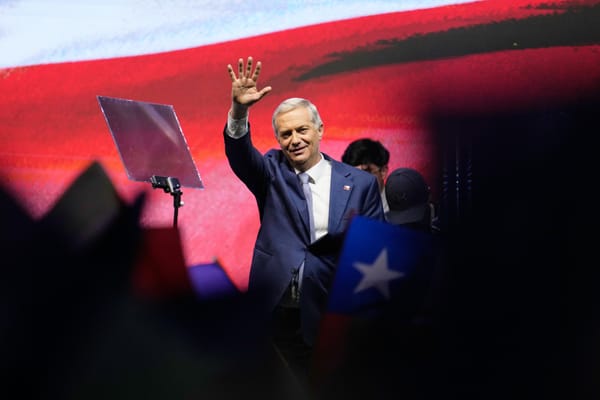
On December 14, Chileans elected the conservative José Antonio Kast to the presidency by a nearly 20-point margin over his Communist Party rival, Jeannette Jara. Kast’s landslide victory is a rebuke of the unpopular administration of progressive President Gabriel Boric, in which Jara served. Despite a handful of pro-worker accomplishments, Boric proved unable to address a range of problems including post-pandemic inflation, crime, and illegal immigration.
After veering to the left under Boric, Chile has now elected its most right-wing leader since the end of General Augusto Pinochet’s dictatorship in 1990. For decades, conservative politicians took pains to distance themselves from that era’s abuses. Kast has broken that mold, vigorously defending the dictator’s legacy.
The problem the president-elect faces is that the series of crises that eventually brought him to power are ultimately rooted in the flaws of the neoliberal economic model imposed by Pinochet and his “Chicago Boy” advisors—one of whom was his brother, the economist Miguel Kast, who served as president of the central bank under the dictatorship. Boric and the left failed to provide a workable alternative, but many of the same factors that worked in the president-elect’s favor during the campaign are likely to become liabilities once he is in office.
“Until recently, Chile was heralded as an economic success story.”
Until recently, Chile was heralded as an economic success story. The reforms introduced by Pinochet and the Chicago Boys eventually delivered relative prosperity under center-left democratic governments in the 1990s and 2000s. But economic decline in the 2010s, combined with boiling discontent over privatized services including pensions, universities, and healthcare, led to mass demonstrations in 2019 and 2020. Boric, a former student leader, rode this wave of protest to the presidency in 2021, spearheading a referendum to rewrite the dictatorship-era constitution along the way.
That year, voters also elected left-leaning delegates to overhaul the constitution. But after the televised constitutional convention descended into a farce, showcasing the worst excesses of modern progressivism, Chileans widely rejected the proposed new constitution. (A subsequent, right-leaning convention produced a document that voters also turned down.)
Boric seemingly learned from the debacle and sacked dozens of inexperienced identitarian activists from his cabinet in favor of more experienced traditional social democrats. While the government failed to realize all its promises on healthcare and pensions, the poorest 40 percent of Chileans are now eligible for free care while employer contributions for notoriously miserly pensions have risen. The Labor Ministry headed by Jara also oversaw a reduction of the work week from 45 to 40 hours by 2028 and established protections for gig workers. Chile’s minimum wage is also set to rise to around $500 a month by 2026 from around $400 in 2022.
But these gains failed to compensate for a novel political environment that has benefited the right. Due to inflation, workers’ buying power has fallen in relative terms, and economic growth has slowed to a crawl as Boric’s efforts to promote investments in lithium and green hydrogen by state firms have been stalled by degrowth environmentalists from his own base. Kast has promised to open these sectors to private investment.
Not unlike 2020 in the United States, backlash against police after harsh crackdowns on protesters in 2019 led to funding cuts and officers opting to shirk duties, and crime rates promptly doubled. To his credit, Boric increased funding for police and created a ministry of public security, but many voters blame him for the crime wave, with encouragement from Kast, who has promised to consult El Salvador’s Nayib Bukele on security.
Finally, Chile’s immigrant population has doubled to over 1.6 million, an enormous figure for a country of just under 20 million. Around 80 percent of Chileans want greater restrictions on immigration, and record low deportations under Boric provoked anger from working class voters, though the administration attempted to stem new arrivals by militarizing the country’s northern border. Kast has promised to deport all illegal immigrants and build a “border shield” consisting of walls, ditches, and fences.
Jara’s loss offers lessons for an international left hobbled by the influence of out-of-touch progressives who routinely oppose policies such as resource extraction and border enforcement. From the United States to Brazil and Colombia, green fundamentalists have sought to reduce fuel supply at a time when workers were reeling from post-pandemic inflation.
To the extent progressives have learned any lessons from recent setbacks, it seems to be that they can have their cake and eat it too by focusing their message on cost-of-living issues while downplaying—but not renouncing—toxic activist commitments. (This is the Mamdani strategy.)
Such an approach might succeed, but only if real material improvements are forthcoming. In Mexico, the ruling left-wing Morena party has more than doubled the minimum wage in real terms since 2018, and its climate scientist president has championed fossil fuels as a job creator even as she is actively investing in renewables.
In contrast, the recent struggles of center-left leaders like Britain’s Keir Starmer and Denmark’s Mette Frederiksen show that limiting immigration in combination with neoliberal austerity is a losing electoral strategy. Eventually, progressives and conservatives alike will need to accept the reality that immigration enforcement, affordable and dependable healthcare, security, and worker flourishing are all integral components of industrial society.
In Chile, that entails recognizing flaws in the country’s underlying economic model, something the Pinochet loyalist Kast is unlikely to do. Pinochet’s reforms allowed his successors to initially benefit from subsequent trade deals, but returns have gradually diminished; average growth has consistently fallen under every president since redemocratization. The resulting worker precarity and deindustrialization have come with major drawbacks; gig work now comprises an enormous share of economic activity, while manufacturing has all but vanished. Kast seems dead set on making matters worse by emulating his neighbor, Argentine President Javier Milei, promising to impose spending cuts worth 4 percent of GDP—a move certain to crash the economy.
There is at least some reason to be optimistic about the country’s democracy, still among the most robust in the region. Despite Kast’s links to Pinochet and Jara’s nomination by the Communist Party, both candidates were remarkably moderate in their stance towards Chilean institutions. The president-elect has shown little indication he hopes to extend his term, persecute opponents, or limit speech. And the broader tenor and coalitional aspects of Chilean politics suggest that—as we saw with the constitutional process—even as voters are angry at the status quo, they will also offer a corrective to any counterproductive radical disruptions.