


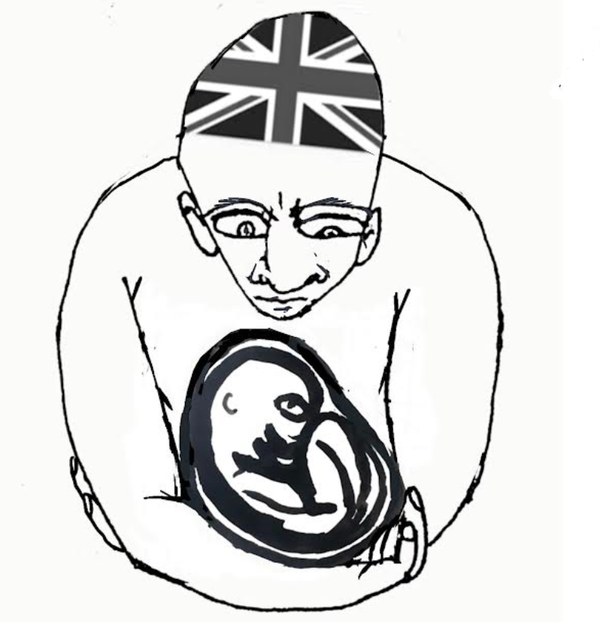
In June, the Supreme Court struck down the Trump administration’s attempt to end birthright citizenship for the children of illegal immigrants and some temporary foreign visitors. But the administration has refused to accept defeat. Indeed, there is every indication that the American right is now united in opposition to unconditional jus soli, under which almost anyone born on US soil is granted citizenship.
“The recent experience of the United Kingdom serves as a warning.”
If Trump and his allies were to succeed overturning birthright citizenship, the change would go deeper than immigration policy. It would alter the relationship between citizens and the state—with consequences that the right would be likely to lament. In this regard, the recent experience of the United Kingdom serves as a warning.
For centuries, unconditional jus soli stood at the heart of Britain’s constitution. Against the backdrop of debates over immigration and fears over demographic change, Margaret Thatcher introduced the British Nationality Act of 1981. By limiting jus soli, this act fundamentally reset what Britishness meant.
Prior to 1981, British law on nationality was based on the medieval notion of an enduring bond between subjects and the monarch. Whoever is born in a territory where the monarch is sovereign owes that sovereign allegiance. This is where the jus soli principle originates. A 1608 case that turned on whether a child born in Scotland after the Union of the crowns was legally an English subject and thus entitled to the same rights was crucial in bolstering jus soli in the common law tradition. As a presiding judge, Edward Coke, wrote: “Whosoever is born within the King's power or protection, is no alien.” This principle was later reiterated by William Blackstone, who wrote that “children of aliens, born here in England, are, generally speaking, natural-born subjects, and entitled to all the privileges of such.”
As the British empire expanded its dominion across continents, it raised the question of whether all the people born in the diverse places where the English crown claimed sovereignty could be considered British just as those born in Britain were. In theory, at least, whether you were born in London, Toronto, Hong Kong, or Calcutta, you were a British subject and thus entitled to the rights and duties that entailed.
The 1948 British Nationality Act was the apogee of this imperial conception of citizenship. In response to Canada establishing its own separate citizenship in 1946, the British government created a British citizenship that applied to all British subjects across the empire. Britishness coincided with the nation and the empire. What was significant about this Act is that it gave all members of the Commonwealth the right to live and work in Britain, the mother country. The framers of the law did not intend for this to facilitate mass migration into Britain, but that is what it did.
“Empire,” the postcolonial theorist Gayatri Spivak wrote, “messes with identity.” This terse observation is often understood to mean that colonialism irrevocably alters the identity of the colonized. But that applies equally to the colonizer. Some on the right see the 1948 act as the beginning of the end of the British nation because it coincided with mass migration from the “New Commonwealth” countries that were non-white, permanently transforming the ethnic alchemy of Great Britain.
Parliament restricted Commonwealth immigration in 1962 and 1968. The Conservative politician Enoch Powell gained a broad hearing for his claim that neither Commonwealth migrants nor their progeny could really belong in Britain, even if they were born and raised there. A notorious National Front slogan in the 1970s and ’80s was “There Ain’t no Black in Union Jack.” These nativist stirrings, and the steady withering away of the British empire, were in the background when Thatcher restricted jus soli.
In immediate political terms, this move allowed Thatcher to undercut the rising appeal of the National Front. But more broadly, she believed that the existing British settlement had run its course. Limiting immigration was part of her attempt to erect a new settlement that would fit with Britain’s new position in the world after the demise of the empire. In her memoir, Thatcher criticized her patrician intra-party rivals for not recognizing that “large-scale New Commonwealth immigration over the years had transformed large areas of Britain in a way which the indigenous population found hard to accept.”
Supporters of the 1981 Act also believed that the increasing ease of communication and travel had made Britain’s jus soli principle easily exploitable and untenable. During the debate over the law in the House of Lords, Lord Home observed that “in these days of mass travel,” tourists and students were coming to Britain “on a scale which was totally unknown only a few years ago.” Did the progeny of these recent arrivals really have a right to claim British citizenship? Lord Home had his doubts.
Britain isn’t the only country to have abandoned unconditional jus soli in recent decades. Australia, France, Ireland, and New Zealand have all followed the British example, mostly changing their citizenship laws to a hybrid model of citizenship that incorporates elements of jus sanguinis and conditional jus soli, where you can only acquire citizenship by birth if one parent is a citizen or a long-term resident. In all of these cases, the changes were a response to unprecedented rates of mass migration and the sense that citizenship was being cheapened by birth tourism. Even India, which at independence, had one of the most generous jus soli regimes among postcolonial states, shifted to a bloodline-based model. (India hoped to ensure that illegal immigrants from Bangladesh would not gain automatic citizenship for their children.)
This pattern doesn't bode well for those who wish to preserve birthright citizenship in the United States. America has become an outlier. But the experiences of Britain and France make clear that getting rid of birthright citizenship neither automatically curbs mass immigration nor help with social and cultural integration. In fact, it can exacerbate the latter problem. One reason European countries have struggled with integrating immigrants is that the children and grandchildren of immigrants continue to have foreign status despite being born and raised in Europe. America’s system of birthright citizenship, by contrast, promotes psychological and civic inclusion.
If America got rid of birthright citizenship today, the immediate result would be a marginalized underclass, numbering in the millions, who were born and raised in American society but were excluded socially and economically and relegated to a legal no man's land. They would be in America but not of it. No matter how hard ICE pushes, it wouldn’t be able to deport them all.
“The citizen was at the state’s mercy.”
There is an even more profound issue at stake in birthright citizenship. The 1981 British Nationality Act made it easier for the state to strip the citizenship of dual nationals judged to be not “conducive to the public good” or a threat to national security, even if they were born in Britain. In practice, this meant that citizenship became a privilege the state accorded to the citizen. The state no longer answered to the citizen; instead, the citizen was at the state’s mercy.
Salman Rushdie described this transformation in a 1982 essay. In his view, Thatcher’s government had stolen one of Britons’ “most ancient rights.” What was once the “right to citizenship by virtue of birth” has become a “gift of government.” Believing that the act was directly only at immigrants and ethnic minorities, the British had failed to see that the rights of all had been handicapped. Is it really a coincidence that the British state has grown more contemptuous of the rights of the country’s citizens in the decades since?
For anyone who values the rights accorded by citizenship, the costs of this transformation outweigh any potential benefits. This is especially likely to be true in America, which has a broadly successful history of assimilating migrants. That success stems not only from America’s immigration policy but from its magnetic revolutionary mythos as a nation dedicated to freedom, equality, and the citizen’s priority to the state, ideals anyone of any background can embrace. To weaken that identity would be a terrible mistake, and, in the end, would curtail the rights of all Americans.