


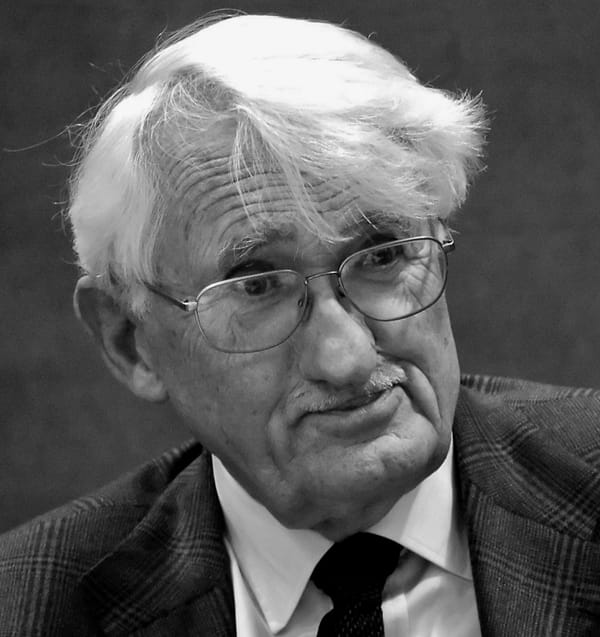
“Donald Trump is going to complete the system of German idealism!”—so declared the Twitter philosopher Kantbot on a Manhattan street corner shortly after the 2016 election. Regardless of how well the president is delivering on that campaign promise, just over a year after the unphilosophical former real estate mogul’s return to office, German philosophy is in the news.
The field’s leading figure over the past half century, Jürgen Habermas, has just died at ninety-six. Days earlier, another éminence grise, Peter Sloterdijk, was spotted at a symposium in the Alps where the MAGA-adjacent anti-democratic blogger Curtis Yarvin was also in attendance. Sloterdijk has provoked plenty of scandals in his time—one of which led the late Habermas to detect “fascist implications” in his work—but Die Zeit’s Marlene Knobloch describes the 78-year-old philosopher’s mustache “twitching up and down” as he listened to the New Right’s leading thinker elaborate his view that “All power comes from God.” (Yarvin is a self-described atheist.) Completing the triad is Alex Karp, the Frankfurt-trained philosopher turned CEO of the leading data analytics firm Palantir. Lately, Karp has been making headlines for his predictions about the political fallout of automation, the use of his software by ICE and US forces in the Middle East, and the relocation of his company’s headquarters from Colorado to the MAGA-friendly territory of Miami.