


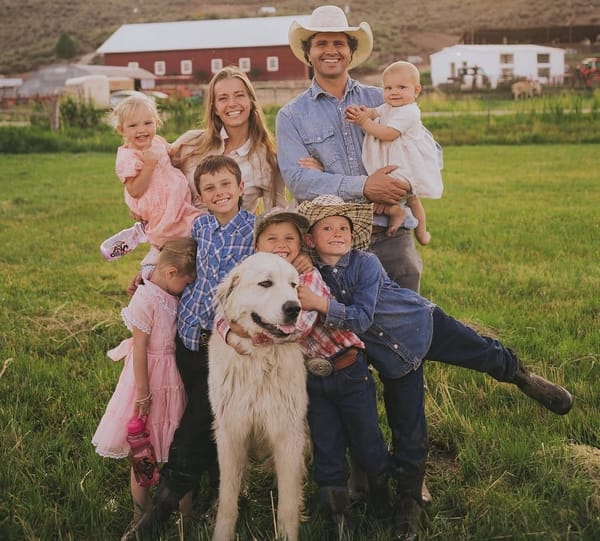
Since the pandemic, social media feeds have been quietly bearing witness to a small but revealing homesteading revival. For many, the grocery shortages, supply chain disruptions, and economic instability of 2020 exposed just how fragile our industrial systems were. Helped by the rise of remote work, they took their cue to flee the metropoles to buy and cultivate land and raise livestock, even producing their own energy. A Homesteaders of America survey conducted in 2023 found that a quarter of homesteaders began in the last three years and nearly half are Millennials or Zoomers. Predictably, they have turned their new lifestyle into an aesthetic—racking up hundreds of thousands of views on YouTube, Instagram, and TikTok, marketing an off-grid lifestyle while being terminally online.
“These neo-pioneers have preserved an insight that the modern left has abandoned.”
The deeper irony is that the usually right-coded libertarian impulses driving this movement resemble the original anti-statist strand of socialism far more than anything offered by today’s technocratic left. However quixotic or backward their experiments may be, these neo-pioneers have preserved an insight that the modern left has forgotten: that ordinary people should be able to govern their lives without bureaucratic oversight.
America has long been a laboratory for utopian experiments. From Robert Owen’s New Harmony project in the early 19th century to the “back to the land” movements of the 1960s and 1970s, disenchanted individuals have often tried to erect new alternative communities and ways of living as a counterpoint to the oppressive status quo. These were often intended to be prefigurative, to prove that “another world is possible.”
Today’s revival, by contrast, is less utopian than defensive. In that same 2023 poll, 52 percent of homesteaders named “government unrest and policies” as a key motivator. Typically, the politics involved are libertarian, even anarchist, in orientation. But they also encompass a rejection of technocracy, Big Pharma, and the urban, along with a desire to live out religious values and idealized portrayals of traditional lifestyles. A large percentage of homesteaders also homeschool their children, implicitly rejecting the state’s role in education.
One of the clearest expressions of this political outlook is the rise of “agorist” homesteading communities. Deriving from the Greek word agora, meaning market or gathering place, these projects seek to create a “counter-economics” free of what they see as the coercive control grid of the state and corporations. Libertarian agorist activist Derrick Broze started one such project in Texas, which evolved into the Conscious Resistance Network and now spans into Northern Mexico. Influenced by agorism, Broze’s homesteaders seek to resist what they see as the byzantine rules and regulations choking human exchange to create peaceful, cooperative networks outside “the system.” Broze argues that schemes like this are part of a long-term project to create “parallel systems” that will “take back power from the technocratic state” to create a society based wholly on voluntary interaction.
America isn’t the only place where settlements are appearing. In Britain, the Wild Minds Community adheres to a similar anarcho-libertarian ethos. With taglines like “secure your freedom” and “escape the system,” it is meant to appeal to those who agree the “world’s gone mad” because of developments like digital IDs, “fake food,” smart cities, and “centralized control dressed up as ‘safety.’”
It isn’t hard to see the appeal. In the Lockean logic that undergirds much of libertarian theory, mixing one’s labor with unused land accords a legitimate claim to private property. With private property comes self-sufficiency, security, independence, and ultimately, a form of freedom. For today’s “tradwives,” this vision offers an escape from uninspiring waged labor in offices or retail jobs and a return to a domestic sphere framed as meaningful and protected. If nothing else, a traditional division of labor can appear more coherent than the increasingly confused norms governing modern sexual and domestic relations.
But the appeal should not be mistaken for a realistic political horizon. Strains of libertarian homesteading turn rejection of technocratic scientism into a rejection of science in toto. At their most extreme, they not only seek to escape the state, but to dispense with industrial society. They represent yet another attempt to restore the petit-bourgeois communities that have been reduced to rubble by economic developments. And so they rely on the romantic illusion of reconnecting with the soil and recovering a lost authenticity made attractive by the alienation of modern urban life.
Nineteenth-century American individualist anarchists like Benjamin Tucker held a similar belief: If enough people simply “withdrew,” the state would eventually “starve” to death. But this outlook is both simplistic and evasive; it refuses to explain why the modern state arose in the first place, let alone confront it directly. For these reasons, today’s revivals seem destined to fail, much as the experiments of earlier eras did.
But there is a rational kernel within the homesteaders’ unrealistic program. They really believe that they are free people who can take responsibility for themselves. They don’t need permission to exercise their agency. They want to escape the ceaseless regulation, the bureaucratic collectivism of the state, and the ever-pervasive surveillance implicit in schemes like digital ID. They reject being subjects of what Theodor Adorno called the “administered society.”
This couldn’t be further from the supposed “socialists” of today, who are really aspiring administrators. They merely want to oversee the technocratic capitalist state with all of its coercive inflections and deploy it paternalistically for the sake of a more “progressive” capitalism with a pacified working class. They are like an engineer fiddling with cogs in a machine. They also couldn’t be further from historical Marxists and socialists who wanted not to administer society, but to emancipate it. This meant opposing the state in the name of the independence of society.
Hal Draper, the American socialist writer and historian, once noted that Karl Marx was more opposed to the intrusion of the state into social life than even Lord Acton, one of the 19th century’s great critics of concentrated power. A genuinely Marxist movement would be as keen to blow up the bureaucratic-technocratic state as the most hardened libertarian.
For all the flaws and deformities of these homesteaders and agorists, their example should be a jolt to anyone who still hopes to revive socialism. The telos of socialism is a world in which the state is subordinated to society, not the present condition in which society is subordinated to the state. It is a world where coercive authority becomes unnecessary and recedes into history; a world where the free relations of individuals generate their own spontaneous order; a world where society becomes self-regulating. In other words, freedom.