


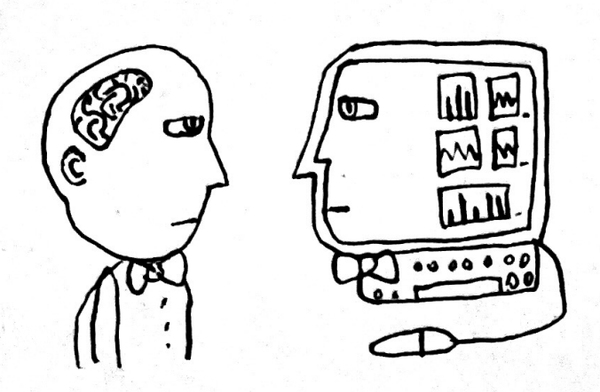
Earlier this month, Ohio State University unveiled its new “AI Fluency Program,” a campus-wide initiative designed to ensure that every student graduates fluent in artificial intelligence. Not merely familiar—fluent. The message is unmistakable: Using AI isn’t just permitted, it’s expected. Mastery of large language models is now a prerequisite for success, a kind of digital literacy for the age of optimization. As The New York Times recently noted, institutions from Duke to the University of Maryland to the California State University system are following suit, “embedding artificial intelligence tools in every facet of campus life.” Once considered a potential shortcut or cheat, generative AI is being recast as a mark of cutting-edge competence—less like sneaking notes under the table, more like learning a second language. In this brave new academic order, the AI-using student is no longer suspect, but the standard.
Welcome to the new steroid era in America, in which the speed, subtlety, and near-invisibility of AI assistants grant individuals the power of a flawed but capable demigod. In the two and a half years since OpenAI introduced ChatGPT in November 2022, it has iterated and improved to the point that users are getting a significant performance boost, despite frequent hiccups and hallucinations. Users don’t have to know precisely what they’re searching for. You can simply prompt, nudge, and suggest, and the ghost in the machine summons words and images to fill in the blanks.
“What counts as cheating when the performance-enhancing tools are increasingly baked in?”
The NCAA bans all use of performance-enhancing drugs (PEDs), but the rules around performance-enhancing technology for AI use are muddy, with colleges like Ohio State encouraging it while others have made the use of tools like ChatGPT for schoolwork punishable by expulsion. The ongoing conflicts over student AI use raise larger questions: What counts as cheating when the performance-enhancing tools are increasingly baked in? Is using AI to help, say, draft your essays—or your job cover letters or wedding vows—dishonest, or simply judicious? Where exactly do we draw the line between self-improvement and self-debasement, between tool and crutch?
It was none other than OpenAI CEO Sam Altman who introduced the comparison with PEDs into the discourse. During a Senate subcommittee hearing and a Joe Rogan appearance in 2023, the tech whiz called ChatGPT “The Internet on steroids.” He meant it in the colloquial sense, a vivid way to hype the sheer power and pace of his company’s shiny new thing. Yet, PEDs offer an instructive analogy for the tensions of AI usage: They make us capable of incredible feats of creativity and productivity, while damaging our souls.
During Major League Baseball’s steroid era in the 1990s, players injected steroids and drank pre-game coffees spiked with amphetamines (so-called greenies) to push the boundaries of human performance, even as the risks to health and the integrity of the game mounted. The players’ bodies visibly changed—bulkier chests, broader shoulders, even larger craniums, and their hitting power grew exponentially. It wasn’t just the sluggers like Barry Bonds and Mark McGwire who used PEDs to set home run records; some pitchers, too, were using steroids to recover faster, throw harder, and gain a competitive edge. That is, until it erupted into a national controversy, prompting a wave of media exposés, federal investigations, and congressional hearings.
Similarly, Lance Armstrong’s rise to the top of the professional cycling world in the aughts became a parable of the dark side of human optimization. Armstrong, once hailed as a cancer survivor and seven-time Tour de France champion, was ultimately stripped of his titles after it was revealed that he’d participated in years of systemic blood doping and an elaborate cover-up operation. During his confession, Armstrong told Oprah he believed taking the drugs was similar to filling his tires with air and bottles with water; he didn’t view his actions as cheating, but “leveling the playing field” in a sport flooded with dopers. He had a point. One analysis showed that in the 16 years between 1998 and 2013, 12 Tour de France races were won by cyclists who were confirmed dopers, and 65 percent of those who finished in the Top Ten were caught using PEDs or had links to blood doping.
Like it or not, nearly everyone under 25 that is in college or aspires to be is using AI assisstants as digital genies—not just for schoolwork and exams, but also to write emails, fix online dating bios, flirt, argue, plan vacations, and even to navigate stress and grief. One survey from the Digital Education Council claimed that 86 percent of students globally regularly use AI in their studies, with two-thirds of students using ChatGPT. Similarly, a Study.com poll of 1,000 college-age students found that roughly 89 percent admitted to using ChatGPT to finish a homework assignment, 48 percent confessed to relying on it for at-home quizzes, and over half had the bot write an entire essay on their behalf. And yet, paradoxically, more than 70 percent of those same students believed ChatGPT should also be banned from campus internet networks. This cognitive dissonance reveals a generation caught somewhere between temptation and unease, torn between reliance on AI assistance and a lingering sense of its corrosive effects.
The performance-enhancing drugs scandals in sports weren’t merely about isolated cases of bad actors but the entire culture; the substances became widespread precisely because of the pressure athletes felt to keep up. In clubhouses and locker rooms, whispers of who was using what and how much turned into a proverbial arms race. The logic was as brutal as it was pervasive: If your competitors were juicing, could you afford not to? Careers, contracts, sponsorships, and legacies hung in the balance. And if you had to sacrifice the integrity of the game or your own health—increased aggression (’roid rage), liver damage, shrunken testicles, and long-term heart risk—so be it.
“Suddenly, it feels impossible to compete unless you, too, turn to AI tools.”
Likewise, if enough students see their peers improving their grades, test scores, and job prospects with the help of ChatGPT, the arms race only intensifies. Suddenly, it feels impossible to compete unless you, too, turn to AI tools. That’s why countless other universities are likely to follow the example of Ohio State. We might admire those institutions and young people who stay au naturel—the refusenicks who are “rawdogging life,” to use a choice Mark Zuckerberg phrase—but they’re quickly being left behind. “If you do not use it as a learning tool, then you will destroy your career progression and become stagnant and limited in your knowledge,” one user told Harvard Business Review.
Maintaining the uneasy status quo in education seems impossible. It’s become a cat-and-mouse game in which professors scramble to outwit their students, bringing back Blue Books for exams and designing assignments that AI can’t easily mimic, even as they are also quietly adopting AI tools to grade papers faster, draft recommendation letters, and churn out academic articles. This shift isn’t cost-free—it carries profound psychological implications. Studies have found that when we outsource cognitive tasks to devices, we subtly change how we experience and grapple with knowledge. At what point does the tool stop serving you, and you start serving it—conforming your voice, your thoughts, and your work to the contours of what it considers the boundaries of acceptable thought?
This situation is not new. Every technological leap—word processors, search engines, autocorrect—has changed how we write and think. But the ChatGPTs of the world feel like a quantum leap of a different order. It's not just that they’re helping us write faster or find facts quicker. It’s recalibrating our sense of self-reliance, our tolerance for ambiguity, and our patience with our own thoughts.
As the youngest generations grow up and AI systems continue their relentless march through the institutions, workplaces face parallel dilemmas. White-collar jobs that once thrived on expertise, persuasion, or creativity now confront a wave of automation that doesn’t necessarily replace humans wholesale but reshapes the terms of engagement. A junior copywriter, a paralegal, a market researcher—these roles increasingly orbit around AI systems, tweaking and refining their outputs rather than generating raw material from scratch. The result is a kind of creeping deskilling, masked by apparent efficiency gains. It’s not that the human will become irrelevant; it’s that they will be redefined and self-marginalized.
Even in civic life, the steroid metaphor applies. Imagine a future election season in which every campaign deploys messaging systems powered by large language models (LLMs) to fine-tune, in real time, the ideal talking points for every voter demographic, perhaps on an individual level. Imagine a flood of AI-generated micro-influencing operations, custom-tailored for psychological persuasion, saturating social media feeds. Are we prepared for the political version of performance enhancement, where the line between authentic democratic expression and algorithmic manipulation blurs to the point of meaninglessness? First, we gave the machines our busy work, then we handed over our social life, now we’re in the process of giving over the rest of our complex thinking, including—perhaps—political thinking. Eventually, we’ll be like those reliant on Google Maps, who can’t get anywhere without a phone telling us where to turn.
And yet, to reject AI outright is to pretend we can stuff the virtual genie back into the bottle. If, like me, or say, Pope Leo XIV, you are an AI skeptic, I have bad news for you: The time to question whether LLMs should play a significant, if not essential role, in human affairs is over. But surely we can plan for what happens next. Steroids reshaped sports but also led to regulatory regimes, testing standards, and cultural reckonings about fairness and health. We need a similar reckoning for AI—not a Luddite’s wish for destruction, but a referee’s insistence on acceptable rules, boundaries, and accountability.