


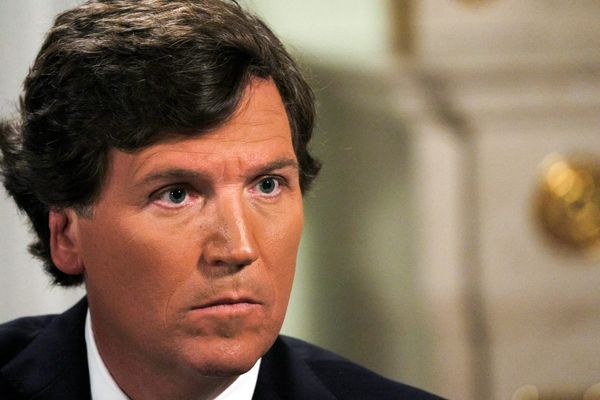
Why do so many Americans support Israel? In his recent interview with “groyper” Nick Fuentes, Tucker Carlson was the latest to ask a question that has vexed politicians, journalists, and scholars. “They’re not Jewish, most of them are self-described Christians,” he marveled. “They’re Christian Zionists. Like, what is that?”
This was not the first time Carlson has discussed what he called the “brain virus” of Christian Zionism. In June, Carlson grilled Sen. Ted Cruz about the theological sources of his foreign policy positions. When Cruz paraphrased Genesis 12, Carlson was incredulous that God’s promise to bless those who bless Abraham, his descendants, and their land could refer to the modern State of Israel. Last year, Carlson hosted the country singer John Rich. They did not discuss Israel specifically, but Rich echoed a conspiracy theory that evangelist C.I. Scofield’s success was orchestrated by rich Jews in order to promote Zionism among Christians.
Carlson is increasing their prominence on the right, but such ideas have been popular on the left for decades. Beginning in the 1980s, a whole genre of books and articles contended that American Christians’ enthusiasm for Israel was based on an “end times” scenario derived from the Victorian theologian John Nelson Darby, and mainstreamed by Scofield in the early 20th century.
The details of this end times scenario are intricate and highly contested. The central idea, though, is that Biblical prophets foresaw that the Jews would return to the promised land and establish a powerful state there, before suffering a period of “tribulation” that culminates in the return of Christ to rule in person. Translated into politics, this is thought to mean that Christians should strategically promote the security and prosperity of Israel without mistaking these circumstances for ends in themselves. They know that God is in charge and will bring terrible suffering to Jews, the Middle East, and the world before establishing a divine kingdom to be inhabited by Christian believers.
It's a thrilling story and there’s a reason it provided the basis for bestsellers including the late Hal Lindsey’s The Late, Great Planet Earth and, later, the Left Behind novels. It’s also controversial. Going back to Darby’s time, every aspect has been challenged by theologians and Biblical scholars. Despite these challenges, though, there’s little doubt that it’s been influential. As Rich described from his own experience, millions of Americans were raised on the 1909 Scofield Reference Bible, which included elements of the apocalyptic story in notes appended to the source text.
“The history of Christian Zionism in America is far longer and more various.”
But it’s a mistake to attribute US foreign policy—or even Christians’ views of that topic—to Darby’s so-called “dispensational” eschatology. The history of Christian Zionism in America is far longer and more various than that.
The story begins in 16th-century Europe. Stimulated by the renewed emphasis on the authority of Scripture—including the so-called Old Testament—Protestant scholars began to reassess references to “Israel” in the Biblical text. Were these, as Catholic theology suggested, prefigurations of the church that were fulfilled by the appearance of Jesus? Or did they refer to the people and land of Israel, who had a future as well as a past in God’s plan?
Preceding the Scofield Reference Bible by more than 300 years, the so-called Geneva Bible of 1560 included marginal notes that affirmed the latter interpretation. The explanations of the prophets are particularly striking. A note on Isaiah speaks of a time when Israel “shuld buylde again the ruines of Jerusalem and Judea.”
These ideas were conveyed to the new world by the Puritans, who brought “our Geneva” with them as the favored translation. In addition to drawing on the narrative of the Biblical Israel to explain their own “errand into the wilderness,” some Puritan leaders looked forward to the re-gathering of the Jews in what was then Ottoman Palestine and the establishment of some kind of state there. True, these early modern Christians expected the Jews to convert at some point in the process (the exact sequence of events was disputed). But Protestants in Britain and America envisioned a form of “Zionism” centuries before the emergence of the organized Zionist movement in Europe.
The influence of classical Puritanism waned through the eighteenth century. But hopes for of Jewish “restoration”, including some form of political autonomy, were shared even by theological liberals. In 1819, former president John Adams, a sometime Unitarian, wrote to the Jewish American politician Mordecai Manuel Noah that “I really wish the Jews again in Judea an independent nation.” Twenty five years later, Noah delivered lectures on the restoration of the Jews with American assistance to large audiences in New York City.
This survey is brief and incomplete. But such examples demonstrate that not only a form of Zionism, but also the idea of a “special relationship” with the United States were present in American culture long before Darby visited in the middle of the 19th century.
In fact, it’s only since the 1970s that (ostensible) believers in some version of the end times scenario have been prominent in modern public life. For much of the twentieth Century, and especially in the decades following World War II, liberal Protestants were America’s most visible and influential supporters of the State of Israel. What mattered to figures such as Reinhold Niebuhr was not the eventual return of Jesus. It was the political, moral, and religious bonds that he believed connected Jews and Christians. Martin Luther King, Jr. expressed similar views.
Of course, we can’t apply arguments from the middle of the 20th century—let alone the middle of the 16th century—directly to the present situation in the Middle East. And ideas associated with Darby, Scofield, and Lindsay were important in the evangelical and fundamentalist circles that contributed to the emergence of the “Religious Right” in the Reagan era. How far that influence affected actual policy remains unclear. Some of the more lurid anecdotes that purport to demonstrate that Republican presidents deployed their executive powers with an eye on the millennial kingdom are, at minimum, dubious.
Even at the popular level, moreover, the influence of “dispensationalism” has been waning for years. And it was never more than a part of Americans’ historically intense relationship with Zionism and the State of Israel. Whatever you make of Christian Zionism as a religious, political, or cultural phenomenon, it isn’t some alien infection, as Carlson suggested. It has been with America since the beginning of British settlement.