


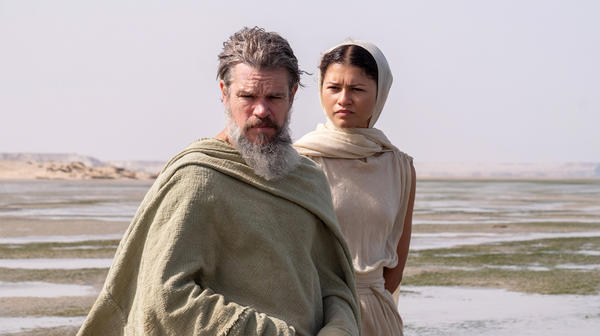
For months you’ve heard that Christopher Nolan’s Odyssey is a debacle of woke, foisted on us as a mockery of the heroic age of the West. For the past few days, now that reviews are coming in, you’ve heard praise: It’s an epic spectacle, as moving as it is innovative, as intelligent as it is grand. Both are true. The movie is vast, ambitious, clever, and affecting. It is also highly subversive, a kind of study in using Homeric materials to serve radically different ends.
The movie is easy to praise. It looks handsome; the special effects all look real, and while the costumes are sometimes odd—were they remainders from the Batman movies?—this is every inch a state-of-the-art high-budget Hollywood epic. You get to see a giant Cyclops, and Circe turning men to pigs, and the picked soldiers waiting inside the Trojan Horse. The Sirens, Scylla and Charybdis, and the story of the Cattle of the Sun are much as written in the book. Lovers of the details of the poem will find Argos on his dung-heap and Alcinous aiming a stool at Odysseus. And to see Odysseus a despised, abused beggar in his own halls makes Homer look like a Christian prophet—and Nolan does nothing to dissuade you from coming to this conclusion, clothing Odysseus with monklike cowl and Christlike beard. Matt Damon, playing Odysseus, is up the task, offering his back to the smiters, courting a mistreatment that will justify the rage in his heart.
The Odyssey’s signature complex timeline, featuring various characters telling tales that take the narrative back in time, finds its perfect director in Nolan, who by his usual wizardry manages to tell a naturally unfolding coherent narrative without any regard for strict chronological consecution. But Nolan’s chronic brilliance in his screenplays comes with a cost: his dialogue. Bland at best, at its worst it sounds like George Lucas in The Phantom Menace. We need Odysseus in bed talking about Agamemnon controlling trade routes as much as we need Queen Amidala’s thoughts about the importance of democracy. Nolan loves to explain his own screenplay, from Odysseus’s oracular utterances about his own approach (“You see a man best from below,” he intones to his son) to Circe interpreting the meaning of her own spells.