


Williamson Street is the strangest street in Wisconsin. On the right side stands the Willy Street Co-op, the most expensive grocery store I have ever set foot in. A loaf of bread costs $11. They sell vegan crackers, gluten-free brownies, and a litany of health supplements. On the bulletin board, you’ll see posters about protecting trans kids, abolishing ICE, and “grieving circles” where people gather together to process the trauma caused by climate change.
That’s the right side of the street. The left side looks like a scene in a post-apocalyptic film. The sidewalk is filled with zombies doing the fentanyl fold. They’re either leaning against the wall, hunched over the Narcan vending machine, or sleeping in the middle of the sidewalk. There’s always urine, feces, broken glass, cigarette butts, spilled cans of soup, and moldy bread littering the asphalt. It is simultaneously a public dumpster, an open air drug market, and a place that feels like it’s about to erupt in violence. One Tuesday afternoon a few weeks ago, I saw a shirtless man with a face tattoo walking in-between traffic, waving his fists, and threatening to kill drivers. I was walking to a coffee shop. The scene was so typical that I had already forgotten about it by the time I had my cappuccino in front of me.
What I never see on Willy Street is a police officer. So you can imagine my surprise when the cop cars flew down my street in Madison last month. According to reports, a man was trying to break into parked cars. When the first officers arrived, he stole a bicycle and pedaled away. Four officers caught up with him at the intersection of South Baldwin Street and Williamson Street. He resisted arrest. In the video, one officer screams, “He’s got a knife!” The man, Corey Ruiz, apparently pulled out a butcher’s knife and sliced an officer open. That officer then shot him three times in the head. They handcuffed his lifeless body. His blood poured into the street.
“By the end of the day, the street had been taken over by activists.”
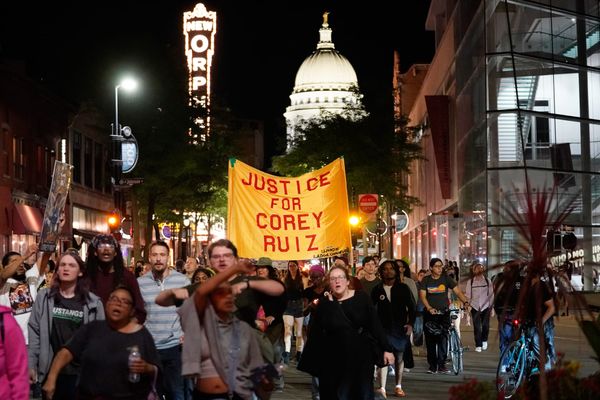
By the end of the day, the street had been taken over by activists. Before the cops cleared it out, there was a barricade of couches, shipping pallets, and other trash blocking people from driving down the street. The activists erected a Black Power statue in the middle of the intersection. They are still demanding everything from murder charges for the arresting officers to the end of capitalism. As one stretch of graffiti says, “The time to be Martin died. The time to be Malcolm will be our glory.”
As far as sociological experiments go, there’s nothing more revealing than watching the affluent white liberals shopping at the Willy Street Co-op interact with the deranged, often black, homeless people who frequently cross the street to ask them for money. Just last week, I saw a white woman say, “I’m so sorry, but I have nothing to give,” as she walked out of the co-op with hundreds of dollars of groceries before getting into her Cadillac Escalade. More typically, the patrons of the co-op hand out money that will surely be spent at the drug market across the street. When I once asked a stranger why they just gave money to someone who was clearly on drugs, and who was clearly going to use their money to buy more drugs, they asked me why, as a white man, I didn’t give that homeless black man money. “Because I’m not an ATM,” I responded.
The longer answer is that I’ve seen drug use firsthand. And I’ve never bought into the argument that what the drug users need is more money to fund their addictions. I’ve also never bought into the argument that drug use, theft, and other so-called “crimes of poverty” would disappear if more people like Zohran Mamdani were running our cities. While I never lived in government housing, most of my friends did growing up. I cut my teeth in the projects of Greater Boston. If I ever believed more handouts from the government would solve our social problems, my childhood quickly dispelled me of that notion. The parents continued to use drugs. They continued to not have jobs. They continued to beat their kids. The only difference was my parents were paying their rent.
According to my Madison neighbors, white supremacy is why Corey Ruiz is dead. He was, as one local writer puts it, “murdered by police for being black.” It’s the sentiment that is now scrawled in graffiti, on posters, and in the speeches I hear from my house. “In the system that our white patriarchy has cultivated, no black American will be safe from the threat of death by officer. No man, woman or child will ever be able to walk the sidewalk, care for their family or work a job without being violently murdered and taken from the world.” Accordingly, the system must be destroyed.
“A third activist told me that I need to read Huey P. Newton.”
One activist explained to me that “whiteness is a cancer that needs to be excised.” Another activist told me that “housing insecurity is treated as a crime” and that “the white cops sentenced this Black man to death because he didn’t have a house.” A third activist told me that I need to read Huey P. Newton, the violent cokehead holding a spear in that Black Panther Party photo. Two of these activists work at Epic, the billion-dollar software giant that dealt an enormous blow to worker’s rights in the Supreme Court case Epic Systems Corp. v. Lewis. As if it even needs to be said, all three of them are white.
Listening to them talk, I was reminded of a scene in Ari Aster’s 2025 film, Eddington. In the scene, a young white man attends a protest for social justice. At the protest, he learns that “we can’t just feel happy with ourselves . . . The goal is to be white abolitionists. That means changing institutions, dismantling whiteness, and not allowing whiteness to reassert itself.” Over dinner, he relays what he has learned to his father. His father responds, “Are you fucking retarded? What the fuck are you talking about? You’re white.”
In a 4,000-word article about Corey Ruiz’s death, the word knife is used once. The local writer is more interested in toppling the entire city. In his article, “The City We Owe Him,” he compares our police to those who enforced apartheid in South Africa. “Police are not the dependable public service,” he writes. “They are an armed institution sent to manage the wreckage after housing, treatment, education, employment and mental-health systems have already failed.” The police need to be defunded. The police need to be dismantled. The police, as the lawn signs in front of the two-million-dollar, lake front homes on Madison’s isthmus remind me, need to be abolished.
Democratic socialist Francesca Hong, a member of the State Assembly from Madison who just narrowly lost the Democratic gubernatorial nomination, claimed during her campaign that she no longer stood by her prior statements in favor of defunding and abolishing the police. However, she responded to Corey Ruiz’s death by stating: “Fatal encounters between members of the public and law enforcement happen far too often—especially for people of color. The only acceptable number of police killings is zero.” Hong wasn’t alone in failing to mention Ruiz’s alleged knife attack, or the fact that he had forty prior arrests; much media coverage has also left all of this out.
In 2021, Corey Ruiz pleaded guilty to resisting arrest and causing bodily harm to a police officer. According to the prosecution, this is what he said to police:
“I’ll beat the fuck out of you.”
“I’ll knock your fucking lenses to your eyes.”
“I hope the next offender you come across kills you and everyone you care about.”
This is a man who, I am now told by Hong and others, was my loving neighbor, a member of my community, and someone who was wrongfully killed not because he was a drugged-out convict swinging a butcher’s knife at police officers, but because of racism and capitalism. The powder keg of white wealth, white guilt, and black homelessness—exploded by the bullets that hit Corey Ruiz on July 22, 2026—may make Madison the next city to pursue a disastrous “defund” experiment. As Karl Marx wrote, history repeats itself, “The first time as tragedy, the second time as farce.”