


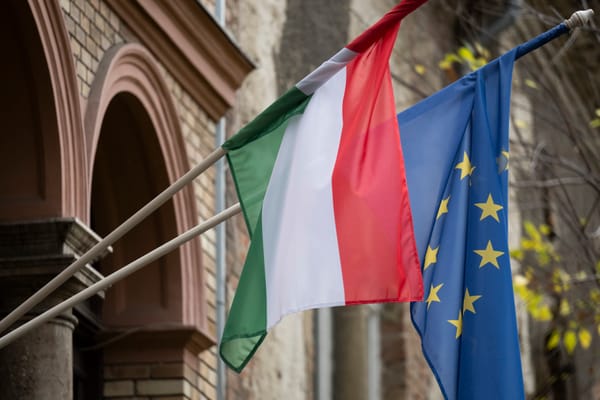
Since at least 2003, when Donald Rumsfeld contrasted the “old Europe” of France and Germany with the “new” Europe made up of central European countries, commentators have stressed the difference between Western and Central Europe. While conservatives like Rumsfeld often see Central Europe as a source of vitality, many liberals regard it as a zone of “democratic backsliding.” Both perspectives fail to see the profound internal divisions that must be overcome if Central Europe is to emerge as a coherent geopolitical bloc.
The first significant division is between Central European elites and the broader society. Even though Central Europe may appear to be a bastion of resistance to Brussels ideology and a partner for global players, most elite Central Europeans have become distinctly westernized. Political leaders, officials, journalists, NGO representatives, and academics often develop a strong loyalty to Brussels which trumps their national loyalty. And those who don’t necessarily identify with the West often incline toward it nonetheless, because it offers them better financial and career prospects.
“The West is not the only force seeking to shape the region.”
Of course, the West is not the only force seeking to shape the region. More than ten years ago, China launched the 14+1 format of economic cooperation with former communist countries to improve its access to the European market. In response, Washington supported the Three Seas Initiative, connecting transport and energy infrastructure of countries between the Baltic, Adriatic, and Black Seas to broaden its LNG market and to get a foothold between Germany and Russia.
The Westernized elite stands and falls with the importance of the European Union. If Brussels’ plans for further centralization are fulfilled, the influence of its allies and servants in the member states will also grow. But this is not very likely. In light of the catastrophic failures of EU policies (the Green Deal, Covid vaccine purchases, arming Ukraine, anti-Russian sanctions, and mass migration), it is more likely to expect a crisis in European institutions, which will open up space for more intensive cooperation among Central European nations. However, this can only succeed if Central Europe is able to politically come to terms with its internal diversity.
The Czech novelist Milan Kundera defined Central Europe as a maximum of diversity in a minimum of space. The flip side of this diversity is political fragmentation. There is no issue on which the countries between the three seas can easily agree, be it Ukraine, Russia, China, or European single currency. Indeed, they are plagued by a number of historical disputes and ancient hatreds.
“The flip side of this diversity is political fragmentation.”
Moreover, Central Europe consists of two historically and geopolitically distinct areas: the Baltic and the Danube. Baltic Europe consists of Poland and the Baltic states. They are located in the lowlands around the Baltic Sea, and their modern history has unfolded in cooperation and conflict with Orthodox Russia and Protestant Prussia. The leading force in this area is Catholic Poland, whose politics since the 1990s have been defined by fear of Russia, distrust of Germany, and interest in its eastern neighbors—Belarus, Lithuania, and Ukraine—with whom it has tense relations for historical reasons.
Poland is trying to secure its interests in two ways. First, it is building special strategic relations with the United States. During the second Iraq War, it had its own occupation zone in Iraq for a time, hosted a CIA prison, built an LNG terminal for American gas, became the main driving force behind the American-oriented Three Seas economic initiative, and sought to establish an American military base. American soldiers finally came to Poland when the Biden administration strengthened NATO’s eastern flank after Russia’s invasion of Ukraine.
Poland is also trying to turn into an independent great power. Thus, it is building a strong national army that would give it the ability to defend itself against conventional attacks. Poland has been recently spending nearly 5 percent of its GDP on defense and has the third-largest army in NATO after the United States and Turkey (but ahead of France and Germany). To complement its national capabilities, Poland is trying to assimilate not only the Baltic states but also Danube Europe into its sphere of interest.
However, the Danube region is different. Its geographical axis is the Danube River, and its modern history is marked by conflicts with the Muslim Ottoman Empire and by the Catholic Austrian Empire. The role of Prussia was marginal, and that of Russia ambivalent. While Russia was both a geopolitical rival and ally to Austria, it was a liberator from Turkish rule for the Balkan nations. The Danube region has no leading power; it is polycentric. There are four capitals on the Danube: Vienna, Bratislava, Budapest, and Belgrade. Three of them were the centers of larger geopolitical entities: Vienna in the Habsburg Monarchy, Budapest in the Hungarian part of Austria-Hungary, and Belgrade in Yugoslavia.
Even today, Austria, Hungary, and Serbia are attempting to pursue their own distinctive policies. Austria is making extensive investments in Central European countries and maintaining its neutrality. Although neutrality was imposed on it after the war, the policy proved successful and became the source of Austrian political identity. Hungary is grappling with the consequences of the division of the Hungarian nation after World War I, which makes it focus on defending the interests of Hungarian minorities in the territories of its neighbors. Otherwise, it strives for pragmatic cooperation in all directions, including Moscow, Beijing, and Washington. But its rejection of migrants and military aid to Ukraine puts it in conflict with the ideology of Brussels.
Orthodox Serbia, which experienced NATO bombings and the American-organized secession of Kosovo in 1999, is trying to find an economic and political balance between Moscow, its historical ally, and Brussels, from which it expects economic modernization and prosperity. It is also trying to strengthen its prosperity through intensive relations with Beijing. Despite their mutual differences, none of the three states shares Poland’s analysis of geopolitical risks. This is also the case with others in the Danube Europe, except for Romania with its strategic location on the Black Sea coast.
Romania hosted a CIA prison at the beginning of the century and is now building a massive NATO air base. But this direction does not stem from the stable attitudes of Romanian society—unlike in Poland—but from the long-term influence of Western powers on Romanian power structures. Western involvement is so important to the Romanian elite that when a supporter of the anti-Brussels line threatened to win, the election was simply canceled.
Could the whole of Central Europe, both Danubian and Baltic, function as a coordinated whole? It would only be conceivable if two conditions are met: geopolitical uncertainty and honest brokerage. Central European cooperation flourishes in geopolitical uncertainty. The Habsburg Monarchy was established in the 16th century as a response to the Turkish threat. The Little Entente after World War I sought to counter Hungarian revisionism. The Visegrad cooperation of Czechoslovakia, Hungary, and Poland started in the 1990s to make the Soviet Union withdraw its troops from Central Europe as fast as possible. It was recently revived to stop mass migration. The deeper the crisis of European institutions and the more complete the United States’s departure from Europe, the deeper the uncertainty in Central Europe and the greater the internal demand for its political coordination.
“Central Europe has neither a natural center nor a natural leader.”
But Central Europe has neither a natural center nor a natural leader. If it is to build a decentralized cooperation among sovereign states, a local mediator is needed. Czechia can act as an honest broker. It neighbors both Baltic and Danube Europe, belonging partly to both. Unlike the Baltic countries, it had no direct experience with Russia except in the second half of the 20th century, and unlike the Danube countries, Czechia has no Ottoman legacy. There are far fewer Russophiles in Czechia than in Slovakia, Serbia, or Bulgaria, but also significantly fewer Russophobes than in Poland or the Baltic states. Before succumbing to the European wave of Russophobia, it held a middle position among Central European states towards Russia. Unlike many others, it also has no historical disputes with its Central European neighbors over territory or minorities.
A Central European role would also bring advantages to the Czech Republic. It would enable it to counter the influence of Germany, which has always prevailed there: in the Middle Ages from Bavaria and Saxony, later from Protestant Prussia and Catholic Austria. After the restoration of statehood in 1918, Prague unsuccessfully attempted to balance Germany with France, and after 1945 with the Soviet Union, which led it to the communist empire. After regaining sovereignty in 1989, Czechia integrated economically with Germany, relying on Washington for security and Brussels for politics. With the expected crisis in Washington and Brussels, Central Europe appears to be the only credible alternative to the complete integration of Czechia into the German sphere dominated by aggressive progressivism.
In the end, what European liberals fear today and European conservatives hope for may come to pass. A space may emerge in Central Europe that will represent an alternative to Brussels-led Europe. But before that happens, Europe will have to sink a little deeper into the Brussels swamp.