


On May 5, 2026, in Gwangju, South Korea, a twenty-three-year-old man named Jang Yoon-gi stalked, sexually assaulted, and brutally murdered Lee Chae-won, a seventeen-year-old female high school student. During the subsequent investigation, police discovered two “real dolls”—hyperrealistic life-sized sex dolls—in the perpetrator’s apartment. Both dolls had been mutilated: their necks and breasts slashed by sharp weapons. Criminal psychologists and prosecutors concluded that these mutilations had served as a calculated, physical rehearsal of the violence he later inflicted on his human victim.
This case serves as tragic, real-world illustration of what a growing number of feminist campaigners and scholars argue: that sex dolls encourage the objectification of the female form while serving as a psychological catalyst and practice tool for extreme sexual violence. This has led to calls for the production, distribution, and use of sex dolls to be criminalized. Real life sex abuse cases have amplified these calls in recent months. In addition to Yoon-gi, there was the case of Jason Forbes in Australia. In February of this year, Forbes was sentenced to seven and a half years when police disrupted his plan to abduct a girl whilst posing as a police officer. Forbes was found to be in possession of a child sex doll.
The first mass-produced inflatable sex dolls (little more than rubber mannequins with painted facial features) became available, mainly through mail-order catalogues and sex shops, in the 1960s. But from the 1990s onwards, manufacturers began using latex, then silicone, to produce dolls that were far more realistic, with articulated skeletons and other lifelike features. As Jo Bartosch and Rob Jessel write in their 2025 book Pornocracy, “The latest generation are not only warm, fleshy and able to be manipulated into any sexual position—they come integrated with artificial intelligence and synthesised speech for the ultimate believability.”
“The market is flourishing.”
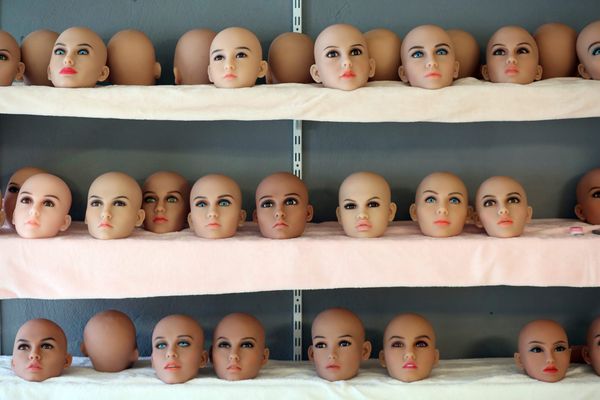
Today, high-end sex dolls cost several thousand pounds, and can include heating systems, AI-powered conversation, realistic facial expressions, and simulated breathing. There are also removable orifices, and mouths fitted with sucking motions. Buyers can choose breast size, hair color, and other physical attributes. For those who can afford it, different heads can be attached to the body of the doll, for a bit of variety. The market is flourishing. One 2025 estimate put the global value at $4.71 Billion.