


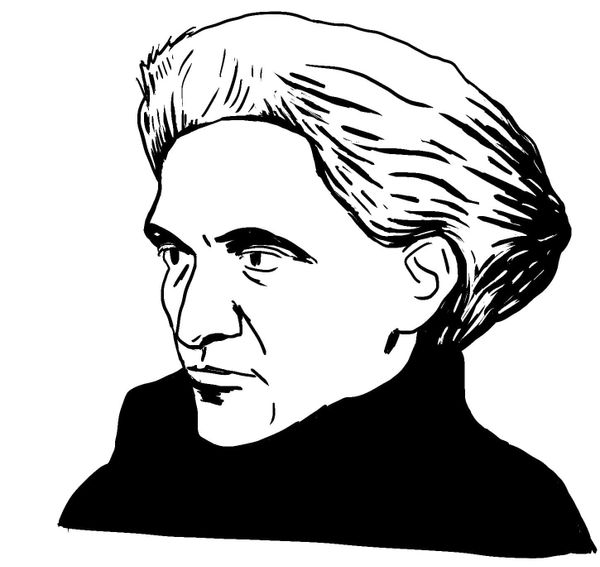
Stefan George is the most elusive figure in the literary history of Wilhelmine and Weimar Germany, a period that begins with Friedrich Nietzsche’s excoriations of Judeo-Christian morality in the late 1880s and ends with the Nazi book burnings of 1933. From a distance, George’s life looks like a secret passageway connecting these two ominous termini. He appears as the Antichrist in the age of democracy, as the counterrevolutionary herald of the Third Reich.
The life of this poet is often divided into three periods. Around 1890, the young George stood under the banner of “art for art’s sake.” He was inspired by Mallarmé and the French symbolists, with whom he studied in Paris; he later translated Baudelaire’s Flowers of Evil into German. He established a literary magazine that published his poems and those of his friends in small limited editions for an invitation-only readership.
After 1900, in the second phase of his career, George metamorphosed from Germany’s leading exponent of aestheticism into a critic of enlightened liberal-democratic culture: “a cold and disfigured humanity,” as he called it in a rare prose essay from 1907, “that boasts its manifold achievements while great deeds and great love are vanishing.” This “world of contradiction,” he wrote three years later, is “totally mechanical · totally shadowlike · totally derivative and incapable of generating its own life.” In 1913, George published Star of the Covenant, the holy scripture of George’s emergent brotherhood, in which a voice from heaven promises spiritual rebirth to his devoted flock after the obliteration of the modern world: “Ten thousand men must the holy madness smite / Ten thousand must the holy plague destroy / Tens of thousands the holy war.” The following year, German soldiers carried copies of it into the trenches.
During the Weimar Republic, in the twilight of his career, George’s poetic activity receded. He devoted himself to mentorship, cultivating a cadre of followers, often called the “George Circle,” whose boyishly handsome members—this was a selection criterion—were admired by Germany’s intellectual vanguard and appointed to prestigious academic posts at the best German universities. They were celebrated for their monographs on great men among the likes of Plato, Frederick II, and Napoleon, each thick volume bearing George’s trademark stamp of approval on its cover in the form of a curved swastika. It is hardly surprising that some of George’s followers trumpeted völkisch ideology throughout the 1920s, or that a few remained committed to the Nazi regime well after Hitler’s rise to power in 1933—the year of George’s death in the Swiss village of Locarno at the age of sixty-five.
“George was not a political theorist.”
That is the shape of George’s life in the imagination of someone who knows him from sketches of modern German history, where his name sometimes appears alongside those of illiberal political philosophers such as Oswald Spengler, Carl Schmitt, and Ernst Jünger. In the English-speaking world, where there has never been much interest in George’s poetry, this is where one is most likely to encounter his message. This is unfortunate for several reasons. In the first instance, George was not a political theorist; he was the most respected German poet of his time. His name belongs in literary anthologies alongside Rainer Maria Rilke and Thomas Mann, who were long considered lesser writers, but whose posthumous fame overshadows George’s work.
But even if one ignores George’s poetry and sees him as he was seen in the later years of his life, as the energetic prophet of The New Reich—the title of his final collection of poems—there is no clear path leading from his aristocratic ethos to the racist mass movement that triumphed as he lay on his deathbed. On the contrary, his work can be cited as a critique of Nazism, and many of his disciples read it this way. The George Circle was a sanctuary for Jewish intellectuals and homosexual poets in early twentieth-century Germany, and even after 1933, these disciples never forsook the wisdom of their “Master,” as they called George with deference and affection. Almost all of them carried his teaching into exile with unqualified devotion, nurturing future generations of literary critics and historians in Princeton, Berkeley, and Chapel Hill.
Despite this, for much of the past century, George has been regarded, at best, as a sensitive lyric poet at home in The Penguin Book of Homosexual Verse, and at worst, as a megalomaniacal cult leader and pedophile. But today it is precisely those features of George’s life long considered irredeemable—his ethical severity and his cultivation of virtue in young men through the educative power of love—that appear most inspiring and alive. At a time when learning is becoming indistinguishable from vocational training, when the mind confronts its technological obsolescence, and when the relations between teachers and students are surveilled by Title IX officers, George appears, with all his foibles, as an iconoclastic sage, man, and teacher.
The first thing one notices about George is the otherworldliness of his person and work. He bore cartoonish features: a stumpy neck, usually obscured by a high white shirt collar, supporting a spherical head with protuberant cheekbones, thin lips, a protruding mandible, and deeply sunken eye sockets that gave the impression of an insomniac. He wore a dense mane of hair swept back, flowing perpendicular to his face as though a fan were pointed at his nose.
“He left his individual mark on all that he touched.”
He was allergic to everything conventional that might restrict his will to expression, and he left his individual mark on all that he touched. In his poetry, he omitted articles, replaced semicolons and periods with a two-dot ellipsis, and either forwent the comma or substituted a period centered like a bullet point in its place. His signature was his use of lowercase letters for nouns, which are necessarily capitalized in German so that they are not mistaken for adjectives or verbs. These eccentricities, combined with archaic diction, poetic contractions, and regional dialect, make it challenging to read George’s verse, which appears to be written in a private language.
The inaccessibility of George’s poems was intensified by the psalmodic, anti-theatrical intonation that George adopted when reading them. His idea of art was negatively informed by commercial standards of evaluation. But to his admirers—especially social philosophers like Georg Simmel, Georg Lukács, and Theodor Adorno—George’s rigorous hermeticism was the source of his greatness. He transcended the instrumental and degraded character of communicative language by inventing a syntax in which humanity speaks as though for the first time. It has still hardly been registered that the entire philosophical critique of the “reification” of modern life did not begin with a rediscovery of Hegel and Marx, but was born from a confrontation with George’s longing for a vital connection to his fellow men.
George also possessed an unconventional handwriting resembling the uncial script used by the Christian scribes of late antiquity. His collaborator, the graphic artist Melchior Lechter, helped design a special typeface on the basis of this writing—today one can download the font under the name St-G-Schrift—for George’s poetry collections. The poems from the period of collaboration with Lechter, which are usually considered George’s finest, depict symbolic dreamscapes that combine with art nouveau illustrations to form a kind of Gesamtkunstwerk. The Tapestry of Life (1900), for example, was published on 17”x17” paper in an edition of 300, bound with wooden boards, and stylized like a medieval incunabulum, with towering candelabra framing the poems.
This collection opens with a programmatic cycle in George’s oeuvre: A world-weary poet is confronted by his double in the form of a naked angel with almond blossoms for fingers and a wreath of roses around his chin. The angel says that he has been sent as a herald of “the beautiful life” before then dropping a bouquet of lilies and mimosas onto the ground. As the poet bends to retrieve the flowers, he is astonished to see the angel mirror his movement: “Then HE too knelt · in bliss I bathed / My entire face in the fresh roses.” Ink drawings of angels, doves, harps, stars, and peacock feathers saturate every corner of this exquisite and narcissistic erotic fantasy.
Something happened to George at the age of thirty-five, introducing a caesura into his career with world-historical implications: He fell in love with a thirteen-year-old boy. The Jewish scion, Maximilian Kronberger, had soft, boyish features and a Mediterranean complexion. He wrote poetry that George considered impressive. Most importantly, he showed George an admiration that exceeded mere respect for his worldly experience and fame. Kronberger appeared to George as the incarnation of “the beautiful life”—the realization of the angel’s message. Then, shortly before his sixteenth birthday, he died of meningitis. And George became a teacher and prophet.
Heartbroken, George published a memorializing album of poems in honor of “Maximin,” as he renamed his beloved. A cropped image of Kronberger’s head and bare shoulders in profile appears adjacent to the title page of this extremely rare book. (The original photograph, which extends down to the adolescent’s naked thighs, was hung on the walls of George’s residences.) George prefaced the album with a prose essay. He states that Maximin appeared in his midst as “a plague seemed to rage that no medicine could help and that was to end in the soullessness of the human race.” But the boy “restored our confidence and filled us with the light of new promises,” for he embodied “almighty youth just as we had dreamed it” and “he showed us things as they are seen by the eyes of the Gods.” He embodied a new value hierarchy oriented around youth, male beauty, and creativity, such that “the oppressive present lost its exclusive right since it had to submit to another order.” Nietzsche called this “the transvaluation of values.”
George was neither the first to bemoan the soullessness of modern society nor the first to dream of cultural renewal. These were pet themes of German philosophy in the wake of Nietzsche. One famous meditation on this topic was published the same year as Maximin’s death: Max Weber’s The Protestant Ethic and the Spirit of Capitalism. This discipline-defining sociological study concludes with a string of sentences that liken capitalist modernity to an “iron cage” inhabited by the “Last Men” from Nietzsche’s Zarathustra: maggot-men who think they have found happiness yet remain ignorant of their own inconsequentiality, whom Weber calls “specialists without spirit, sensualists without heart.” Weber doubted that “new prophets” would arise to vanquish the world of capitalist vocational culture with new values, but he knew this was the only salvation.
Later in his career, Weber developed his trademark concept of “charisma” to denote the logical possibility of a person who could challenge institutions that had congealed into second nature. Charisma is a form of authority grounded in the special “gift” of a divinely inspired individual, as opposed to the authority of tradition or the rule of law. This obscure Pauline term had never been applied to magnetic individuals until Weber adapted it for this purpose. Incredibly, it has somewhat recently come to light that Weber’s very first printed use of this word—a word that, over the past century, has become part of our everyday vocabulary—appears in a letter to a colleague about the “utterly absurd” cult that George had erected around a dead teenager.
After the deification of Maximin, young people revered George as a divinely inspired figure with the power to oppose modernity with an alternative vision. He amassed disciples. Already, he was no stranger to mentorship. His frequent collaborator Karl Wolfskehl, a colossal figure in Munich’s fin-de-siècle bohemian culture, had introduced him to his first disciple in 1899: Friedrich Gundolf, a preposterously beautiful teenager then finishing his studies in Darmstadt. Gundolf was George’s first and proudest creation: a boundlessly inventive mind formed entirely in George’s mold, who would remain spiritually devoted to his Master until his death in 1931.
Gundolf knew that his submission to George was alien to an individualistic epoch for which autonomy is the highest value. In a 1908 essay on the subject of “Allegiance and Discipleship,” he criticizes the cult of “personality” as a cloak for “talent without humanity · grandiloquence without need · brilliance without body.” The righteous man is not an autonomous individual; he extinguishes his ego and “rejoices in making himself into fuel for a higher flame.” Another admirer of George, the young historian Friedrich Wolters, ingratiated himself with George one year later with a similar essay on “Lordship and Service,” presenting a quasi-medieval social theory of subjection under an all-powerful creative sovereign. George was impressed.
Gundolf was appointed to a position in Heidelberg in 1910, where he quickly became the most beloved literature professor in Germany. Wolters began his professorship in Marburg some years later. But they were both ruthless critics of modern academic institutions, which poison the mind with abstractions and weaken the faculty of valuation, the strength of convictions, while blocking the appreciation of greatness in the world. This appears in the background of Wolters’s essay on servitude, which states that there is a “spiritual kingdom” impervious to analytical observation with its own imperceptible atmosphere and its own laws of transmission across generations.
The disclosure of these laws and the proclamation of what Wolfskehl called a “Secret Germany” taking shape, under George’s guidance, beneath the crumbling Second Empire, was the impetus behind an antagonistic mock-academic anti-journal co-edited by Gundolf and Wolters in 1910-11, called the Yearbook for the Spiritual Movement. George contributed nothing but oversaw every aspect of production. It is thus a fascinating glimpse into George’s teaching; many of the journal’s themes would reappear in poeticized form in Star of the Covenant a few years later. A swastika appears on the title page of the journal, which from this point forward—long before the symbol was appropriated by the Nazis—is how George authorized his students’ works.
“George’s idea of culture was influenced by the early Nietzsche.”
A basic argument appears across the journal’s three volumes: that the modern secular notion of society as a decentralized system of semi-autonomous functions run by atomized specialists is adversarial to culture as such. George’s idea of culture was influenced by the early Nietzsche, who had defined it as “the unity of style in all the expressions of the life of a people.” The essence of culture lies “not in the diversity of its elements,” writes one disciple, Berthold Vallentin, but in “the fusional power that gives these elements form.” Culture is nothing but coherence, and George felt that a world pathologically driven by technological progress toward the intrinsically limitless satisfaction of needs entails subordination to contradictory, impersonal social structures while masquerading as the emancipation of conscience, desire, and personality.
The most important contributions to the Yearbook criticize the mechanistic epistemological foundations of the modern sciences. Science, according to Gundolf and Wolters, should enrich culture by harnessing the world’s vital forces in the direction of man’s creative, form-giving power. But the basic operation of modern science is the murderous re-conception of every seed of spontaneous life as raw material for the satisfaction of the lowest human desires. This implies the technological domination of nature and “the despoliation of the forests,” Gundolf notes. But even more insidiously, it means the annihilation of the soul—the locus of life in the human being—which is gnawed away by a corrosive intellectualism that allows rational considerations to impede what would have been spontaneous moral decisions. Ethical life, according to Gundolf, depends upon “the instinctive exclusion of every restrictive and life-destroying element and the selective assimilation of all that is conducive to life.” But these instinctive actions appear to the enlightened mind as arbitrary prejudices that must be dissolved by the acid of reason.
The upshot of the mechanistic worldview is an atomistic theory of the individual and a leveling spirit that spurns every deviation from uniform mediocrity as a transgression against nature. Like Nietzsche, George believed that the excellence of a culture is measured by the achievements of its greatest specimens, not the living standards of its lowest. The combative elitism of George’s teaching flies in the face of liberal-democratic propriety and is admittedly hard to read with much sympathy today. Gundolf was contemptuous of “the masses” and felt that the average working-class citizen was a rudderless bundle of drives calling out for a salutary yoke. Wolters—who would soon come to represent a more aggressively political wing of the George Circle—argues that if a nation declines from a lack of creative men, “a neighboring nation with greater strength does right to dissolve this degenerate entity and enslave what remains of it.”
Moreover, for George and his disciples, it is always men who are the creative ones, for “the power of woman can only be illuminated by the masculine flame.” The “disjointed, progressive, godless woman” of modernity, according to Gundolf and Wolters, stands for ideals whose implementation will facilitate “the extinction of all capable, powerful instincts in the face of pacifistic, feminine, destructive ones.” Wolters in particular regretted that childcare is so often left in the hands of women, weakening the courage of young men. Women are not teachers; learning is activated through an erotic tension between men and boys.
Many of the intellectual women who had previously associated with George were justly appalled by the Yearbook’s misogyny and broke off all contact with the Master. Others began to whisper that the George Circle was a pederastic cult. Some combination of prudishness and morbid curiosity about George’s sexual proclivities, which today appear entirely at odds with the aggressive antifeminism of his circle, has long stood in the way of a proper understanding of the role of eros in George’s orbit. We wonder: Was George gay? Did he groom teenage boys? The compulsion to pathologize nonstandard expressions of love did not quite exist in George’s time as it does today. To be sure, the figure of “the homosexual” had been around since the 1860s, and George was often seen as one such figure. But it is important that George did not use this word for himself.
George’s attraction to boys was bound up with a pedagogical interest. All education, he believed, is essentially erotic. “I am your proper teacher when I love,” he writes in The New Reich, and “You are my proper pupil when you love.” A teacher who has never been aroused by the glow in the eye of his student is not a real teacher, and a student who has never felt the urge to gratify his teacher’s erotic wishes has probably never learned anything. Men copulate with women as a law of nature; men love boys as the ground of culture. George had a word for this, which he used just once, in an introduction to his virtuosic translation of Shakespeare’s sonnets, which Shakespeare for his part had addressed to a “Fair Youth.” Recognizing that his own epoch was bound to spurn or explain away the Bard’s erotic fixation on a nameless young man, George writes that “ages perverted by materialism and intellectuality have no right to speak on this point, for they cannot even imagine anything of the world-creating power of suprasexual love.” What is this?
George revered a kind of love that is neither asexual nor ignorant of the body, but a sublimation of sexual desire that remains conscious of physical beauty as its point of departure. Most of those accepted into his circle were remarkably handsome young men, but for George this was only a facet of what the Greeks called “kalokagathia.” It indexed a harmonious constitution of the soul. Eros that remains arrested at this level of animalistic arousal did not interest George, regardless of whether it occurred between a man and a woman or between two men. George was tolerant of sexual relations between men, which were then criminalized under the German penal code, and some of his disciples were open about their preference for men. But there is no evidence that he granted his disciples anything more than affectionate handshakes and kisses on the cheek. “Friendship between men must be educative and tragic,” he once told a disciple. “Otherwise, it is disgusting.”
With a century of hindsight, it appears to us that George’s idea of educative homoeroticism was simply the repressed shape that gay love was forced to assume at the time. But George’s conviction was the opposite of this, and it is worth taking seriously his idea that the modern notion of homosexuality—the pathological conception that was fresh in George’s time and is accepted as a psychological identity in our own—obscures the essentially educative telos of love between men.
Gundolf, who despite his love for George was an inveterate womanizer with no homosexual inclinations, once suggested that George’s erotic fascination with young men was elucidated by Plato’s Symposium and Phaedrus—George’s two favorite dialogues. “Only the Greeks and the Germans know world-creating love,” Gundolf writes in his book on George. This simplifies the matter too much. George was stranger than Socrates. George wanted to breed a new German nobility who resembled him in mien, gait, attitude, fashion. He wanted to extricate young men from their corrupted middle-class households to establish a new aristocratic race, a new dynasty.
“Beauty was the surest sign of belonging to this dynasty.”
Beauty was the surest sign of belonging to this dynasty, and it was necessary for George to have the best stock. His disciples were thus stationed all over Germany and were tasked with soliciting attractive boys on the streets, like representatives of some dubious modeling agency scouting teens at a suburban shopping mall in the 1990s. The disciples then described the boys in letters to George and arranged initial interviews. This was a crucial, albeit bizarre, component of George’s “statecraft,” the Realpolitik of his spiritual kingdom. Upon discovering that one such “miracle” had been living in Heidelberg for years before being brought to his attention, George admonished his disciples: “You just noticed this boy for the first time? Why do you even have eyes?”
George’s first meeting with his prospective disciples involved an exam. The student had to read one of George’s poems in the same rhythmic and liturgical style that the Master was known for. In other ages, tests of intelligence and physicality had been useful, but in the modern world, it is a young man’s intonation that betrays his chastity, his ability to withstand the pressures of reality. But beyond the regular recitation of poetry, George did not have any regimented educational program or cultish rituals, save the odd gathering of his favorite disciples at Whitsuntide. He was foremost a spiritual mentor. In the case of young students, he might administer handwriting exercises (cursive betrays an impatient soul), assign poems to memorize, or discuss whatever the student was studying in school. With older disciples, George offered counsel on the form and content of their scholarly projects as much as their marriage prospects. The goal in each case was neither the transmission of knowledge nor the production of warriors, but the fortification of the disciple’s resistance to the conformist, world-destroying values of the middle class.
The capstone for a disciple was to write a biography of a great man whose harmonious soul and integral life—one in which every action is an unconscious expression of the man’s essence—could inspire a world that disfigures humans into dead functionaries of abstract social systems. Conventional biographies reduce a man to circumstances; the George Circle’s biographies reduce these circumstances to the formative agency of the creative man. Gundolf’s Goethe and Ernst Kantorowicz’s Frederick II are the two most famous examples. Like all works of the George Circle, they were written in a vivid style, without footnotes, and with clearly hagiographic, mythologizing intentions, infuriating the established professoriate. And yet no one could deny that they evidenced greater erudition than the unreadable studies of professional academics. They presented the academy with a formidable opponent: humanistic scholarship in the service of life.
Gundolf’s closest friend, the Jewish historian and literary critic Erich Kahler—who contributed an essay to the third volume of the Yearbook and occasionally hosted George at his Bavarian villa in the 1910s—expressed his disappointment late in life, as an independent scholar living in Princeton, that the George Circle had been repressed in Germany and that American students did not even know the poet’s name. “This is regrettable,” he told an audience in 1963, for “the life and work of this poet contain vital instruction for our contemporary youth.” For Kahler, George was a paragon of “the power and impulse of self-mastery.” He taught his followers to “hold fast to the dignity of the human being in the whirlwind of world affairs.” Consequently, “in its innermost essence, the George Movement was diametrically opposed to National Socialism.”
This was an eccentric opinion in the 1960s and it remains one today. It would require an entire book to tabulate the evidence for and against the George Circle’s complicity with Nazism. It is obvious from the Yearbook that George had illiberal and anti-democratic intentions for the future of Germany. In the early months of World War I, Gundolf and Wolfskehl joined the chorus of pro-war German intellectuals by writing enthusiastic articles for major news outlets peppered with quotations from Star of the Covenant. They implied that when George heralded the death of “tens of thousands in the holy war,” he authorized the sack of Belgium. But George did not share the war enthusiasm of his contemporaries. When his disciples became overly concerned with politics, he would chasten them by saying: “This has nothing to do with you.”
Still, we might ask, why did he allow Wolters, who never quite espoused George’s “aesthetic fundamentalism,” to abandon scholarship for nationalist propaganda in the 1920s? And why did George permit Wolters’s friends—who dominated the circle after George’s falling-out with Gundolf in the early 1920s—to promote racist and eugenicist ideas? And why did George feel, on the eve of Hitler’s rise to power, that the nation was starting to adopt his views? On the other hand, why did George reject the Nazis’ invitation to be an honorary member of the Prussian Academy of Science in 1933, and why did he ask one of his Jewish disciples to pen the response on his behalf? Most interestingly, was the Nazi colonel Claus von Stauffenberg inspired by George, his erstwhile mentor, when he attempted to assassinate Hitler in 1944? Why did he shout, so it is rumored, “Long live Secret Germany,” just before his execution by firing squad?
The picture that emerges from these and a hundred other cases is one of an aristocratic ethos that, in a moment of weakness, neglects the border separating the spiritual kingdom from the real nation before then coming to its senses and calling upon George’s teaching in a moment of need.
The scholarly literature on George does not have a favorable opinion of his teaching, though. The devotion he demanded from his disciples is said to have prepared the nation to submit to a fascist dictator. But for George, submission in the context of an erotic education is nothing at all like submission in politics. The modern soul is sick, supple, and suggestible, and George believed that its powers of resistance are paradoxically strengthened by the authoritative grip of a teacher who can force it to find its inner harmony. This explains why George’s disciples often reported having felt liberated under his authoritarian tutelage. By contrast, the autonomous agents of the enlightened world, who refuse on principle to be led by another, “throw themselves into the arms of the first bad man they see as soon as they are brought to the point of despair,” George once told a young disciple, “for they do not have the courage to come to terms with life.”
“George scrutinized every word his students wrote.”
In 1908, Gundolf wrote that “the concept of discipleship is alien and almost ridiculous to our age.” This is more so the case today. In the humanities, where George left his mark on German learning, it is nonexistent. George scrutinized every word his students wrote. He sat in on their university lectures to ensure that they were taking seriously their task as ambassadors of higher culture. And these disciples were deadly serious, for they revered George and did not want him to withdraw his love. By contrast, the ideal-typical relationship between teachers and students today is transactional and businesslike. It is common, for example, for graduate advisors to pass a dissertation without having read a word of it, to encourage early career scholars to neglect their teaching in favor of high-impact scholarship that no one will ever read, and to shrug their shoulders as the art and thinking and the craft of writing are rendered irrelevant by LLMs.
There are many good reasons to disagree with George’s anti-democratic aspirations, to scrutinize his method of acquiring disciples, and to impeach his moral probity at the dawn of the Third Reich. He is not the right teacher for our present moment. But in a world without teachers, it is worth returning to the life of the Master to recall what such a figure once was.