


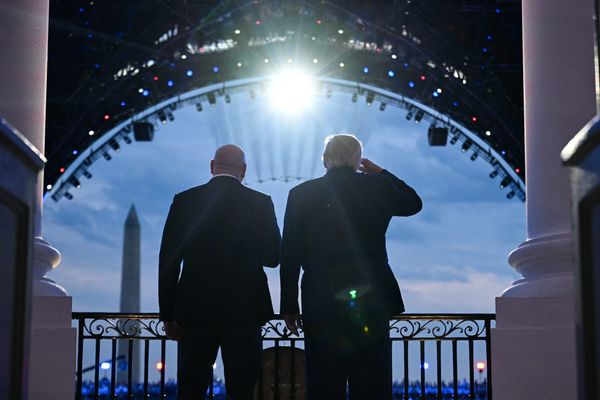
Donald Trump’s UFC fight at the White House is a sign of far-reaching changes in American culture and politics. To understand just how unthinkable this event would have been in a previous era, consider that John McCain once called for a ban on mixed martial arts, the combat sport practiced in the UFC. McCain represented an older, more genteel GOP. He disagreed with Trump not only about combat sports but about the standards of civility that should govern politics. He also believed that it was possible to lose with dignity, a belief Trump does not seem to share.
One figure who continues to espouse McCain’s view of politics is the conservative columnist George Will. For Will, baseball is the ideal metaphor for American politics. This is because even the best baseball teams lose about a third of the time, which makes baseball, like democracy, “a game that you can’t like if winning is everything.” Will also likes the fact that in baseball no one player—not even the pitcher—can dominate the action. Standing behind this appreciation is a republican ideal: that no one man should dominate society.
In all these ways, baseball stands in contrast to football, a sport in which one man—the quarterback—coordinates and disproportionately influences the action. It thus fits with the image of the imperial presidency that Americans have feared in figures from Andrew Jackson to Franklin Roosevelt to Donald Trump. It consists, in Will’s words, of “violence, punctuated by committee meetings”—a sport fit for a nation that carries out projects on a vast scale, projects that require not only the marshaling of resources and exercise of force but also specialized skill and expert management.
“Baseball is the sport of a bygone America.”
Baseball is the sport of a bygone America. It presents a pastoral ideal cherished by conservatives who celebrate bourgeois values such as fair play, the rule of law, and social equality. Football, by contrast, is the sport of American empire with managerial characteristics, so it is only fitting that it surpassed baseball in popularity in the decades after the World War II.
Now a different kind of sport is rising. Joe Rogan, a longtime UFC commentator, is the most popular podcaster in the world, and now, the president of the United States has hosted a UFC fight on the White House lawn. Though combat sports are far from displacing football in popularity, they now enjoy a political resonance that football lacks. This is because they express the energy of a new kind of politics embodied in the figure of Donald Trump.
At the outset of the White House fight broadcast, images of Abraham Lincoln and Franklin D. Roosevelt were intercut with scenes from UFC fights. The montage expressed a very Trumpian idea of the presidency. “There is a fighter’s mentality, whether you’re in the UFC, or whether you’re president,” Trump said in 2018. In the eyes of many, he exhibited that mentality in Butler, Pa., when he raised his fist after an assassination attempt and said “Fight! Fight! Fight!”
“The perception that Trump is a fighter has long been central to his appeal.”
The perception that Trump is a fighter has long been central to his appeal. At the Republican National Convention in 2016, UFC president Dana White endorsed this view. “I’ve been in the fight business my whole life. I know fighters,” White told the crowd. “Ladies and gentlemen, Donald Trump is a fighter, and I know he will fight for this country.”
Sports like MMA run counter to the notion of live-and-let-live. They are also an individual affair. If they are rising in popularity, then, it may be a sign that not only is the old bourgeois ethic embodied in baseball fading, but so is the postwar managerial imperialism embodied in football, with its array of highly specialized and carefully coordinated athletes. In this way, UFC at the White House fits with the broader populist rebellion against elite management of society.
Combat sports have long been seen as a way to challenge the establishment. It is no coincidence that Norman Mailer, who celebrated the rejection of conventional values in works such as “The White Negro,” adored boxing. Indeed, scholars have argued that boxing’s popularity in countries such as Cuba and Mexico has a distinct political resonance. If, as the historian Ilene O’Malley has written, “racist class oppression emasculated lower-class men,” then the demonstrative masculinity of combat sports can be seen as anti-imperial and revolutionary.
For this reason, left-wing leaders such as Fidel Castro embraced boxing as a way to assert national dignity. Trump is doing the same with MMA. He, too, sees himself as the leader of a people in need of vindication. He, too, associates national greatness with masculinity. The UFC fight on the White House lawn was a pure expression of Donald Trump’s agonistic and anti-elitist outlook. It was not bread and circuses, a distraction from politics. It was part of Trump’s very own American revolution.