


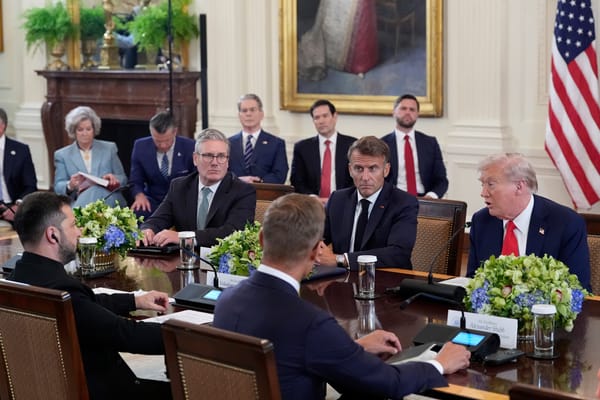
The new National Security Strategy document issued by the Trump administration has shocked in two ways. The first lies in its surprisingly dovish stance toward China. Those hoping for a grand strategy to confront the People’s Republic are thereby disappointed. The second shock lies in the brusque assessment of the existential risks facing Europe. According to the document, the continent faces the “stark prospect of civilizational erasure.”
These stances are connected. They come from the conviction that whatever challenges the United States faces from China in the 21st century, rerunning the paradigm of the Cold War, with the traditional European allies and China in lieu of the Soviet Union, is the wrong way to do it. Not only is this paradigm inadequate to grasping the nature of the challenge from China, it also is dependent on a coherent concept of Western civilization that no longer reflects existing conditions in Europe. About that much, the National Security Strategy is clear. Yet the real shocking part of it is that the conclusions it draws about Europe also apply to the United States.
For a president who rose to prominence by challenging bipartisan deference toward “Chyna,” dovishness seems like a major shift. But Trump’s challenge to China was primarily about reordering the rules governing trade relations in favor of American interests; he wasn’t going around arguing that the United States should defend Taiwan at all costs. And 2025 isn’t 2015. Formerly, presidential speeches would be rewritten to avoid offending the Chinese; now, politicians compete to tout their anti-China credentials. The official Washington paradigm for engagement with the world has shifted. It’s Cold War 2.0, and it’s easy to see the appeal. The Cold War paradigm gestures toward the last strategic success of the United States. In 30 years, nothing—neither the New World Order, nor the “indispensable nation,” nor the Global War on Terror, nor the “Asia Pivot” has supplanted it. Faced with new challenges that they did not anticipate, most policy planners look back to the world of their youth, idealizing the paradigm of those years and believing that we just need to apply the old playbook to a new situation.