


A quarter of a millennium ago, the New World declared its independence from the old one. This was not a matter of geography, but of society and history. This New World—the world of modern freedom—had been developing in the West for several centuries, but its historical trajectory was global from the beginning. By the later eighteenth century, the New World was everywhere demanding that the Old Regime of the West make way for it. All the ruling establishments—be it the parliamentary oligarchy in Britain, the tight-knit patriciate that governed Geneva, or the absolute monarchies of France and Austria—faced radical, reforming, and revolutionary movements. For all the differences between these movements, they shared common aims: that modern, bourgeois freedom should be given full scope to develop on its own terms, and that the state should be the servant of society, not its master. From the “Wilkes and Liberty” and parliamentary reform movements in Britain to the Volunteer Movement in Ireland, from the Genevan Revolution to the Patriot Revolt in the Netherlands, from the Brabant Revolution to the French Revolution, the bourgeois revolution reared its head. This revolution was waged for the New World of bourgeois society, not for the bourgeoisie. While it was defeated and thwarted almost everywhere, it made a spectacular breakthrough in a backwater of Western civilization, among the eastern seaboard colonies of British North America. And though the victory that the bourgeois revolution achieved there was fragile and tentative, it endured—and endures.
“America is not a country that had a revolution, but a revolution that has a country.”
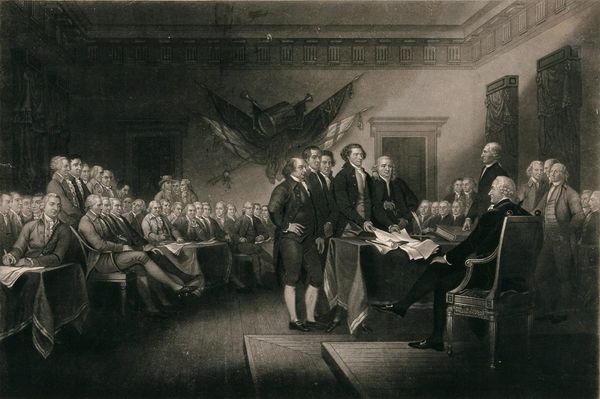
America is not a country that had a revolution, but a revolution that has a country. The revolutionary spirit of the modern, bourgeois world was crystallized in a document drafted by Thomas Jefferson, revised by the Committee of Five and the Second Continental Congress, and finally adopted by the Congress on the Fourth of July, 1776. Before paying “a decent respect to the opinions of mankind” by detailing the causes that compelled American independence, before proclaiming the right to political revolution that legitimized this independence, the Declaration announced a social revolution: “We hold these truths to be self-evident, that all men are created equal, that they are endowed by their Creator with certain unalienable Rights, that among these are Life, Liberty and the pursuit of Happiness. That to secure these rights, Governments are instituted among Men, deriving their just powers from the consent of the governed.” The very familiarity of these words obscures the social revolution they proclaimed.
The historical New World—the “commercial society” of Enlightenment thinkers and the “bourgeois society” (bürgerliche Gesellschaft) of Hegel and Marx—was one in which the freedom of all made possible the greater freedom of each, and the freedom of each contributed to the greater freedom of all. The Declaration’s unalienable rights are the rights of the society of free labor, of universal social cooperation based on the free exchange of labor and its products. In this society, human beings have no masters and set the course of their own existence (life and liberty); they are not prescribed the ends for which they live, but rather determine them in the midst of living (the pursuit of happiness). By proclaiming these self-evident truths, the Declaration made clear that a new society had come into existence and that it would brook no power outside of itself. In declaring the independence of the United States of America from Great Britain and its empire, the Revolutionaries declared the independence of this New World from the world as it was and had always been.
We do well to remember C. L. R. James’s remark that these “self-evident” truths were not self-evident anywhere in the world when the American Revolutionaries proclaimed them. Indeed, as Adam Smith observed in his lectures on jurisprudence in 1762 and 1763: “A small part of the West of Europe is the only portion of the globe that is free from slavery, and is nothing in comparison with the vast continents where it still prevails.” Even in Western Europe, where servile labor had come to an end in the late Middle Ages, a social and political order based on hereditary privileges and caste distinctions still prevailed. The commoners—the Third Estate of those who labored—were still subject to countless restrictions, degradations, and cruelties. And the truths declared in the French jurist Charles Loyseau’s A Treatise on Orders, written in 1610 and in wide circulation as late as 1789, were still a more apt description of social and political reality than those proclaimed by the American Revolutionaries in 1776: “Because we cannot live together in equality of condition, it is necessary that some command and others obey. Those who command have several orders, ranks, or degrees. Sovereign lords command all within their state, addressing their commands to the great; the great to the middling, the middling to the small, and the small to the people.” As Allan Ramsay, the Scottish intellectual and painter, close ally of George III and Lord North, and fierce critic of the American cause, argued in his 1769 Thoughts on the Origin and Nature of Government: “These are truths not drawn from sophistical reasoning, and juggling with ill-defined words; but from plain sense and observation. By an appeal to universal experience we may prove that the relation between master and servant is of natural and divine appointment, just as we should prove, if anybody were so senseless as to doubt it, that the sun and moon were so.” If one surveyed the Western world in 1776, it was Loyseau’s and Ramsay’s truths, not Jefferson’s, that would seem self-evident.
But Jefferson and his fellow Revolutionaries sensed that another order was possible, and it was this hope that received its fullest expression in the Declaration. With it, an armed rebellion of colonial settlers became an epoch-making event. In the words of the Great Seal of the United States, designed by the Irish immigrant and American Patriot Charles Thomson and adopted by the Confederation Congress in 1782, the Declaration heralded not only a separation from Great Britain but the dawn of “a new order of the ages” (novus ordo seclorum). The bourgeois revolution had created a country, establishing a bridgehead for the New World in its struggle with the Old Regime across the globe. “Far from remaining monarchical, hierarchy-ridden subjects on the margin of civilization, Americans had become, almost overnight,” Gordon Wood writes in The Radicalism of the American Revolution, “the most liberal, the most democratic, the most commercially minded, and the most modern people in the world.” They embraced bourgeois society, making the United States, as Theodor Adorno put it, “a radically bourgeois country.”
The Revolution and the radical causes that it gave rise to, including the anti-slavery movement, sought to recognize and guarantee the rights to life, liberty, and the pursuit of happiness. “All eyes are opened, or opening to the rights of man,” Jefferson wrote in 1826 to mark the fast approaching fiftieth anniversary of American independence. He was confident that the social revolution announced in the Declaration—“that the mass of mankind has not been born, with saddles on their backs, nor a favored few booted and spurred, ready to ride them legitimately, by the grace of God”—would spread across the globe, “to some parts sooner, to others later, but finally to all.”
The American Revolutionaries were practical utopians. They were able to go beyond the established social and political “truths” of their day because, contra Ramsay, they did not believe they were confirmed by “universal experience.” For, beneath the commanding heights of church and state in the eighteenth-century West, amid the hustle and bustle of everyday life, men and women were experiencing a new way of being in the world, one constituted by the social cooperation of free labor. It was this experience, and the profound sense of possibility that it engendered, that gave the signers of the Declaration the audacity to claim that their “truths” were self-evident, and, indeed, that they were the only basis for legitimate government and laws.
The mustard seed of this New World was planted in the later Middle Ages. As a cumulative effect of many developments—the urbanization of the High Middle Ages and the rise of self-governing communes, the crisis of feudalism and the collapse of serfdom during the fourteenth and fifteenth centuries, the Renaissance, the discovery of a direct maritime passage to Asia and of the Americas, the Reformation and the fracturing of Latin Christendom, and countless others—a vast zone of progressively free labor emerged in Western Europe. This world-historical jailbreak marked the advent of modern society. Freed from servitude, the members of the Third Estate brought into being a dynamic, commercial sociability over the course of the next three centuries. For a free laborer could only fully escape the chains of dependence and domination through peaceable and mutually beneficial cooperation with other free laborers. This social cooperation was much greater than the sum of its parts—leading to an ever-extending division of labor and an ever-expanding market that not only secured the freedom of labor but also made it dramatically more productive. In March 1776, four months before the Declaration of Independence was adopted, Adam Smith’s Wealth of Nations explained commercial society—bourgeois society—more clearly to itself than ever before.
Amid the free relations of daily life, the consciousness and rational capacities of the Third Estate developed and expanded. Through countless acts of self-determination, its members became increasingly capable of determining themselves, both individually and collectively. During the seventeenth and eighteenth centuries, this radical transformation of social being made possible a similar transformation of social consciousness—indeed, it engendered the consciousness of society itself. It was now possible to view humanity not as the product of divine or natural forces, but of society—of forces that humanity collectively creates over time. This process of “the self-creation of man” (Marx) took a dramatic turn with the rise of free labor. If obstacles and impediments to the universal cooperation of free labor were eliminated, it might be possible for society to govern itself. From Locke and Mandeville to Montesquieu and Rousseau to Smith and Kant, Enlightenment thinkers sought to clarify how those “born to be ruled” might live according to a law they give themselves, rather than receiving it from those “born to rule.”
To return to where we began: Throughout the West during the later eighteenth century, the New World of bourgeois society dramatically confronted the Old Regime. “The hour of revolution was at hand, promising freedom to conscience and dominion to intelligence,” George Bancroft wrote in the third volume of the History of the United States, “History, escaping from the dictates of authority and the jars of insulated interests, enters upon new and unthought of domains of culture and equality, the happier society where power springs freshly from ever renewed consent; the life and activity of a connected world.” Even in Britain, where the society of free labor had developed farther than anywhere else in Europe, where the Glorious Revolution had defenestrated absolute monarchy, and where Locke had most clearly conceptualized the independence of society from the political order, the spirit of the Old Regime prevailed in Westminster and Whitehall. As John Adams averred in his much read Dissertation on the Canon and Feudal Law, a series of four essays published in the Boston Gazette in 1765: “The canon and feudal systems, though greatly mutilated in England, are not yet destroyed. Like the temples and palaces in which the great contrivers of them once worshipped and inhabited, they exist in ruins; and much of the domineering spirit of them still remains.”
The constitutional order born in the 1688 Revolution settlement had ossified into a parliamentary and landed oligarchy happy to live off the fruits of bourgeois society while doing little to represent and advance its interests. During the 1760s and 1770s, radical movements emerged on both sides of the Atlantic to challenge this political establishment: in Britain itself, to demand stronger links between taxation and representation; in British North America, to prevent already strong links from being severed. In the face of these challenges, the British ruling class claimed their parliamentary regime was absolute and naturally ordained, issued general warrants, prosecuted John Wilkes, scoffed at proposals for reform as so much “sophistical reasoning,” and doubled down on their efforts in North America to raise revenue, sideline the colonial assemblies, and consolidate an imperial bureaucracy and military answerable only to them.
“Colonial American radicals faced greater peril.”
When the battle lines were finally drawn in 1774 and 1775, British radicals proved unwilling to take up arms, understandably refusing to risk the extensive freedoms they already enjoyed for new ones they might win. But colonial American radicals faced greater peril: the prospect of an unaccountable imperial state, capable of taking the fruits of their labor without their consent, commanded by a parliamentary oligarchy claiming absolute authority over them. But their fierce resolve to resist the new imperial policies, to take up arms against imperial authority, to continue in hostilities until their demands were met or they were defeated, and, finally, to declare independence, was born as much from hope as fear.
Anyone who has spent any time rummaging through the correspondence and publications of the political and intellectual leaders of colonial radicalism cannot help but notice the growing confidence with which they identified their struggle with the cause of humanity, and with which they believed the prospect of remaking the world was within reach. Such confidence is already present in Adams’s Dissertation, but it continued to grow year after year, reaching a fever pitch in January 1776 with the publication of Thomas Paine’s Common Sense: “We have it in our power to begin the world over again. A situation, similar to the present, hath not happened since the days of Noah until now.”
The ultimate source of this seemingly boundless confidence—of this firm belief that the New World would win out against the Old Regime—was the social experience of the free settlers in British North America. By the eve of the Revolution, they had undergone one of the most remarkable economic and demographic developments in recorded history. Although settler life was overwhelmingly agricultural, it was thoroughly commercialized. The dominant economic units, the family farms, were connected to networks of local, regional, and imperial trade. Due to the widespread availability of land and high degrees of social and economic mobility, a life of propertied independence was available for the many, not just the few. Artisans and craftsmen faced no guild restrictions and the high demand for their labor made them relatively prosperous and less dependent on the patronage of a wealthy elite. The colonial population ballooned from fewer than 200,000 on the eve of the eighteenth century to over two million by 1776. On the eastern seaboard, older cities like Philadelphia, New York, Boston, Providence, Newport and Charleston grew, while new backcountry towns sprang up to connect the western frontier to the coastal economy. The civil society among the free settlers in North America was more dynamic and expansive, and less burdened with elements of the Old Regime, than anywhere else. There were few feudal vestiges, no titled nobility, and no great religious establishments. The vast bureaucratic and military establishments of Europe were also absent. Widespread property ownership made for a remarkably inclusive electorate, with the majority of free adult males in all the colonies able to vote in elections for the lower houses of the assemblies.
In British North America, the realm of civil society—the realm of free social cooperation—existed without so many of the encumbrances and impositions that it suffered in Western Europe. Here, society clearly had primacy over the state. Here, the priority of the “social” to the “political” was self-evident. The experience of bourgeois freedom ran wider and deeper among the colonial settlers than elsewhere in the West. It was this experience that provided the surest foundation for the revolutionary hope that received its final form in the 1776 Declaration, wherein Jefferson and his co-signers proclaimed the independence of the New World from the Old.
The higher echelons of American culture—from elite media and universities to leading museums, art galleries, and publishers—have expressed a deep ambivalence about, and occasional hostility toward, the 250th anniversary of the American Revolution. Despite this, tomorrow people all over the world will celebrate the Declaration of Independence—some loudly, most quietly. They will do so because they know it is their declaration too. For the “electric cord in that Declaration” invoked by Abraham Lincoln in July 1858 is longer now than ever before as the society of free labor has expanded across the globe.
In that speech, Lincoln addressed the relationship between recent immigrants to the United States and the annual celebrations of the Fourth of July. What he said then might now be said of people the world over: “If they look back through this history to trace their connection with those days by blood, they find they have none, they cannot carry themselves back into that glorious epoch and make themselves feel that they are part of us, but when they look through that old Declaration of Independence they find that those old men say that ‘We hold these truths to be self-evident, that all men are created equal,’ and then they feel that that moral sentiment taught in that day evidences their relation to those men, that it is the father of all moral principle in them, and that they have a right to claim it as though they were blood of the blood, and flesh of the flesh of the men who wrote that Declaration, and so they are. That is the electric cord in that Declaration that links the hearts of patriotic and liberty-loving men together, that will link those patriotic hearts as long as the love of freedom exists in the minds of men throughout the world.” That electric cord may be badly frayed, but it remains unbroken. Two hundred and fifty years on, people all over the world will honor their Declaration of Independence.