


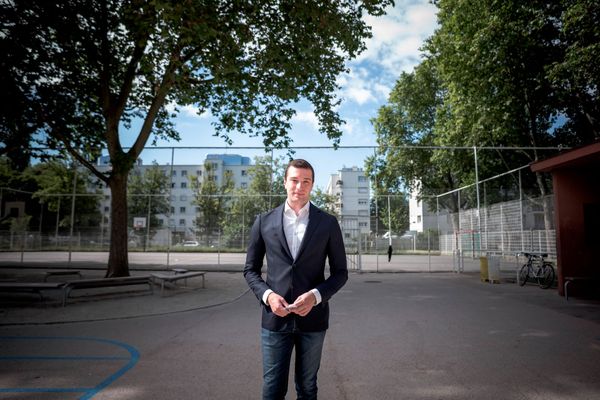
Worldly American liberals have at least one thing in common with the French far right: They love French destinations that are quaint, traditional, and relatively unaffected by globalization and immigration. Recent travel stories in The New York Times, for instance, sing the praises of Provence, the French Riviera, and Normandy. Rural life and regional uniqueness are fine if savored on vacations, even if locals who champion such things are dismissed as xenophobes. The American Francophile’s distorted picture of the country is part of why Jordan Bardella, the far-right politician who could be France’s next president, is an enigma on this side of the Atlantic.
Were he to win the 2027 election, Bardella could become president at thirty-one. (He leads current polls, though whether he runs depends on the legal fate of Marine Le Pen, who is currently appealing a corruption conviction that could prevent her from being the National Rally’s candidate next year). His popularity is closely tied to his mastery of social media. His squeaky-clean persona is a triumph of political marketing, and a further indication of Marine Le Pen’s success at “de-demonizing” the National Rally. But Bardella is also the product of a distinct political topography that, as Macron’s arrogant centrism enters its death spiral, may heighten his appeal.
Even more important than Bardella’s youth and media savvy is his background. He hails not from a picturesque province or a charming city, but from a gritty suburb. His name is not French, but a globalized mess: part Italian, part American. Bardella’s France is very different from the country known to most French elites. To understand him, one must map his identity, emphasizing the unfamiliar spaces in which it was forged.
The first place to which one must look to understand Bardella’s identity is Italy. His mother, Luisa Bartelli, was born in Nichelino, southwest of Turin, in 1962. His mother’s memories of the region, Bardella explains in his 2024 autobiography Ce que je cherche, was not of the “vast expanses of plains and hills bordering on the Alps,” but of “factories as far as the eye could see, factories belonging to the Fiat empire, and the gray suburbs of the triangolo industriale.” Bardella’s grandmother, Iolanda, who hailed from Abruzzo, the mountainous region near Rome, had a job sorting old clothes, deciding which could be resold. His grandfather, Severino, worked as a standards inspector for Carrozzeria Bertone, a company that, in 1966, helped design the first Lamborghini. Shortly after Luisa’s birth, the family moved to France, settling in the working-class city of Saint-Denis, just north of Paris.
In Bardella’s telling, his Italian grandparents chose to live in France because of its thriving postwar economy. For them, it was a “land of growth and hope,” and a way to flee the “precariousness and harshness of their lives.” Their relocation occurred under the auspices of the 1947 Franco-Italian migration agreements. After the war, the two former enemies found themselves in opposite economic situations: Italy was experiencing high unemployment, while France faced a labor shortage. The agreement provided for Italian farm and industrial laborers to immigrate to France at a rate of 17,000 a month. They were recruited by offices in Italy, which also administered (with the help of French authorities) medical and occupational tests. France’s National Immigration Office, created in 1945 to supervise recruitment of foreign labor, covered Italian migrants’ travel and lodging. Unions were kept in the loop, and employers were strictly forbidden from recruiting workers directly.
Bardella’s family was among the last Italians to settle in France under the 1947 agreement. Upon arrival, the French state offered them lodgings consisting of “a bedroom, a basin serving as a bathroom, and communal toilets in the courtyard.” His grandfather became a construction worker, while his grandmother worked for the city government as a cleaning lady in the local schools. They eventually became citizens.
Bardella, the French nationalist, proudly identifies with one of France’s largest immigrant populations. Between the late nineteenth century and the First World War, some 1.8 million Italians emigrated to France (around the same time as many of them also came to the United States). It is estimated that several million French citizens have Italian roots. Although some Italian immigrants in France tried to cling to their identity, on the whole, they generally assimilated, facilitated by similar cultures and languages. Jean Cocteau once remarked that “Italians are good-tempered Frenchmen.” Nor has a shared fondness for food done any harm. Bardella never misses an occasion to declare his love of Italian cuisine. Most of his countrymen feel similarly. After the Americans, the French eat more pizza than any other nation. You haven’t lived until you’ve had that French specialty, a pizza with a sunny-side-up egg on it.
In Bardella’s telling, his family story exemplifies immigration properly done. In 1945, Charles de Gaulle stated that France’s immigration policy should seek to attract “positive elements.” And what better examples of such immigrants, Bardella implies, than his own relatives? His grandparents “rebuilt their lives, without in any way renouncing their origins, embracing a prosperous France that gave them a chance.”
“In Bardella’s telling, his family story exemplifies immigration properly done.”
Using a strategy that is only superficially paradoxical, Bardella leans heavily into his Italian heritage when explaining his concerns about the threats to French identity. He notes that his father, Olivier Bardella, was born in another industrial suburb to Guerino, a southern Italian, and a mother of Kabyle and French Alsatian origin (about whom Bardella has less to say). Guerino worked as a driller on construction sites in the Middle East and North Africa, including the Hassan II Mosque in Morocco. When Bardella was a child, his father took him to Morocco to meet his grandfather. His grandfather would talk about why he no longer lived in France: “France has changed a lot. I no longer recognize this country. There’s nothing but disorder, tension, aggression, and the sense of filth when you go to [certain neighborhoods]. I miss France, but I don’t want to go back.” This quote perfectly captures the current National Rally’s complex politics: An Italian-born worker who doesn’t want to leave a job in Morocco to go back to France is cited as an ideal witness to the loss of French identity and security due to mass immigration.
Bardella’s second defining characteristic is the fact that he is a banlieusard. Though the term translates as a “suburbanite,” the connotations of the American idea of “suburbanite” is the inverse of banlieusard: The former suggests white middle-class comfort, the latter a cramped, not-so-white working-class existence.
Bardella grew up not just in any suburb, but specifically in Saint-Denis, a city with a population of about 150,000 located just north of the Paris city limit. The town is the home to the Basilica of Saint-Denis, where all of France’s kings were buried going back to the Middle Ages. Its other major monument is the Stade de France, the enormous stadium built in the late 1990s for France’s national soccer team. Saint-Denis thus represents two poles of French identity: on the one hand, the deep historical connection between monarchy and Catholicism, which made France the “eldest daughter of the Church”; on the other hand, a country whose character in the sports realm is defined by teams reflecting how the French population has been transformed by the experience of colonialism and immigration, as reflected in the “Black-Blanc-Beur” (Black-White-Arab) team that won the 1998 World Cup.
Though the basilica remains a significant monument, Saint-Denis in recent times is best known for its working-class population. Bardella notes that the monument loomed over his grandparents’ modest dwellings. Beginning in the nineteenth century, the region underwent significant industrialization. Paris’s suburbs were home to many factories. The working-class communities that there gave rise to the so-called “red belt” (ceinture rouge), the circle of municipalities with socialist and communist mayors in the city’s immediate suburbs. One mayor of Saint-Denis was Jacques Doriot, a communist politician who, after embracing a left-leaning variant of fascism, became a notorious collaborator during the German Occupation. Bardella likes calling attention to his family’s ties to local communists. His grandfather was friends with Auguste Gillot, a laborer and anti-German resistance member who was the communist mayor of Saint-Denis from 1944 to 1971. When his mother needed help finding public housing, she reached out to a communist town councilor.
Though Bardella waxes nostalgic about them, the working-class communities surrounding Paris were once a source of considerable social anxiety among the city’s well-heeled inhabitants. Those fears have given way to new ones, centered on the new wave of immigrants that have arrived in the banlieues in recent decades. While the French state is forbidden from collecting data on ethnicity, the spotty data that is available suggests that Saint-Denis’ North African population is around 18 percent. Some of this immigration began as part of the same movement that brought Bardella’s grandparents to France in the postwar years. In 1974, the French government, faced with high levels of unemployment resulting from the economic crisis, officially ended labor migration to France. Yet in 1976, the government agreed to a significant exception to this decision, granting legal immigrants the right to bring their spouses and children to France. The “family reunification” policy led to the rapid growth of North African populations in Saint-Denis. The Seine-Saint-Denis department, the administrative subdivision in which Saint-Denis is located, notes on its website that it “has the highest proportion of immigrants (30 percent of the population) of all the départements of mainland France,” representing 130 nationalities.
Immigration was arguably the decisive factor in Bardella’s political formation. In Saint-Denis, he grew up in a cité, the name the French give to the modernist public housing projects that are common in the suburbs, and which are home to many populations of immigrant origin. After his parents divorced, he lived with his mother in a small apartment in a cité. He remembers stairwells covered in graffiti and recalls that when he came home from school, he found junkies convulsing in the hallway. The projects were full of drug dealers, who, over time, became increasingly brazen. Bardella and his mother developed a system in which whoever got home first texted the other so that they could quickly open the apartment door and double bolt it after the other entered.
His neighborhood also offered him a vantage point from which to observe the rise of radical Islam. Early one morning in 2015, he recalls, he woke up to a terrifying noise, rushed to his window, and saw a helicopter hovering over the neighborhood, bathing it in intense light. Days after a massive terrorist attack that had killed 130 people (notably at the Bataclan concert venue), the police had located the perpetrators and were zeroing in on a street a short distance from Bardella’s home.
Bardella emphasizes his roots in the quatre-vingt treize—or “93,” as the Seine-Saint-Denis is commonly referred to, after the administrative number assigned to the department. This move is striking because Seine-Saint-Denis has become so closely associated with French youth of African and North African origins. It is, for instance, one of the capitals of the French hip-hop scene. A young rapper from the “93” who performs as JKSN recently reflected on his home in a song: “I eat, I sleep Seine-Saint-Denis / I think Seine-Saint-Denis / the Seine-Saint-Denis mentality / I’m gonna die in Seine-Saint-Denis.”
“Bardella at once bemoans the loss of French identity and affirms his modernity.”
With his appeals to his origins, Bardella at once bemoans the loss of French identity and affirms his modernity. Bardella describes Saint-Denis as the “paradoxical paradise” of his childhood, which, “despite its reputation and that violent atmosphere that prevails there, he cannot manage to hate.” At the same time, he recognizes that his town “captures part of our society’s ills”: ghettoization, “the loss of our identity, violence, drug dealing … and Islamic terrorism.” As a politician, Bardella plays on his identity as a working-class son of immigrants who grew up in the “93” while giving voice to popular outrage at what his hometown has become.
French people aren’t supposed to be called “Jordan.” Unlike in the United States, France has historically defined which first names are legally allowed. A law from the revolutionary period limits first names to those derived from various calendars—notably the Catholic saint or feast days—and ancient mythology. Though the law was liberalized in 1966 and 1981, it still gave civil servants the right to refuse to register certain first names if it was in the child’s interest—for instance, if the name would expose the child to ridicule. When French people would explain this policy to me, they would always tell me that it made sure that parents wouldn’t name their children “refrigerator.” The first-name policy mirrors the legal justifications of French bans on religious symbols in schools: both are conceived as protecting children from the arbitrary whims of their parents.
Not many French people are called “refrigerator,” but during the 1990s, a new naming trend did emerge: French parents started giving their kids American names. Between 1989 and 1996, the top male name for newborns was Kevin—an Irish name with zero French roots. Other popular names were Cindy, Jennifer, Dylan—and Jordan, given to 13 percent of French babies born in 1992 and 1993. This trend was the result of the globalization of entertainment and declining traditional norms. Kevin Costner may have lost much of his relevance in the United States, but a generation of French men in their late 20s and early 30s are forever bound to him.
“American names” also carry considerable stigma. The French people who named their children Kevin or Cindy were usually from working-class backgrounds, and such names are looked down on as beauf—a French slur that literally means “brother-in-law,” but which has roughly the same connotation as “redneck.” An article from the magazine Le Point called “The Curse of the Kevins” quotes one of these unfortunate Frenchmen: “A Kevin isn’t allowed to be an intellectual. He can be a bodybuilding trainer, a printer salesman, a store manager. But an intellectual? Never.” In a recent documentary entitled “Save the Kevins,” one of the latter explains that “a recruiting agency advised me not to put the first name Kevin on my CV and to change my identity.”
“By his own account, Bardella gets a lot of crap for his first name.”
By his own account, Bardella gets a lot of crap for his first name. He recalls a fellow activist saying: “Seriously? You’re really called Jordan?” His mother told him that she and her father could not agree on an Italian name, so they settled for Jordan because it was popular at the time. Bardella wonders if they were inspired by “Beverly Hills 90210,” the TV show. Being called Jordan has made it impossible to hide his class identity. But like the boy named Sue in the Johnny Cash song, Bardella realized that it was essential that he “turn ‘Jordan’ into a strength.”
While his first name ties Bardella to a disorienting effect of globalization and highlights his working-class background, it also connects him to a hot button issue: the debate over “French names.” Éric Zemmour, a politician who has tried to outflank the National Rally on its right, favors banning foreign names, declaring “first names are France.” Like Bardella, Zemmour has immigrant origins: He comes from a family of North African Jews, and also grew up in the Seine-Saint-Denis. Zemmour is opposed to recognizing Muslim names while also criticizing the practice of allowing American ones.
Bardella claims that Zemmour shows a “misunderstanding of working-class milieus” and that is a “reductive” to turn the saints’ calendar into a measure of Frenchness. He argues that there is a difference between “Jordan,” which signifies social class, and Mohammed or Ibrahim—two of the most popular names in the Seine-Saint-Denis—which are “religious.” Yet without reneging on his position that Islam threatens French identity, he discreetly empathizes with a form of stigmatization that French Muslims share. Bardella muses: “In a political world filled with Arthurs, Charles, François, and Donatiens hailing from traditional backgrounds, I felt far away from the first names I heard in Saint-Denis during my first twenty years.” It is a stance consistent with the National Rally’s recent efforts to prioritize assimilation and make a distinction between law-abiding French Muslims and radical Islam.
Bardella’s social and geographic background does not, of course, fully define him. Some point out that, growing up, he lived part of the time with his father, a small business owner residing in a posh suburb who paid for his son to attend a private Catholic school. Nor should his origins detract from the political connections he has forged. When he was eighteen, Bardella met Jean-Marie Le Pen, the hard-right, Holocaust-denying founder of the National Front, which later became the National Rally under the leadership of his daughter Marine.
Around the same time he started becoming politically active, Bardella began dating the daughter of Frédéric Chatillon, who in the 1990s had led the Groupe Union Défense (Group Union Defense), a student organization on the outer fringes of the far right. Bardella also dated Marine Le Pen’s niece. While the National Rally has long had a dynastic quality, Bardella’s current girlfriend, Maria Carolina, hails from a non-metaphorical dynasty: she is the scion of the House of the Bourbon Two-Sicilies, the branch of the French royal family that ruled southern Italy until unification. Since dropping out of college, he has worked exclusively for the National Rally. Other than part-time work with his father’s company, it’s the only job he has ever had.
Bardella, who did not respond to my requests for comment, is an unusual member of the French political class. If elected, he would not only be France’s youngest president and the first from a far-right party, but also the first real banlieusard, the first to have grown up in public housing, and the first without a university degree. If he is elected, it will surely trigger an avalanche of handwringing about the rise of populism, the far right, racism, and intolerance. But it will also mark the political advent of a different France, one still unfamiliar to most observers abroad.