


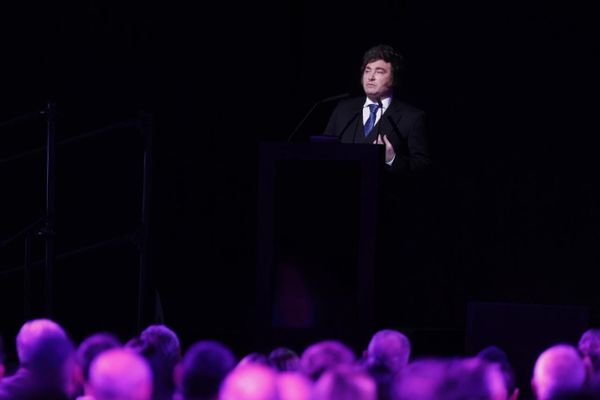
On June 3, Argentine President Javier Milei published an op-ed in the Financial Times under the title “Argentina Invites AI to Free Itself.” The article announced, among other things, a proposal for a new legal category of “non-human corporations”—that is, companies “operated by AI agents or robots.” This innovation, Milei argued, could be as transformative as the 1602 invention of the limited liability corporation in the form of the Dutch East India Company. “Let Buenos Aires be for AI what Amsterdam was for the age of sail,” he declared.
Milei’s op-ed is the latest sign of the South American nation’s transformation under its libertarian president, a change also visible in the tech investor Peter Thiel’s recent arrival in the country. Milei was elected to stabilize a country in decline, but it is now clear that his significance and ambitions extend well beyond Argentina’s borders.
Historically, Argentina has been associated with state intervention, powerful labor unions, mass politics, and left-wing radicalism. It was the homeland of Juan and Eva Perón and the birthplace of Che Guevara; less well known is the fact that the original funding that helped establish the Institute for Social Research in Frankfurt—the future Frankfurt School—came from the fortune of Félix Weil, the son of a German-Jewish grain merchant who made his wealth in Argentina. More recently, the most prominent Argentine on the world stage was Pope Francis, who in texts such as Laudato Si’ offered a thoroughgoing critique of the power of finance and the valorization of technology.
The symbolism of Milei’s enterprise is therefore impossible to ignore. If Argentina made an outsized contribution to global politics in the twentieth century, under its new president it is positioning itself to do so once again, pushing in the opposite direction.
Before coming to power, Milei began cultivating relationships with leaders of the emerging global right. Brazil’s former president, Jair Bolsonaro, was one of the first figures with whom he established political affinities. Santiago Abascal, leader of the right-wing Vox party in Spain, supported him when he was still viewed as a marginal figure. Once in office, Milei invited Viktor Orbán to his inauguration, developed a close relationship with Giorgia Meloni, and openly bet on Donald Trump’s return to the White House, even while Joe Biden remained president of the United States.
“These were risky moves.”
These were risky moves. Argentina depends on assistance from the International Monetary Fund, which makes good relations with Washington essential. Likewise, Milei’s ideological alignment with Bolsonaro strained relations with Brazil, Argentina’s main trading partner, now governed by Luiz Inácio Lula da Silva. During the presidential campaign, Milei also stated that he would never trade with “communists,” despite the fact that the People’s Republic of China is one of Argentina’s most important trading partners. Milei appeared willing to sacrifice commercial pragmatism in the name of a new ideological identity.
Another element of Milei’s international strategy is his strong connection with Israel. Argentina hosts the largest Jewish community in Latin America and has maintained a historically close relationship with the Jewish state. Juan Perón himself recognized the newly created state early on, and there was even a meeting between Eva Perón and Golda Meir in which the future Israeli prime minister expressed gratitude for Argentina’s support. Milei has taken that relationship to an unprecedented level by visiting Israel, developing a personal relationship with Benjamin Netanyahu, and making support for the country a central component of his identity.
Milei is often grouped together with Trump, Orbán, Meloni, Bukele, Bolsonaro, and Abascal, but the policy differences among them are significant. Whereas several of these leaders have sought to reinforce national sovereignty and rebuild state capacity, Milei came to power declaring: “I am the mole who comes to destroy the state from within.” What unites these actors is a shared enemy: the political consensus that dominated the West after the end of the Cold War. But Milei evidently isn’t satisfied with a purely oppositional role. Instead, he is attempting to turn his country into a laboratory for new possibilities.
For decades, Argentina was presented as a case study in economic decline and political dysfunction. A quip often attributed to Nobel Prize-winning economist Simon Kuznets held that there were four kinds of countries: developed countries, underdeveloped countries, Japan, and Argentina. The joke captured a long-standing sense of Argentine negative exceptionalism.
Under Milei, however, Argentina has become more than a mid-sized economy struggling to stabilize itself. It appears as a test: a large-scale social experiment intended to demonstrate whether a radical libertarian revolution can construct a new form of political legitimacy.
The growing attention Argentina attracts from technology entrepreneurs, investors, lobbyists, and intellectual circles associated with the American right must be understood in this context. What interests these actors is not merely Argentina’s economic potential but what the country has come to represent: an opportunity to help shape a government attempting to translate the ideas, aspirations, and critiques of the emerging right into political reality.
This is the context for Milei’s Financial Times op-ed and the new AI framework it announced. Milei argued that the countries that prosper in the age of artificial intelligence will be those capable of adapting their legal and institutional frameworks to the pace of technological change.
Behind the discussion of artificial intelligence lies a broader ambition. Milei is not merely proposing a different regulatory framework, but advancing a different vision of Argentina itself: a frontier society where new technologies, new institutions, and new forms of economic organization can be tested before they are adopted elsewhere. Rather than trying to align itself with the world as it is, Milei’s Argentina is trying to accelerate toward the world to come.
“Milei’s Argentina is trying to accelerate toward the world to come.”
Throughout much of the past century, Argentina oscillated between different strategies of international integration. Some governments sought integration into the globalized world through trade, while others sought to shield the country’s interests through protectionist policies. Milei is proposing something different: transforming Argentina into a node within an emerging international coalition of political leaders, investors, technologists, and intellectuals experimenting with alternatives to the existing order.
The interest Milei generates stems less from what he has achieved than from what he represents: the idea that Argentina could become a sanctuary for capitalism in a world riven by crisis and uncertainty. His gambit is that the template for an emerging new global order may come not from the center but from the periphery of the international system.