


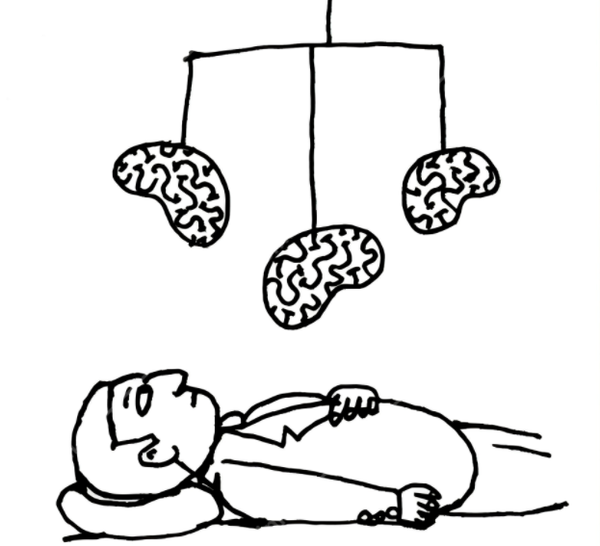
All in Your Head: Illness as Identity, Trauma as Fashion, and the Desire to be Disordered
By Fredrik DeBoer
Simon & Schuster, 336 pages, $30
Traumatized: The New Politics of Public Suffering
By Catherine Liu
Verso, 192 pages, $24.95
More than a decade ago, I noticed that the walls at the university where I taught were plastered with posters designed to raise “awareness” about mental health. When students began to tell me that they were passionate about mental health, I began to suspect that the word was taking on new meanings. But it wasn’t until one passed me a leaflet in the foyer unhelpfully informing me that one in four people suffer from “mental health” that I understood what was happening. Somewhere along the way, the boundaries between mental health and mental illness had become blurred until the former meant the latter.
Two new books, Fredrik deBoer’s All in Your Head and Catherine Liu’s Traumatized, draw attention to one of the strangest achievements of contemporary therapy culture. Even as psychological suffering has become more visible, it has become increasingly difficult to speak bluntly about its degrees, causes, and uneven spread. Everything becomes curiously melded together and flattened out. Hence, when the British royals set out some years ago to inform everyone that “we all have mental health,” no one should have mistaken what that meant. Mental health is a continuum or spectrum, we are often told, and somewhere along it sit students with exam stress and people convinced their neighbors are poisoning their water. Everyone is in some sense ill.
Well, not everyone. Even as we are all being told we belong somewhere on the “mental health” spectrum, the World Health Organization is calling for an end to “coercive practices in mental health.” The UN Disability Committee is urging states to pursue “the abolition of substitute decision-making regimes” in favor of “supported” alternatives for those we once called “mentally ill,” but who are now variously “people with mental health conditions” or “psychosocial disabilities.” These are people whose suffering often expressly means they are unable to make decisions for themselves. The rest of us are presumed fragile, but the psychotic is increasingly presumed sovereign. As deBoer writes, it has become “our transcendent obligation to pretend that a man in the grip of psychosis [is] somehow still free.”
DeBoer and Liu both show that attempts to flatten out the experience of suffering, disability, and mental illness fail to accomplish their purported aims, such as “destigmatizing” and expanding access to care. This is because reality, whether in the form of the severity of impairment or of social class, eventually asserts itself, with the consequences falling on those least able to bear them.