


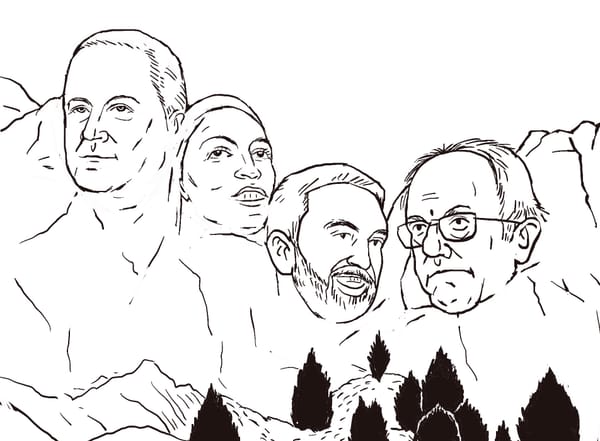
Liberal and conservative commentators have rushed to downplay the importance of democratic socialist Zohran Mamdani’s stunning victory in the New York City mayoral election. “The odds are that Mamdani’s victory is actually less significant than you think,” declared New York Times columnist Ross Douthat. The Third Way, a Washington thinktank, urged “Democrats at all levels to resist the pressure to align with Mamdani’s politics and agenda.” And my sometime co-author Ruy Teixeira, writing in The Liberal Patriot, went further and declared the seeming triumph of the left an illusion. “The left’s 21st century project has failed,” he wrote.
I’ll grant that in 2028, Democrats should recognize that a politics and a persona that wins voters in New York City or in Seattle, where socialist Katie Wilson was elected mayor, may not play as well in York, Pa. or Green Bay, Wis. But for all its limitations, the Democrats’ left wing is now the principal source of the party’s energy and ideas. After Donald Trump passes from the scene, the battle for the nation’s political future could as well be fought between the Democratic left and the Republican right, with the centrists from the Third Way watching from the sidelines.
Teixeira, who is the most dismissive of the American left’s accomplishments, traces its trajectory and fall over the last 125 years:
The 20th century encompassed the era of social democracy followed by an attempt to resurrect the left through the Third Way after that era’s ignominious end. In the 21st century, the left embarked on a new project they hoped would remedy 20th century weaknesses and inaugurate a new era of political and governance success.
“The American left, by any reasonable measure, has enjoyed a revival in this century.”
This project, he contends, “has failed and failed badly.” He cites, among other things, its failures “to stop the rise of rightwing populism,” to “retain its working-class base,” and to “create durable electoral majorities.” This history identifies the left with the Democratic Party, and that party’s rise and fall in the 20th century with that of social democracy. But in fact, the American left, by any reasonable measure, has enjoyed a revival in this century after having been dormant for much of the last century.
The Socialist Party of America enjoyed fleeting success in the first decades of the 20th century, reaching its high point when its presidential candidate Eugene Debs won 6 percent of the vote. But in the end, Debs’s revolutionary vision had attracted far less support than the reformist platforms of the Republican and Democratic progressives of the era. The only segment of the Socialist Party that enjoyed success after World War I was Victor Berger’s Milwaukee’s “Sewer Socialists,” who campaigned and governed on the promise of reform rather than revolution.
The Communist Party, which split off from the Socialist Party after World War I, operated largely as a clandestine force rather than a viable electoral project. And by identifying socialism with Soviet totalitarianism, Communists discredited socialism among most Americans. In the 1960s, some on the New Left that emerged from the civil rights and anti-war movements embraced socialism, but the movement failed to cohere, and dissipated by the early 1970s.
Even if one broadens the definition of the left to include those moments when the Democratic Party was able to shift the balance of wealth and power in the country to benefit the working class—the reforms of the Second New Deal in 1935-36 and Lyndon Johnson’s championing of civil rights legislation and Medicare in 1964-65—success was fleeting, as Jefferson Cowie has argued in The Great Exception. There were repeated attempts on the party’s left to advance further reforms, but they were repelled. The climax came during the Carter administration, when multiple attempts at reform (directed at labor law, consumer protection, campaign finance, hospital cost containment, and capital gains tax rates) were defeated in Congress, and when Edward Kennedy’s primary challenge was defeated in 1980.
In Europe, by contrast, left-wing parties wielded considerable power and influence. Even in the 1930s, when fascism and Nazism were on the rise, socialists briefly held power in France. After World War II, European socialist and social-democratic parties, buoyed by powerful labor movements, ran governments, and even when out of power, exercised decisive influence over them. They were able to build far more egalitarian societies than that of the United States.
In Europe, it is possible to speak of an “arc of social democracy,” but in the United States, there was not an arc, but only moments of influence. The Third Way of Bill Clinton and the Democratic Leadership Council, which Teixeira describes as an attempt to “resurrect the left,” was in fact an attempt to marginalize it. Through the Third Way, Clinton sought to find a middle ground between what the DLC called “liberal fundamentalism” and Reaganite conservatism. He achieved this aim. Although some Democratic centrists object to the term, both Clinton’s and later Barack Obama’s administrations were part of the arc of neoliberalism.
If anything, this century has seen the first glimmers of an American left after its embers flickered and died out earlier in the 20th century. There was the rise of the Occupy movement in 2011, followed by Bernie Sanders’s presidential campaigns of 2016 and 2020 and the victory of Alexandria Ocasio-Cortez in 2018. It is within the realm of possibility that Sanders, had he won the nomination in either of those campaigns, could have been elected president. Now, self-described democratic socialists have won mayoralty elections in New York City and Seattle. These kinds of results were inconceivable for most of the elections that took place between World War I and the early 2010s, and certainly during the decades after World War II.
More broadly, the Democratic Party now has an increasingly strong left wing that supports strengthening labor and public interest organizations, checking corporate power through stronger government regulation (particularly in the wake of Trump's evisceration of agencies like the EPA), expanding public control of and access to health care, reforming the regressive tax code, instituting public financing of campaigns, and shaping private investment for the public interest.
Democrats who champion these measures include Elizabeth Warren, Jeff Merkley, Tammy Baldwin, Ro Khanna, and Jamie Raskin. In the House, membership in the Progressive Caucus has risen from 60 in 2008 to 96 today—almost half of the party’s House representation. Although these politicians identify as “progressives” rather than socialists, their politics jibes with Sanders' and Ocasio-Cortez’s democratic socialism. In my 2020 book, The Socialist Awakening, I call them “shadow socialists.” They represent a significant leftward turn in American politics.
What has driven this surprising upsurge of socialist and progressive politics? There is an obvious reason why politicians like Sanders and Mamdani can say they are socialists without risking certain defeat. The end of the Cold War ended and the dissolution of the Soviet Union and empire in 1989 weakened the identification of socialism with communist totalitarianism. The identification of socialism with communism persists among many older Americans, especially among Latinos who identify socialism with its Cuban or Venezuelan varieties. But among younger Americans born after the Cold War’s end, and among minorities, many of whom were skeptical of Cold War appeals, a rising share approves of socialism while disapproving of capitalism. In an extensive poll conducted by the Cato Institute this year, 43 percent of respondents had a favorable view of socialism, but the numbers were much higher among the young. Among 18- to 29-year-olds, 62 percent had a favorable view of socialism. In addition, 67 percent of blacks were favorably disposed, along with 62 percent of Asians and 56 percent of those who live in big cities.
This higher approval of socialism, or even its mere acceptance as an alternative, might not have occurred if the politicians on the left had not begun redefining socialism along the lines of European social democracy and as an extension of Franklin Roosevelt's New Deal. In the wake of his election to Congress in 1990, Sanders branded himself as a “Swedish-style socialist.” And during his presidential bids, he identified democratic socialism as the realization of Franklin Roosevelt’s Four Freedoms. That wasn’t an abdication of socialism, but a course correction that rejected utopian dreams in favor of what was realistically possible.
“Mamdani cited the precedent of Milwaukee’s municipal ‘sewer socialism’ during his campaign.”
On the fringes of the American left, there are still groupuscules that echo the Marxism-Leninism and Maoism of the New Left. In the DSA, there are “communist” caucuses. Former Seattle city councilwoman Kshama Sawant, who is running for Congress as a member of the Revolutionary Workers Party, has denounced Mamdani for his moderation. But beginning with Sanders, politicians who have run successfully as socialists have identified it with something that happens within capitalism the way that capitalism itself developed within feudalism rather than as something that comes only after capitalism has been eliminated by a revolution. Mamdani cited the precedent of Milwaukee’s municipal “sewer socialism” during his campaign.
The ferment that produced this new socialist or progressive left didn’t occur until the new century. During the 1990s tech boom, there was little interest in socialism. During his first two decades in politics, Sanders was seen as an eccentric gadfly. But in the 2000s, the dotcom crash followed by the Great Recession, the effects of which lingered well into the 2010s, created skepticism about the benefits of capitalism, particularly among the young. That opened the way to the emergence of socialism as a credible alternative. More broadly, the recession and its fallout shattered faith among many policymakers and voters about the benefits of the free-market model that Ronald Reagan and his successors—including Clinton and Obama—championed.
The fall of market liberalism buoyed a socialist tendency in the Democratic Party that emerged fully in Sanders’s first presidential campaign. By loudly rejecting the taboo against active government intervention in the market, Sanders opened the way for a leftwing politics that saw government as a means to boost social programs, reduce inequality, and direct private investment to worthy social objectives, such as reducing the pace of climate change.
But growing disbelief in market liberalism also led to the rise of Donald Trump and the MAGA movement, a Republican politics that aimed to stem the flow of foreign labor and that advocated government intervention to make American industry competitive again. Sanders and Trump were, in this sense, two sides of the same coin. The rise of right-wing populism was due not to the failure of the Democratic left, as Teixeira claims, but to the failure of both the Republican and Democratic varieties of market liberalism.
Critics of the left often fault it for, as Teixeira puts it, failing to “retain its working-class base.” This point certainly applies to the Democratic Party, as he and I argued in our co-written book Where Have All the Democrats Gone? But in relation to the history of the American left, there are two different questions buried in this assertion. The first is whether—and if so, when—the left had a working-class base; the second is who belongs to the working class in modern American capitalism.
The Marxist view of socialism, shared by the pre-World War I leadership of American and European socialist parties, was that the industrial working class, employed in factories and organized into unions and socialist parties, would expand exponentially and eventually overwhelm a small capitalist class that controlled finance and goods production. But instead, beginning early in the 20th century, the ranks of service and white-collar workers, some of them also employed in goods production, swelled to the extent that they dwarfed the numbers of blue-collar industrial workers.
Some of the white-collar workers held routine clerical or sales jobs. But others performed complex skills that required higher education. The latter were described in labor statistics as professionals and technicians. Management consultant Peter Drucker described them as “knowledge workers.” Over the last half century, this group has grown to be about a fifth of the labor force, greater in number than blue-collar workers. The number of professionals and technicians is expected to grow by 10.5 percent between 2023 and 2033—more than double the rate of the overall wage and salary force.
As a rule, knowledge workers possess more flexibility in their jobs than blue-collar or clerical workers and they may also exercise authority over other workers, but over the last decades, they have suffered from a process sometimes called “proletarianization,” in which they have gradually lost autonomy and authority. That promises to continue, and even to accelerate because of the rise of artificial intelligence.
While some Marxists—joined by some conservative critics of “wokeness”—group knowledge workers with managers in the hybrid concoction “professional-managerial class,” they are a distinct group from managers. They do not retain ultimate authority in their jobs, and a great many of them do not judge their success at work by whether they created profits or losses. Medical personnel try to make people healthy; teachers try to get their pupils to learn; computer programmers try to create cool code; engineers want their designs to work. In 1970, when I was working on the journal Socialist Revolution, we called them part of a “diversified proletariat.” Canadian researcher D.W. Livingstone describes them as “non-managerial employees.”
“Blue-collar workers were an important part of the older American left.”
Blue-collar workers were an important part of the older American left, and after World War II the leadership, if not the rank and file, of the United Auto Workers, the Machinists, and a few other industrial unions identified with the left. But the Sixties New Left drew heavily on college students and graduates who were or would become knowledge workers. In the last decade, these same sorts of workers have formed the base of the new democratic socialist and progressive left. They have, for the most part, come from the lower or middle rungs of these professions in terms of income and status. They were nurses more than doctors; teachers more than professors or administrators; computer programmers rather than managers and executives.
This distinction between middle class knowledge workers and upper and upper-middle class professionals or managers holds within the Democratic Party. In the 2016 primaries, Sanders often took the middle segment of voters, while Hillary Clinton did better than him among the highest incomes. Sanders’s principal support from organized labor in his presidential campaign came from the nurses’ union and from unionized teachers. Mamdani did best among middle-income voters but lost to Cuomo among voters making over $200,000. The DSA’s membership seems to be drawn primarily from the lower and middle ranks of professionals who in the last decades have been subject to diminishing opportunities and rising costs from student loans. One DSA member told me the organization is dominated by “downwardly mobile millennials.”
To be sure, an American left can’t be viable in national and most state elections if it does not include large numbers of blue-collar and lower-level white collar and service workers. There aren’t enough states where winning knowledge workers will carry the day. Without a broader base, the left will also be unable to fulfill its historic mission of representing the many against the few.
But there is ample precedent for workers who have had more education and enjoy more autonomy to play a leading role in the left. In the United States, craft workers played an important role in the fledgling American Federation of Labor and in the Socialist Party. That was also the case with the first European socialist and social-democratic parties. There, craft workers were suffering from proletarianization because of technology and the reorganization of industry. Today’s knowledge workers, facing similar pressures, are well-positioned to play a formative role in the rebirth of the left.
To date, the left has not created durable electoral majorities in part because it has embraced cultural radicalism. To some extent, it has taken the Democrats down this garden path. In our book, Teixeira and I describe a “great divide” that separates the culture of the high-tech post-industrial metro centers and college towns from the culture of small and medium-sized towns and rural areas of America. In electoral calculations, the latter have a disproportionate influence in choosing presidents and in the composition of the Senate, which means it is impossible to build a durable majority without responding to their concerns. Between these electorates—and to some extent, between men and women and between voters who graduated and did not graduate from college—there are yawning differences on issues of immigration, crime, race and gender, and on the semi-economic issue of climate change.
Today’s burgeoning left, which is concentrated in the big metro centers and college towns, reflects, and has taken to extremes, the cultural stances of the people who live there. The DSA, for instance, doesn’t just support a wink-wink-nod position on border security, but it supports open borders; it backs some version of defunding the police; it supports “gender-affirming care” for minors and reparations for the descendants of slavery. It favors the rapid phasing out of fossil fuels. These positions are not merely impolitic. Except for, with some qualification, the case of climate change, these positions are simply wrong-headed. Open borders, for instance, would threaten the wages of unskilled workers and make unionization difficult, if not impossible.
The democratic socialists and left-wing progressives who have gotten elected have steered clear of the most extreme stances, but as Sanders’s own trajectory on immigration from skeptic in 2016 to booster in 2020 demonstrates, they still end up with positions that put them at odds with much of the electorate. If the left wants to expand its reach beyond what could be called “greater Brooklyn,” it will have to rethink its insularity on cultural issues.
Of course, so, too, will its counterpart on the populist right. If the left is saddled with defunding the police or open borders, the populist right has limited its appeal by its opposition or grudging support for government healthcare and childcare programs, its opposition to abortion, and its unforgiving stance against long-settled law-abiding illegal immigrants and genuine asylum seekers. It also has had to contend with the anti-semitism and racism of the extremists in its midst.
Whether either left or right can transcend its own cultural and social limitations will depend on whether leaders arise who can craft a politics that does so. In the last century, Franklin Roosevelt and Ronald Reagan were able to do that for their fractious following. Trump is unlikely to succeed in doing the same. His version of populism is corroded by corruption and cultural extremism as well as by compromise with market liberalism. The battle will begin after he leaves office. The populist right will have a head start, but it is far too early to write off the left.