


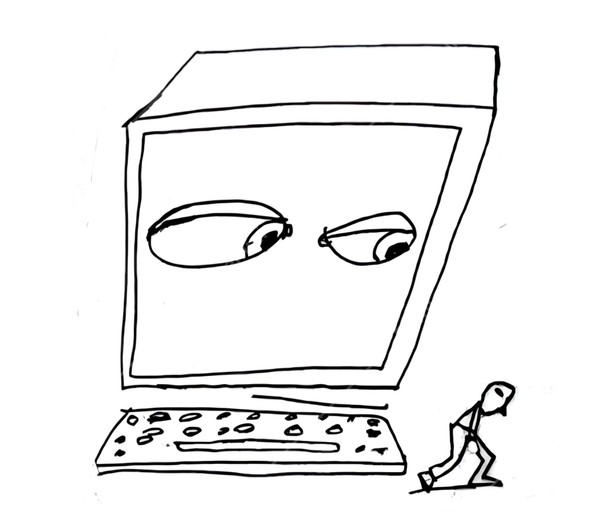
The Information State: Politics in the Age of Total Control
By Jacob Siegel
Henry Holt, 336 pages, $29.99
On March 30, The Guardian reported on a US State Department cable that directed embassies and consulates worldwide to “launch coordinated campaigns against foreign propaganda.” Secretary of State Marco Rubio recommended teaming up with “the Department of War’s Psychological Operations” unit and making use of Elon Musk’s X, which he described as an “innovative” tool that could assist with “countering anti-American propaganda.” The context for this missive, the article noted, was the war with Iran, as well as ongoing tensions with China and Russia.
There was an irony in Rubio’s recommendations. Upon taking power last year, the Trump administration set out to dismantle an infrastructure initially set up a decade prior for the same purposes laid out in the cable. The central node of this apparatus was the Global Engagement Center (GEC), established by executive order in the last year of Barack Obama’s presidency with a mandate to counter foreign propaganda. The month before Donald Trump’s second inauguration, Congress terminated the GEC’s funding, after which its operations were scaled back and absorbed into the State Department. In April 2025, Rubio shuttered what remained of it for good.
The administration’s rationale for getting rid of the GEC was that it was part of a “censorship industrial complex” targeting Americans, specifically conservatives and other critics of the liberal establishment. In a statement to the House Foreign Affairs Committee from around the time the GEC was dissolved, the conservative journalist Benjamin Weingarten decried the “turning of federal agencies … tasked with targeting foreign adversaries instead on Americans and our core political speech.” The GEC, he said, had been a “key cog in such efforts.”
Musk, whose platform Rubio is now recommending as a useful instrument of state-led information warfare, played a role in popularizing this line of criticism. After taking over what was then Twitter in 2022, he offered a number of journalists access to a trove of internal documents revealing the site’s content moderation decisions and interactions with various governmental and nongovernmental parties concerned with propaganda and disinformation. The following year, the “Twitter files” became the subject of a series of hearings in Rep. Jim Jordan’s “Weaponization of the Federal Government” House subcommittee.
Around the same time Jordan’s committee was getting underway in early 2023, Tablet’s Jacob Siegel published “A Guide to Understanding the Hoax of the Century: Thirteen Ways of Looking at Disinformation.” It was the most extensive account to date of how a sprawling project dedicated to countering disinformation had come to exist at the intersection of state agencies like the GEC, NGOs, Big Tech corporations, and media outlets. What set Siegel’s account apart was its attention to how this enterprise first arose out of military, espionage, and propaganda efforts in the early 2010s. In 2014, according to Siegel, the war against ISIS, the Euromaidan uprising in Ukraine, and Russia’s annexation of Crimea “convinced US and NATO security officials that the power of social media to shape public perceptions had evolved to the point where it could decide the outcome of modern wars.” The result was a new emphasis on “hybrid warfare,” in which military force was combined with sophisticated new forms of digital propaganda.
It was around the 2016 election that America’s chickens, once again, came home to roost. For decades, “misinformation” and “disinformation” had been terms of art used mostly by intelligence analysts and scholars of propaganda, but in the age of Trump, they became ubiquitous in American political discourse. Largely thanks to the claim that Russia had interfered in the election on Trump’s behalf, Siegel argued, domestic politics had become another theater of hybrid warfare.
“Domestic politics had become another theater of hybrid warfare.”
In his new book, The Information State, Siegel suggests that the nature of digital technology rendered this outcome all but inevitable. He cites a report from the RAND Corporation published in 1996, the dawning of the internet era, which predicted that the new information landscape’s “blurring of clear geographical, bureaucratic, jurisdictional, and even conceptual boundaries” would make it impossible to “clearly distinguish between ‘foreign and domestic’ threats … or ‘between public and private, military and commercial, and strategic and tactical.”
This is why, Siegel writes, “efforts to control the information environment overseas returned home.” It seems unlikely, therefore, that Rubio’s new initiatives will stay focused exclusively on foreign state actors any more than previous anti-disinformation projects did.
The Information State examines the ways states have sought to collect, control, and wield information going back to the France of Louis XIV. Siegel’s narrative lays special emphasis on two previous periods of US history in which rapid technological change coincided with foreign military excursions: the presidency of Woodrow Wilson and the Vietnam era. World War I, by Siegel’s account, was the founding moment of modern state propaganda, justified then as now by the need to counter foreign threats. Some of the era’s leading intellectuals, driven by faith in progressive technocracy, went to Washington to support the federal government’s use of new media tools to tame the unruly masses. Something similar happened in the 1960s, when the “best and the brightest” sought to instrumentalize cutting-edge information technology for hard and soft power ends as well as domestic crisis management.
“Both of these prior episodes ended in ignominy.”
Both of these prior episodes ended in ignominy. Wilson’s Committee on Public Information (CPI) was disbanded toward the end of his presidency, and some of its most prominent collaborators, like Walter Lippmann, came to regret their participation. Later, the arrogance of the Johnson administration officials who mistook their computer simulations for the actual Vietnam war helped deflate the pretensions of elite technocratic rule for a generation. Meanwhile, the abuses of the 1960s security state in covert enterprises like the FBI’s COINTELPRO prompted Congress to enact new civil liberties protections.
Siegel argues that even though these previous periods of overreach provoked a backlash, much of the damage was never undone. When it comes to Wilson, he writes, his “greater legacy endured.” Even with the CPI gone, “the functions of propaganda, censorship, and publicity diffused throughout countless government offices, public relations agencies, military and intelligence bureaus, and advertising firms.” Likewise, he sees the establishment of FISA courts as a mostly symbolic victory against state surveillance of American citizens. FISA, he says, “is still held up as a model of effective oversight,” but in fact it has “turned into a rubber stamp.”
The years since 2022, when the Twitter files were released, have seen a comparable pendulum swing against the anti-disinformation crusade that began the previous decade. Siegel draws a parallel between the ascendance of Warren G. Harding in 1920, elected “with a mandate to roll back the excesses of the Woodrow Wilson administration,” and Trump’s return to office in 2024. In both elections, voters—a much larger majority of them in 1920—turned against an administration that had attempted to use emergency measures to suppress criticism.
When it comes to surveillance and censorship, though, there was at least one key difference between these transitions. The anti-war activists targeted under Wilson were almost all on the radical left. When the conservative Harding pardoned former Socialist presidential candidate Eugene V. Debs along with twenty-three others, he wasn’t bailing out a political ally—far from it. Instead, at least to some extent, he acted on principle. Comparable magnanimity to left-wing enemies is hard to imagine coming from the Republican currently in the White House.
Indeed, once in office, as Siegel writes, Trump rapidly “demolished the central mechanisms of information control built up over the previous decade,” but he also “maintained the state of emergency”—specifically, in order to go after political targets on the left. Meanwhile, “much of the technical infrastructure of the information state, while dormant, remained fundamentally intact.” It is hardly surprising that Rubio is now making an initial step toward reviving the same partnerships between the national security state and tech companies he promised to dissolve. The weapons of hybrid warfare were still lying around, waiting to be picked up.
In fact, it is questionable whether the information state really was “dormant” up to now during the second Trump administration. Whatever the ups and downs of the relationship between Musk and the White House, a de facto alliance between the administration and X was established before Trump took office, and the site has continued to function as a megaphone for the administration and its allies. During the period Musk had an office in the White House and DOGE was overseeing the demolition of various federal agencies, he publicized the effort on his own platform, whose algorithm was weighted to favor his own posts and those of his political fellow travelers. Surely this was another, more chaotic, iteration of the public-private partnerships that, in Siegel’s telling, are the essence of the information state.
At some points, he suggests as much. After Trump’s return, he says, social media “remained an arena of mass surveillance and collective psychosis” where “invisible, interactive algorithms were still being used to tweak people’s fractional perceptions and influence their behaviors.” However, he also asserts that the fact that “the government was no longer directing how the social media companies deployed those algorithms … made public life freer.” I’m not sure I agree. Musk’s X may have laxer content moderation than Jack Dorsey’s Twitter, but it is neither less manipulative nor less enmeshed with state power.
When he equates freedom with freedom from state oversight, Siegel seems to endorse the cyberlibertarian view that the government should leave the internet alone. Historically, opposition to state interference in technology has generally gone along with an optimistic view of the technologies in question—the idea being that in the absence of government meddling, freedom would spontaneously flourish online. This was the view, for instance, of the early cyberlibertarian ideologue John Perry Barlow, whose “Declaration of the Independence of Cyberspace” Siegel discusses.
However, Siegel’s guiding light is a very different philosopher of technology: Jacques Ellul, who in his 1954 book The Technological Society critiqued the pervasive role of “technique” in modern life. To illustrate Ellul’s concept, Siegel points to TikTok, which by “feeding a curated list of attention-optimized short videos to the platform’s users … enforces ruthless efficiency in the realm of casual entertainment.” Ellul’s work, Siegel says, leads to the conclusion that social media platforms “[attack] the intrinsic worth of human values and relationships by demanding that anything that can be converted into data will be.” Is a platform like TikTok to be considered “free” so long as it avoids state censorship? Ellul surely wouldn’t think so, but the cyberlibertarians who decried the effort to ban or regulate the site on free speech grounds disagreed. I finished The Information State unsure which side Siegel was on.
At times, Siegel uses the term “information state” to refer to something historically limited: the complex of state agencies, NGOs, academic researchers, and Big Tech allies built up around the end of the Obama administration and dismantled by Trump after 2024. But a deterministic technological critique like Ellul’s would surely demand a more general definition. Any state that operates in the age of information technologies, in other words, will by necessity become an information state.
Are all information states alike? Toward the end of the book, Siegel references the writer N.S. Lyons’s theory of a “China convergence”: the idea that all advanced technological societies are gravitating toward the same end state of “totalizing techno-administrative governance,” with China’s model the most fully realized, toward which all the others are slouching. Where China built up its social credit system, American technocrats in the Obama era developed what they called a “whole of society” approach: “a new technique of governance that circumvented the normal legislative process by seizing the levers of the digital system to enact sweeping policy changes.” In such conditions, Siegel observes, the “notion of ‘free and spontaneous’ choices started to look like a farce in the context of an algorithmically controlled environment.”
This is an updated version of the basic problem Lippmann, reflecting on his propaganda work under Wilson, identified when he popularized the phrase “the manufacture of consent” a century ago. It is worth adding that in his initial formulation of the concept, Lippmann’s reference was not primarily to state projects like the one he took part in during World War I, but to the proliferation of “unregulated private enterprise” dedicated to different forms of publicity and propaganda. Regardless of the degree and mode of the state’s participation in the manufacture of consent, it is happening all around us.
The Chinese Communist Party appears to have been largely successful in using the affordances of digital technology to consolidate its rule. In contrast, by Siegel’s account, the “whole of society” apparatus failed in its parallel effort. On the contrary, the enterprise “accelerated a debilitating collapse of legitimacy across American society.” Under Biden, he says, an “illusion of control” fostered by the technocratic information management regime “blinded the administration to the limits and costs of its reliance on digital opinion formation.” As a result, it “lost not only the consent of the governed but its tether to a shared reality.” Something similar, in my view, is happening to the administration that succeeded it, which suggests that loss of contact with reality may be a liability for all those who attempt to govern the information state.
Over a decade after his disillusioning experience inside the state propaganda machine, Lippmann wrote The Good Society, which explored how democratic rights and freedoms might be preserved in the context of an advanced technological civilization. Regardless of what we make of his answer, he was asking the right question. Can there be a “good” information state—or at least a good society in the era of the information state? One of Siegel’s sharpest observations about the defunct progressive iteration of the early 2020s is that “the politics at its core offered no positive vision of the future.” Rather than holding out a meaningful “prospect of shared progress,” its functionaries largely “focused on the state’s power to remediate harm.”
At one point, Siegel describes the “anti-disinformation crusaders” of the past decade as “a modern temperance movement” that “demanded that wicked information be purged from the public square to save innocent souls.” I am tempted to say: if only. Whatever its faults, the temperance movement was in its origins a mass movement, not an elite technocratic one, and it owed many of its political successes to the expansion of democratic rights. What is more, unlike the anti-disinformation crusade, it was informed by a robust project of moral reform, and underpinned by explicit religious convictions about the good life and the good society.
What is more, as disreputable as prohibition may be today, few would object to the idea that the state should seek to discourage excessive drinking, place limits on the times and places in which alcohol can be acceptably consumed, and regulate the content of alcoholic beverages. No comparable consensus exists for the online public sphere, not only when it comes to state regulation but basic social norms. I’m not convinced this is a good thing, and I suspect the resulting anomie will inevitably lead to heavy-handed attempts to reimpose order.
I have argued previously that social and religious conservatives could play a more important role in discussions of technology than they currently do by supplying a more robust moral vocabulary and conception of the good life—something liberal technocrats have mostly been incapable of. Unfortunately, while most of the latter remain trapped in the disinformation frame, many conservatives are seduced by Musk-style libertinism and deregulatory accelerationism. But the public is disillusioned with social media and unenthusiastic about AI, no doubt because it remembers that the previous tech utopias we were promised haven’t panned out. It is time for intellectuals—like Lippmann in his era, whatever shortcomings we find in his answer—to ask what a “good society” is, and how it can be achieved and sustained in the information age.