


Ken Burns has set himself the impossible task of retelling a national origin story that all Americans will embrace as their own. He began work on the resulting six-part, twelve-hour series, The American Revolution, nearly a decade ago, just as the so-called Great Awokening got going. The years 2015-2025 have been energizing and inspiring for culture warriors and historical polemicists. But Burns is neither. His craft consists in conveying, intelligently, artfully and respectfully, the mainstream historical consensus. And that consensus has become so politicized it no longer meaningfully exists. Burns’s earnest effort to reconjure it merely results in incoherence.
“That consensus has become so politicized it no longer meaningfully exists.”
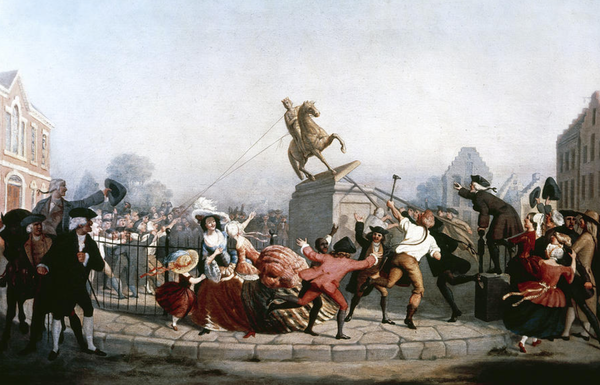
The American Revolution includes a few obvious nods to the culture wars of the past several years. We are reminded that the Patriots tore down statues, that General Washington compelled his troops to get inoculated from smallpox, and that a “handful” of women dressed as men to fight as soldiers in the war. How many women constitute a handful, the documentary does not say. (In my experience as a married father of three daughters, one is enough.)
But the problem goes deeper than these asides. The documentary consists of three overlapping narratives. One is a traditional military history of the War for Independence. The second tells the story of American slaves struggling to realize their own freedom, a struggle that sometimes aligned them with the Patriot cause and more often arrayed them against it. And the third is the story of Native Americans fighting to maintain their ancient sovereignty as a new nation emerged among them.
What ties these conflicting stories together is an argument that Americans have never been a unified or harmonious people. American history was made by Americans who hated, oppressed and occasionally killed other Americans. That is our collective heritage, and to share it, Burns suggests, requires a decent respect for all those who made it. The greatest misconception about the American Revolution, one featured historian observes, accurately enough, is that it unified Americans. The opposite was true. What we remember as the Revolution was experienced at the time as a civil war. This tends to be true of all revolutions. As the final words of the documentary remind us, “the Revolution is not over.”
Only a confirmed grump could dislike Burns’s attitude of ecumenical sympathy and respect toward all those who played their part in the nation’s founding. His film is an almost heroic effort to demonstrate that it is possible to show admiration for the oppressed and forgotten victims of our nation’s history without unduly traducing its traditional heroes. The American Revolution reflects an old-fashioned liberal’s patriotic reverence for his country’s past. But that reverence is now an amorphous sentiment without positive convictions. It cannot fill the vacuum at the core of Burns’s story, his failure to take a definite position as to what the great event was ultimately about.
The title of Burns’s series is misleading. A more apt title would have been something like, “The American Wars for Independence.” Typically, the American Revolution refers to the political overthrow of the British Empire and monarchy and the creation of a constitutional republic, which, for all its limitations, was the most democratic in the history of the world. It was a bloody and divisive civil war but it was also, more significantly, an inspired and creative political achievement.
“The title of Burns’s series is misleading.”
The sudden intrusion of countless ordinary Americans into politics, where they had never before played a prominent part, the way Patriot leaders both harnessed and resisted democratic forces they could not control, the brilliant intellectual innovations that allowed Americans to institutionalize and stabilize that visionary ideal, “the sovereignty of the people”—that story occurs almost entirely off screen, as it were, with historians only occasionally referring to it.
It is rarely fair to criticize an author or filmmaker for the story he didn’t tell. And Ken Burns’s gifts are well-suited to military history. Anyone who has puzzled pointlessly over printed maps depicting battlefield movements will appreciate the clarity of Burns’s live-action versions, all beautifully crafted and filmed. Equally masterful is his restrained use of live-action re-enactments, supplemented by images from paintings, clips from old papers, and, most of all, beautiful film of the land for which all sides fought. The Patriots’ military effort is the most elaborately and elegantly described, yet their cause is the least well explained.
The film honestly and passionately depicts the oppression and dispossession that the American slaves and Native Americans were fighting to resist, mostly without success. The film does not reduce the Patriot cause to these injustices. It honors the courage, skill, and sacrifices of those who fought; it celebrates General Washington as the indomitable man who managed the impossible task of keeping the continental army together despite countless blunders and setbacks, then boldly seized victory at precisely the right moment. But when it comes to explaining what all this patriotic heroism and sacrifice was for, the film is noncommittal and vague, occasionally almost unintelligible.
Consider the historian’s commentary that Burns chose to open the final episode.:
I think that to believe in America, rooted in the American Revolution, is to believe in possibility. That to me is the extraordinary thing about the patriot side of the fight. I think everybody on every side, including people who were denied even the ownership of themselves, had the sense of possibility worth fighting for.
The peril and promise of speaking extemporaneously in response to interview questions is that sometimes you will spontaneously say something brilliant and sometimes you stumble into talking nonsense. So it is no criticism of this accomplished historian—Jane Kamensky of Harvard and the Thomas Jefferson Foundation—to point out that this is meaningless. What is significant is that Burns chose this word salad to open his final episode.
Toward the end of the series, after General Cornwallis surrenders at Yorktown, the narrator says, “The world would never be the same.” But what had changed? The final 40 minutes describe how peace between Great Britain and the United States closed the opening to freedom briefly available to American slaves and betrayed the Native Americans. The Americans demanded that all runaways be returned to their masters; the British honored its promise to the escaped slaves of rebels while enforcing their loyal subjects’ right to reclaim theirs. The Native Americans who fought as allies on both sides went unmentioned in the treaty between the United States and Britain. For them, “there would be no peace. As the United States moved inexorably westward, Native Americans would fight for their independence for another century,” the narrator relates. If the world had changed in these respects, it was for the worse.
The concluding 15 minutes include a cursory summary of the failures of the Articles of Confederation and the framing and ratification of the Constitution. The film highlights the Founders’ effort to balance power and liberty, along with their fears “that a demagogue might incite citizens into betraying the American experiment.” It is hard not to read this as a feeble attempt to make the Founders’ legacy inspire selective resistance to Trumpian lawlessness. Anyone who respects the Constitution and those who framed it should insist that those in power obey its letter and spirit. But Burns wants it both ways, pummeling the Founders’ legacy on behalf of identity politics only to seize that same legacy as a cudgel against right-wing populism.
Here is the film’s final word on the Declaration of Independence’s statement that all men are created equal, given by a historian rather than the narrator: “Jefferson clearly didn’t take that seriously as a slaveholder, but I do. And I think it’s incumbent on all of us to take those words from Jefferson, and make them real in our own lives even if they weren’t real in his.” Left unexplained is why we should take from Jefferson a commitment to ideals he did not share, even in embryonic form.
But then, over a rousing drum beat and images of the suffragettes and the D-Day landings, Jefferson himself speaks:
I will not believe our labors are lost, I shall not die without a hope that light and liberty are on steady advance, and even should the cloud of barbarism and despotism again obscure the science and liberties of Europe, this country remains to preserve and restore light and liberty to them. In short, the flames kindled on the Fourth of July, 1776, have spread over too much of the globe to be extinguished by the feeble engines of despotism.
So which is it? We advance by the light of the ideals established by the Founders, or we see the Founders, by our own lights, as the architects of another feeble despotism that we ourselves must overcome? Ken Burns speaks for a nation unable to agree upon an answer to that elemental question.
Perhaps Americans can continue to unite around their foundational ideals without a shared understanding of the history that produced them, much as Jefferson himself hoped Christian ethics might flourish without the underlying theology. Or perhaps the unique power of the American origin myth, which grew in proportion to the challenge of holding such a heterogenous, fractious people together, has wilted against the pressures of an unprecedented social, cultural and ideological fragmentation—and the dissolution of that myth augurs the dissolution of a coherent national identity. It is too soon to say for sure.
On the approach of 250 years and counting, the story of our Revolution is not over.