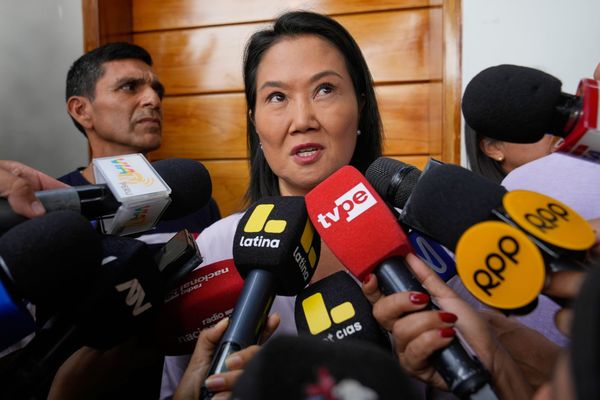
With 98.6 percent of votes counted in Peru’s presidential run-off, right-wing candidate Keiko Fujimori currently holds a lead of just 50.05 percent over her leftist opponent Roberto Sanchez’s 49.95 percent. The margin between the two candidates is so slim that a winner won’t be formally named until mid-July. The math, however, favors Fujimori, who is poised to continue the winning streak of Trump-aligned candidates in the region. What is unclear is whether her victory will conclude or prolong Peru’s decade-long political crisis, for which she holds considerable responsibility.

Keiko is the anointed heir of her father, the former dictator Alberto Fujimori, who governed the country between 1990 and 2000. His achievements—most importantly, crushing the brutal Shining Path insurgency—bequeathed his daughter an enduring base of support. But the darker aspects of his legacy, which include an autocratic power grab, war crimes against indigenous Peruvians, and deep corruption, have also ensured strong opposition to the family’s return to power. 

Keiko lost her previous runs for the presidency by tiny margins, in 2011, 2016, and 2021. But her party, Fuerza Popular (Popular Force), won a majority in the legislature in 2016, enabling the ouster of the center-right president Pedro Pablo Kusczynski just two years into his term. Since then, eight presidents have governed Peru, five of whom resigned or were removed from office by the legislature, thanks largely to the efforts of Keiko’s party. 

The losing candidate’s sour grapes weren’t the only factor. The regional fallout from the scandal surrounding the Brazilian construction conglomerate tarnished the entirety of Peru’s political class. Former presidents Alejandro Toledo, Alan García, Ollanta Humala, and Kusczynski were all convicted of taking bribes from Odebrecht. Keiko herself was indicted for accepting over a million dollars in bribes during her 2011 and 2016 campaigns, but she has consistently eluded conviction.      

Regrettably, a Fujimori presidency may be the country’s best hope for restoring political stability.  Keiko’s opponent, Sánchez, is an ally of former leftist president Pedro Castillo, the devoutly Catholic school teacher from a humble Andean background who attempted a failed self-coup in response to an inevitable impeachment by Congress. Castillo wasn’t the communist threat his opponents claimed he was, but his sheer ineptitude sowed chaos during his brief tenure.

Sánchez campaigned on pardoning Castillo, adopted the former president’s peasant attire, and forged an alliance with ethnonationalist indigenous strongman, Antauro Humala. But unlike the outsider former president, Sánchez is a fairly traditional politician hailing from the nation’s capital. He took slightly more progressive positions on issues such as LGBT rights than the socially conservative Castillo, likely contributing to marginal gains and losses in urban and rural areas, respectively. 

Despite its chaotic politics, Peru’s economy has performed remarkably well in recent times. Inflation stabilized at an enviable 2 percent in 2024, with GDP growth hovering around 4 percent. Through it all, the true power behind the throne has been the country’s Central Bank headed by twenty-year incumbent Julio Velarde. Velarde has won rightful praise for his bank’s political independence and sound monetary policy.

“In this respect, Peru might be viewed as a neoliberal utopia.”

In this respect, Peru might be viewed as a neoliberal utopia in which economic policy is insulated from the vicissitudes of politics. But there are serious problems with Peru’s apparent economic miracle. An astonishing 72 percent of the country’s workforce is composed of informal workers. An increasing share of them are involved in Peru’s deadly and ever-expanding illegal mining sector, particularly in gold. The Andean nation is the second largest precious metals exporter in the hemisphere, accounting for almost $50 billion, more than a quarter of which is thought to be illicit. 

The illegal gold trade in Peru is now roughly equivalent in value to neighboring Colombia’s cocaine trade, and unsurprisingly, homicides have climbed virtually every year since 2017 with the steepest increases in mafia-ridden mining areas. Peru’s Congress has enabled much of this lawlessness. In 2024, the legislature passed a law barring prosecutors from investigating crimes carrying prison terms of six years or less and limiting raids on suspected criminal headquarters. Congress also restricted prosecutors’ ability to strike plea deals, barred police from seizing explosives from illegal miners, and made it harder to seize guns, houses, and equipment. Politicians across the spectrum are complicit in all of this, including Fujimori and Sánchez

It’s conceivable that Keiko may be forced to crack down for no other reason than to boost her legitimacy. As it stands, her likely victory looks set to come thanks to the Peruvian diaspora, with Sánchez winning a narrow majority inside Peru itself. Left-of-center parties also won arguably their best result in the legislature in decades, including legislators from Sánchez’s party. 

Peru would benefit from a constitutional overhaul toward a more conventional presidential system, with higher thresholds for impeachment and removal from office. At the very least, the clause of “moral incapacity”—used for every impeachment this century including that of Alberto Fujimori—should be excised. It remains an open question whether Keiko will attempt to recreate a version of her father’s autocracy.

With her likely victory, Peru is poised to join other Latin American countries with right-wing governments as a staunch ally of the Trump White House. Washington has looked uneasily on the construction of Peru’s Chinese-financed Chancay megaport, which Beijing aims to link via rail with the port of Santos in Brazil. Peruvian interim president José Balcázar also canceled the purchase of twenty-four F-16 fighter planes from the US. Keiko is likely to be more open to US investment even as she continues to deepen ties with China, which often seems to offer a better deal than the United States. Even for the heir of Peru’s most famous right-wing family, ideological alignment may not be enough to trump national interest.

Juan David Rojas is a South Florida-based writer covering the Iberian Peninsula and Latin America. He is also a contributor to American Affairs.

rojasrjuand

Get the best of Compact right in your inbox.

Sign up for our free newsletter today.

Great! Check your inbox and click the link.
Sorry, something went wrong. Please try again.