


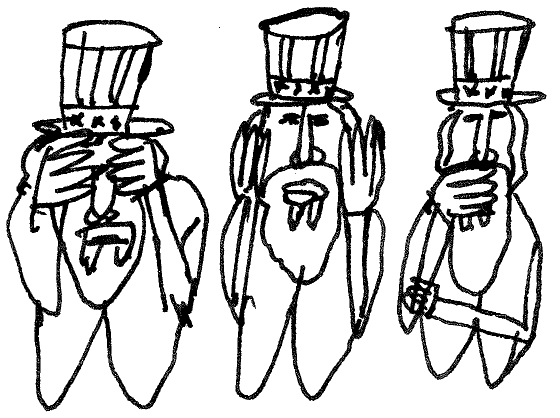
You might have noticed that the internet has been more bonkers than usual since about January 30. That’s the day the Department of Justice dropped 3.5 million pages of new files related to the investigation of disgraced financier Jeffrey Epstein, pursuant to the Epstein Files Transparency Act.
People are going crazy because they finally got their long-awaited evidence of the long-rumored Zionist-financed global network of blackmailable pedophilic cannibal elites. Right? More like the opposite. To find treasure in this document dump, conspiracists are reduced to combining extreme literalism with extreme interpretative license. Literalism: A rich man who acquires a Dutch Old Master painting of The Massacre of the Innocents obviously plans to hang it in his infant kill room. License: A man whose emails sometimes mention “pizza” is obviously a consumer of pedophilic pornography, or some other illicit pleasure starting with p.
Bonkers. Also boring, as Claire Lehmann complained in a tweet that got badly ratioed but wasn’t wrong. To behold a popular mania and observe over and over that it has no basis—nope, still no basis—sorry folks, still no basis—wow, okay, still none—is tedious.
“The ranks of the Epstein skeptics are growing.”
Yet the ranks of the Epstein skeptics are growing. No longer are the journalist Michael Tracey and the attorney Ted Frank waging a lonely war on social media, aided by a few writers such as Park MacDougald, Matthew Schmitz, and yours truly. Now they are joined by liberals and libertarians such as Lehmann, Robby Soave, and Brendan O’Neill; conservatives like Barton Swaim and David Harsanyi; gadflies like Alex Berenson and Richard Hanania; and new right figures including Inez Stepman and Pascal-Emmanuel Gobry.
The latest file drop brought the Epstein story to a crisis. The desperation of conspiracists who still aren’t finding what they’re sure must be out there, the demands for unredacted documents and yet another 3 million pages of files, the threats and condemnation directed at skeptics, have forced many to conclude that this is just another witch hunt. A skeptics’ discourse is gaining momentum and confidence—a natural phase in the life cycle of a moral panic.
I have given Epstein the epithet “disgraced financier,” in preference to the more popular “convicted pedophile,” because unlike the latter, it is accurate. Epstein was convicted in Florida of two crimes: solicitation of prostitution, and procuring of persons under eighteen for prostitution. Those persons were as young as sixteen. In 31 American states (though not Florida), sixteen is the age of consent, reflecting the fact that sixteen-year-olds are post-pubescent. They may, depending on jurisdiction, be victims of statutory rape. But by definition, they cannot be victims of pedophilia.
Epstein-maximalist discourse thrives on an expansion of the term “pedophilia,” such that in some quarters it now denotes any sexual interest deemed exploitative or creepy. Thus, women who did “sex work” (as we call it when we want to normalize it) for Epstein beginning in their twenties present themselves as victims of child sex trafficking, and only the most dauntless skeptics object. Surely, anyone who regards pedophilic crime as uniquely grave must object to its being redefined to encompass the hiring of adult prostitutes—redefined, that is, out of existence. Curiously, the defenders of children against Satanic pedo-cannibals lap this stuff up.
What is going on? Kathleen Stock observes: “The depressing fact is that sexual behaviour like Epstein’s is absolutely standard in our society, in the twin forms of prostitution and the pornography industry.” We could use less panic over Epstein, argues Stock, but more moralism. We could use a realistic account of what ails our society—and it ain’t Zionist blackmail networks. America’s internet pornography industry entails more labor exploitation (“trafficking”) of women than Epstein could have perpetrated in a hundred lifetimes. Internet porn ruins the innocence of more children than Epstein ever encountered, and it warps the sexuality of more adults than could ever be recruited to any globalist cabal.
The Epstein panic, like so many moral panics, arises from an intuition that something is amiss in our libertarian sexual settlement, if we could just say what. Religious discourses would be helpful to this end, but they are rigorously excluded from policy discussions. In the name of freedom and tolerance, we have suppressed so much of our public morality that we lack consensus terms for disapproving many forms of sexual conduct that nonetheless, somehow, perhaps secretly, strike us as wrong: unseemly, antisocial, diffusely harmful, destructive of discipline and virtue.
Moral panics are fits of line-drawing. They are not a resolution of our confusions but a reaction to them; they are furious and irrational because they are compensatory. In our fantasies of monstrosity, we establish with a vengeance what is out of bounds and what is in. Trouble is, we are certain of just two things: Children are off-limits; and we are not monsters, because we don’t do the things Epstein did.
Except that if we confine ourselves to facts, it appears that lots of us do the things he did, just less opulently. Hence our need for “convicted pedophile Jeffrey Epstein.” Without him and his pedo-elite friends, we would be left to confront the Epstein next door, or the one in the mirror.