


For decades, the free outdoor summer performances put on by Manhattan’s Public Theater have been a pillar of New York City’s cultural scene. The New York Shakespeare Festival, now called Free Shakespeare in the Park, launched the careers of Meryl Streep, James Earl Jones, and George C. Scott; many other notable figures of the stage and the screen have appeared in its acclaimed performances since it was launched in 1954 by the theater artist Joseph Papp. Born to Russian Jewish immigrants in Brooklyn in 1921, Papp believed that live theater should be as accessible as the public library. With a thirty-five-foot trailer attached to a decommissioned sanitation truck, he and his company brought Shakespeare to the people for free.
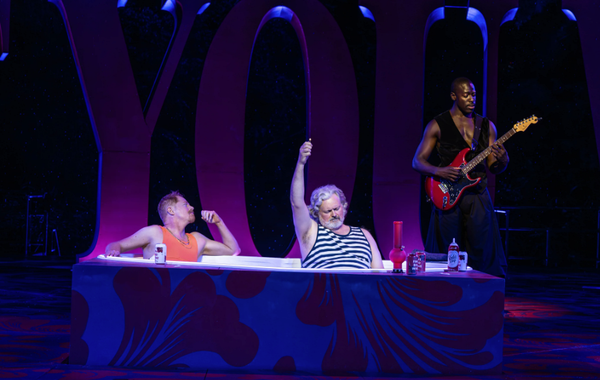
When he first rolled his trailer to Central Park’s Turtle Pond, Papp could hardly have imagined what the festival would become in 2026: the Blade helicopters droning past as the festival’s director of fundraising thanks Citizens Bank and other corporate sponsors for their generous contributions; productions like last summer’s star-studded Twelfth Night, which recast the beloved comedy as a cartoonish spectacle, part Shen Yun Circus and part Spongebob musical.
The first production in this summer’s season was a bilingual Romeo and Juliet set at the US-Mexico border wall. No English supertitles were provided for non-Spanish-speaking audience members, nor Spanish supertitles for the non-English-speakers in the crowd. The star-crossed lovers code-switched in and out of Spanish, as in: “For saints have hands that pilgrims’ hands do touch / And palm to palm the palmer les da un beso.” The laugh lines in Spanish elicited obligatory titters from perhaps a fifth of the audience. The rest maintained a guilty, awkward silence.
Juliet’s balcony scene was staged on a guard tower on the border wall. The Montagues, a Spanish-speaking family of indigenous activists from the wrong side of the wall, staged a campus-style “Abolish ICE” banner drop; the Capulets were border guards, dressed like goose-stepping blackshirts. Transposing contemporary politics onto Shakespeare can, in theory, offer a fruitful way of reimagining the play, but the politics here were slapped on and made little sense. The Montagues and Capulets are “two families, both alike in dignity” battling over ancient grudges; the tragic deaths of the young protagonists prompt them to recognize the meaninglessness of the rivalry and reconcile. The new production’s desperate bid for relevance generated an incoherent statement with little relation to the text, turning a tragic love story about fate, love, and destructive enmity into a black and white morality tale.
“The performance was just as disheartening.”
The performance was just as disheartening, with actors stepping so hard on their laugh lines and gesticulating so wildly that it was as though director Saheem Ali believed the audience, while fully fluent in Spanish, was shaky in its English. As is all too common in contemporary productions of Shakespeare, lines not delivered with vaudeville clownishness were rushed through as though they were barely understood by the actors themselves. Melding children’s pantomime with liberal resistance signifiers, productions like this treat audiences like Sunday school classes full of subliterate children. Romeo and Juliet, like last summer’s Twelfth Night, dripped with condescension.
Another factor at work here is the perceived need to tailor theatrical productions to the demands of social media. Juliet standing on the US-Mexico wall makes little sense, but it looks great on Instagram. In 2025’s Twelfth Night, also directed by Ali, a huge portion of the budget was spent on Drag Race-themed costumes that were exclusively used for the curtain call—a wild made-for-TikTok extravaganza. The audience was encouraged to feel that it was at a party with Peter Dinklage and Sandra Oh and all its parasocial celebrity friends. Aren’t you having fun? It asked. Isn’t this the best time ever? And if not, what’s wrong with you?
Romeo and Juliet ended in a real live wedding ceremony, officiated by Friar Laurence wearing an indigenous feathered cassock. Following the curtain call, the friar, having just sent two beautiful teens to early graves, invites a real couple on stage and actually marries them beneath Juliet’s balcony/guard tower. When I saw the play, the real-life bride and groom, possibly theater donors, looked like they had just strolled down the stoop of their Park Slope brownstone. The contrast with the young, non-white Romeo and Juliet, performed by Daniel Bravo Hernández and Ra’mya Latiah Aikens, was stark. On the one hand, the exoticized fantasy of young love at the border wall; on the other, the stone-faced bourgeois paying for the evening’s entertainment.
The arts have almost always struggled under market conditions, but today’s most successful nonprofit theaters are subsumed in the nonprofit industrial complex. The Public, which sponsors Shakespeare in the Park, is a massive fundraising operation with bloated administrative costs; its artistic director, Oskar Eustis, receives a salary of almost a million dollars a year, even as the actors had to fight through their union just to gross about a thousand dollars a week.
Where today’s theater artists beg and scrape before the donor class, Papp made demands and didn’t relent. He went toe-to-toe with Robert Moses, the famously powerful New York Parks Commissioner, to keep his plays free and open to the public. He canceled a $7 million contract with CBS when the network balked at airing his production of an anti-Vietnam War drama, Sticks and Bones. It’s hard to imagine today’s well-paid artistic directors acting similarly.
Today even Broadway is going bust, with Andrew Lloyd Webber’s Cats: The Jellicle Ball closing despite grossing almost a million a week. To survive but also to put an end to the tawdry spectacle of liberal resistance Shakespeare, theater for the people should be funded by the people. A government intervention on a scale not seen since the New Deal is needed to make the arts thrive again. Until such time, however, we also need a new generation of Joseph Papps: theater artists with spine and a ferocious devotion to bringing art to the people.