


In the wake of Kamala Harris’s defeat in 2024, one heard often that Democrats needed to focus on class rather than identity. But what exactly does it mean to focus on class? And what class is it that Democrats need to focus on? The party’s surging left wing has a clear answer—the working class—and usually offers an expansive conception of who is included in that category. “I think if you have to work to pay your bills,” New York City Mayor Zohran Mamdani has said, “I think that is one definition of being a part of the working class.”
However, some have taken exception to this characterization and questioned whether Democrats like Mamdani are really speaking to the working class. Citing the high levels of education and relative affluence of voters supporting progressive candidates, they claim that Mamdani and his allies’ true base is the “professional-managerial class,” or PMC.
As one writer recently put it, “The ‘PMC,’ as it has become known, was beginning to dominate the political left even in 1977; today, it arguably forms the Democratic Party’s most important voter base.” In the words of another, “Fifty years ago, the professional-managerial class swung right. Today, in America's biggest cities, they’re voting for leftists like Zohran Mamdani.”
The idea of the PMC was popularized by the left-wing social critics John and Barbara Ehrenreich in a 1976 essay in Radical America. Over the past decade, writers from various points on the political spectrum have revived versions of this concept in discussions of resurgent progressive politics, from Julius Krein and Michael Lind to Gabriel Winant and Catherine Liu, whose 2021 book was entitled Virtue Hoarders: The Case against the Professional-Managerial Class.
Is the distinction between the working class and the professional-managerial class, common to all these accounts, useful? Returning to the origins of the PMC concept makes clear how it seemed plausible at the time, but also why it has now outlived its usefulness except as a polemical term against left-wing politicians.
Before the Ehrenreichs wrote their Radical America essay, they had introduced the idea of the professional-managerial class in debates within the New American Movement (NAM), a socialist organization to which they and I belonged. (NAM later merged with Michael Harrington’s Democratic Socialist Organizing Committee to form the Democratic Socialists of America.) The Ehrenreichs had several targets in mind when they formulated the idea of the PMC, but the principal one was the idea of a diversified working class that several of us at the journal Socialist Revolution had developed, which had become inscribed in the New American Movement’s political platform.
The starting point of these debates was Karl Marx’s conception of class struggle as the fulcrum of political transformation. Marx defined membership in a class by a person’s relationship to the process of production. Owners were capitalists; workers who had to sell their labor power to capitalists were members of the working class. One’s consciousness of being either a worker or owner is or can be integral to a collective politics. This common consciousness does not need to be articulated in the words “working class.” An agitator might instead use terms like “working people” or simply “the people.” But the shared position of workers was the basis for a common struggle against owners.
Some Marxist theorists have relied on the historian E.P. Thompson’s argument that English industrial workers didn’t become a class until they were conscious of being one. Class consciousness, for Thompson, is something that is “made” in the course of a class struggle and is premised on the awareness of a common condition and common adversary. In the United States in 1976 and today, there is not a “working class” unified in its understanding of itself. The question, then, is what might prove the basis for the emergence of such an understanding.
“Marx’s dynamic conception of class and of the class struggle has endured.”
Marx’s theory was that as capitalism suffered persistent and growing crises, workers would organize themselves into unions, form a party, become conscious of their common condition, and attempt to wrest control of the government and economy from the capitalist class. Theses suppositions proved wanting, but Marx’s dynamic conception of class and of the class struggle has endured, and is taken for granted in controversy over the professional-managerial class and the working class. For all participating in the debate, class defines a common condition that is conducive to a collective struggle.
Marxists have debated why Marx’s predictions hadn’t come to pass since the late nineteenth century, but the rise of the New Left in the 1960s posed a challenge to the specifics of Marx’s theory of class. The New Left began as a liberal reform movement to secure racial justice and to demand a negotiated peace in Vietnam, but by the middle of the decade, it acquired a radical edge, with many of its militants arguing that the only way to end racial injustice and imperial wars was through a revolution. New Left groups called themselves “socialist” or even “communist” even though their core constituency wasn’t industrial laborers but college students and recent graduates. (The Students for a Democratic Society, or SDS, is an obvious case, but even the Black Panther Party was founded by two students at Merritt College in Oakland.)
Some of these socialist political tendencies, typified by the group Progressive Labor, fell back on the traditional Marxist idea of class struggle. Holding fast to the orthodox Marxist view that only blue-collar workers could bring about revolutionary change, they sent their members to work in factories, as truck drivers, or in related occupations. Other groups, typified by the Black Panther Party and the radical SDS splinter group Weatherman, abandoned any notion of the working class as the revolutionary subject. They argued instead that blacks, and sometimes other minorities, were part of a global anti-imperialist movement against American power. Organizations dominated by whites could function as auxiliaries to Third World revolutionaries. By their account, blacks in the US were colonized subjects, and their struggle was an anti-colonial one.
Those of us who joined the New American Movement, founded in 1971, saw ourselves as the descendants of the original SDS, which had promoted participatory democracy and shunned Marxist-Leninist orthodoxy. But the New American Movement was also an attempt to reconcile the older Marxist theory of class with the development of service workers and professionals who now outnumbered blue-collar factory workers. The explosion of college attendance after World War II, and particularly in the ’60s, had swelled the ranks of college-graduates who worked for wages and salaries and were under the authority of managers and executives. The New American Movement saw these new workers, its Political Perspective of June 1972 declared, as part of “increasingly diversified and stratified working class created by large-scale corporate capitalism.” The document, which the late James Weinstein and I had a hand in writing, went on to state: “The task of socialists is to clarify the origins of the internal divisions in the working class and to find the basis for unity.”
“We were trying to describe an incipient majority that could win power.”
Our idea of a diversified proletariat did not describe an existing class consciousness, but the basis for developing one, whether it explicitly went by the name of “working class” or not. It was meant to describe an incipient majority that could win power. It was based structurally on opposition to a capitalist class, which even if it didn’t directly employ a nurse or a janitor, did so indirectly through the power it wielded over the state and its expenditures. There were, to be sure, differences in income and social standing between the parts of this diversified proletariat, but the key to a common understanding was that the college-educated were increasingly subject to what Marxists called proletarianization.
Like the craft workers of the nineteenth century who found themselves robbed of their status and autonomy and deskilled by the industrialization of their professions, the college-educated white-collar workers were increasingly subject to a loss of autonomy. That was particularly significant for the so-called professionals who judged their products primarily by standards of excellence rather than profitability. Teachers were judged by whether their pupils learned; nurses and doctors by how well they treated their patients; software developers by whether they produced “cool code.” (During this period, I published an interview in Socialist Revolution with a computer programmer who in those days was still using punch cards.)
Marx had depicted the working class as a “universal class” whose interests were identical with those of the society as a whole. For Marx and for the early socialists, that meant the working class was equipped to govern society. In The Promise of American Life, which appeared in 1909, the progressive journalist Herbert Croly ridiculed that idea. “The action of a majority composed of the ordinary type of convinced socialists,” he wrote, “could and would in a few years do more to make socialism impossible than could be accomplished by the best and most prolonged efforts of a majority of malignant anti-socialists.” Croly’s quip was not entirely unwarranted. However, a decade later, Thorstein Veblen prophesied in Engineers and the Price System that the widespread employment of engineers and technicians would raise the possibility of self-government without a capitalist class. NAM’s concept of a diversified working class incorporated Veblen’s optimism about self-government. This new working class, we argued, was equipped with the skills to manage an economy and govern a country.
Inside the New American Movement, the debate with the Ehrenreichs over the nature of the working class began in the mid-1970s and came to a head with their essay in Radical America, which drew a sharp distinction between the working class and the professional-managerial class. The working class consisted of “craftsmen, operatives, laborers, sales workers, clerical workers, service workers, [and] non-college educated technical workers.” The shorthand Marxist version would be wage-laborers engaged in the production and distribution of commodities, but it might extend to include lower-level office workers in finance, whom Marx would have regarded as unproductive workers.
For its part, the professional-managerial class included not only nurses, welfare workers, teachers, entertainers, writers, engineers and other technical workers, but also “middle-level administrators and managers.” The Ehrenreichs defined the PMC as “salaried mental workers who do not own the means of production and whose major function in the social division of labor may be described broadly as the reproduction of capitalist culture and class relations.” Schoolteachers and entertainers, for instance, are “directly concerned with social control or with the production and propagation of ideology.”
On this basis, the Ehrenreichs stipulated that members of the PMC were “objectively antagonistic” to the working class—that is, they were a distinct class with opposing interests that couldn’t be grouped together, as the proponents of a diversified working class had suggested, in a coalition against the ruling class of business and financial magnates. This point would seem obvious in the case of middle managers and administrators, who could be expected to side with their immediate superiors. But the Ehrenreichs also held that registered nurses, schoolteachers, or actors occupied an objectively antagonistic stance toward factory workers, truck drivers, and grocery cashiers.
Their argument derived in part from a visit to China in 1975. The Ehrenreichs, as I learned when they stayed at our house in Oakland after their return, had come to admire the Chinese Cultural Revolution. “Our exposure to the tail end of the Cultural Revolution in China and our involvement in the developing feminist critique of professionalism here fed into our thinking about the class dynamics of the American left,” they wrote in reply to critics of their thesis. They were particularly taken by the Chinese attempt to remove the “conflict between manual and mental workers” by forcing mental workers to integrate with and share the labors of manual workers. That effort, they believed, was preventing the deskilling of the working class that had taken place earlier in the United States.
A feminist critique of expertise was another key influence on the Ehrenreichs’ thinking. In the United States, beginning in the late nineteenth century, activities like medical care and education had been transferred from working class communities to experts hired by cities, states, and the federal government. The PMC, they wrote, existed “by virtue of expropriation of the skills and culture once indigenous to the working class.” They went on to state: “The professional-manager workers exist. only by virtue of the expropriation of the skills and culture once indigenous to the working class.” Feminists had made this argument about midwives and obstetricians, but the Ehrenreichs extended to the working class as a whole.
In the mid-1970s, the Ehrenreichs had on their side the fact that many professionals, whose autonomy and income was protected by guild-like professional associations, and who often owned their own firms or worked in partnerships in small firms, did think politically like middle managers. They were likely to be free-market Republicans, and large numbers of them backed Ronald Reagan in the 1980 and 1984 elections. According to the American National Election Studies (ANES) surveys, a majority of professionals did not back a Democratic presidential candidate until 1988. But after that, the basis for grouping professionals together with managers weakened—and with it, the basis for the Ehrenreichs’ account of the PMC.
Since the 1980s, if not earlier, professionals and managers have diverged in their party and candidate choices; professionals have increasingly backed Democrats, while managers have stuck with the Republicans. In his 2010 book, Red State Blue State, political scientist Andrew Gelman, using American National Election Studies data, charted the different presidential choices of occupational groups:
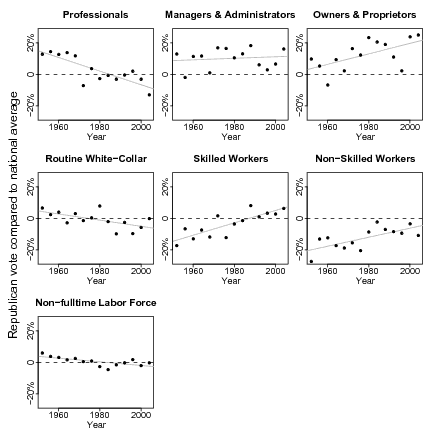
The downward trajectory shows professionals moving away from Republicans, even as support of Republicans remained consistent among managers.
One could argue that an occupational group’s choice of party candidate has no bearing on its class consciousness. But on at least one defining class issue, Democrats are 45 percentage points more likely to approve of labor unions than Republicans, according to Gallup. Likewise back-of-the-envelope tabulation based on the 2024 General Social Survey shows that while there is no significant difference in the responses of managers and professionals when it comes to, say, abortion, 80 percent of professionals reported having at least some confidence in labor unions, while a majority of managers reported having “hardly any.”
Moreover, managers are not organized into unions—if anything, they are the antagonists of unions—while professionals now account for many of the members of the four largest labor unions: the National Education Association, the Service Employees International Union, the American Federation of Teachers, and the American Federation of State, County, and Municipal Employees. Among the professionals represented by SEIU are doctors, registered nurses, physician assistants, pharmacists, physical therapists, social workers, research technicians, lawyers, engineers, court employees, librarians, IT professionals, law enforcement officers, adjunct professors, university researchers, academic counselors, and K-12 early learning professionals.
I could find no comprehensive studies of the political differences between American professionals and managers, but University of Toronto sociologist D.W. Livingstone has written on how Canadian professionals differ in class outlook from managers. In Tipping Point for Advanced Capitalism, Livingstone analyzed surveys of workers in Canada, the United States, and Western Europe to see how they would respond to questions of whether owners of corporations should be able to make gains at the expense of their workers and whether corporations should be prohibited from replacing striking workers. He found a sharp difference between professional employees and managers on two of these questions: “whether owners of corporations make gains at the expense of their workers” and where “management should be prohibited by law from hiring workers to take the place of strikers.” Livingstone rated the responses as either pro-labor, pro-capital, or contradictory. Professionals’ answers, he found, were most similar to those of industrial workers and diverged from those of corporate capitalists, large employers and upper managers.
Class by Oppositional Class Consciousness, Canada, 1982-2016
(%pro-labor/pro-capital views / contradictory views excluded)
I would expect that American industrial and service workers and professionals would not display as much “oppositional class consciousness” as their Canadian counterparts, but the differences between employees, including professionals, and managers would hold. All of this suggests that after the 1970s, when the Ehrenreichs were writing, there is scant evidence for supposing managers and professionals occupy a unified class that is antagonistic to wage-laborers.
Why have professionals and managers diverged over the last half-century? Our predictions in the early 1970s that professionals were being proletarianized seem to have been borne out. Over these decades, many professionals have experienced a loss of autonomy and of expected income. Seventy-five years ago, professionals—typified by the dentist, pharmacist, lawyer, and architect—owned their own firms, and thought politically as a small business owner does. Many were conservative Republicans. Today, many professionals work for corporations that set their income and impose conditions on how they deliver their services. One survey of doctors found that “physicians identify third-party practice acquisition (83 percent) and rapid consolidation (74 percent) as major contributors to autonomy loss, and more than seven in ten (75 percent) support stronger state oversight to safeguard physician leadership in care decisions.”
“Salaried professionals find their freedom constricted.”
Salaried professionals find their freedom constricted. Tech, once considered a highly desirable career, is rapidly going down the path of deskilling. Jobs that involve data analysis have either been automated with artificial intelligence or shipped overseas; software engineers have become proxies for artificial intelligence. As one site for programmers declared: “You were never an engineer; you were a code monkey. AI is a better code monkey than you could ever be.” Many jobs that have not been automated through AI have been outsourced thanks to remote work.
Overall white-collar salary growth has stagnated in the last two years. Much of the reason is a weakening market for professional labor due to outsourcing, artificial intelligence, and corporate consolidation. Between 2023 and 2025, there was declining demand for software developers, business analysts, technology analysts, market researchers, and data analysts, among others. But the pressure on incomes goes farther back. Compared to 2010 and calculated in real wages, many professionals have seen their average salaries go down. These include dentists, architects, pharmacists, economists, engineers, nurses, writers, and actors.
Proletarianization manifests itself most dramatically in the lack of opportunities for young people who go to college and even graduate school with the expectation that they will gain secure, well-paying jobs as professionals. They are the would-be professionals. According to a study by the Burning Glass Institute, five and ten years after obtaining their degrees, 45 percent of college graduates are “underemployed” in jobs that don’t require college degrees. Close to half of those who obtained degrees in biology and biological sciences remain underemployed.
Noam Scheiber recounts in his book Mutiny: The Rise and Revolt of the College-Educated Working Class how young college graduates’ disappointments in the labor market have radicalized many of them. Scheiber cites a Gallup Poll finding that among the college-educated, support for labor unions had risen to over 70 percent by the early 2020s. Opinion analyst Nate Silver found that the “most Democratic voting group” was “voters with postgraduate degrees but lower-to-middle household incomes of $30 thousand to $60 thousand per year.” Many of these voters, one assumes, are would-be professionals subject to proletarianization, whose political consciousness and situation are dramatically different from those of managers.
In a 2016 follow-up to their original essay, the Ehrenreichs themselves acknowledged that because of the process of proletarianization, the PMC “lies in ruins.” They concluded: “The debt-ridden unemployed and underemployed college graduates, the revenue-starved teachers, the overworked and underpaid service professionals, even the occasional whistle-blowing scientist or engineer—all face the same kind of situation that confronted skilled craft-workers in the early twentieth century and all American industrial workers in the late twentieth century.”
Does this mean the diversified working class that we talked about at Socialist Revolution and in the New American Movement is now a living reality? Would it be accurate to describe Mamdani as the candidate of the “working class”? That would be, to say the least, a stretch. As many professionals and would-be professionals suffer downward mobility and begin to manifest the rudiments of a working-class consciousness, many industrial and lower-level white collar workers in the United States have gone in the opposite direction. There may be some convergence in economic conditions, but not in consciousness.
That much is clear in voter preferences for the pro-union Democratic party. If you look at Andrew Gelman’s graphs, skilled and non-skilled workers became less supportive of the Democratic Party between 1976 and 2008. That trend has continued. When Gallup asked about approval of unions in 2024, respondents who had gone to college were 9 percentage points more approving of unions than those with only some college and 11 points more approving than those who had not gone to college. If you were able to translate these figures into occupational categories, and to remove managers from the college-educated, the disparities between salaried college-educated professionals and wage-laborers would be even larger.
In other words, as far as shared class consciousness goes, a diversified working class does not exist. There are many reasons for this. Differences over cultural issues of race and sex and over socio-economic issues like immigration have divided the potential members of a diversified working class. These differences often intersect with differences in political geography, creating a gulf between the world views of small town and metropolitan America. Divisions have also arisen in between private sector industrial and white-collar workers and the unionized public sector workers whose salaries they pay in taxes. These divisions have contributed to the disapproval of unions among workers who might have been expected to support them. Ruy Teixeira and I described some of these tensions in our book, Where Have All the Democrats Gone?
“There are some grounds for optimism.”
But there are some grounds for optimism. If you want to nourish hope that the diversified working class we described in the early 1970s will become conscious of itself, consider the history of the American labor movement or of the European socialist parties. In all these cases, initial leadership did not come from the bottom rungs, but from the top of the labor force. The American Federation of Labor, which would eventually become the AFL-CIO, began among craft workers suffering from proletarianization. The German Social Democratic Party had its beginnings in the late nineteenth century among skilled artisans and craftsmen rather than among unskilled laborers. In these cases, worsening economic conditions and skilled political leadership eventually created common ground, exemplified in the political transformation of the Democratic Party during the New Deal era.
Those conditions do not currently exist in the United States. There are still large gaps in income and status between wage-laborers and professionals, and the political leadership that would unite them is absent. The labor movement is weak and divided. No more than a few percent of Americans could even name the current head of the AFL-CIO. Many Democratic Party leaders are still in hock to culturally progressive lobbies, foundations, and think tanks. The organization to which Mamdani and his allies belong, the Democratic Socialists of America, purports to speak for the working class but enthusiastically embraces the most extreme stands on immigration (open borders), crimes (abolish the police and prisons), sex (biological men in women’s sports) and race (reparations). The PMC may be in ruins, but the diversified working remains, at best, a work in progress.