


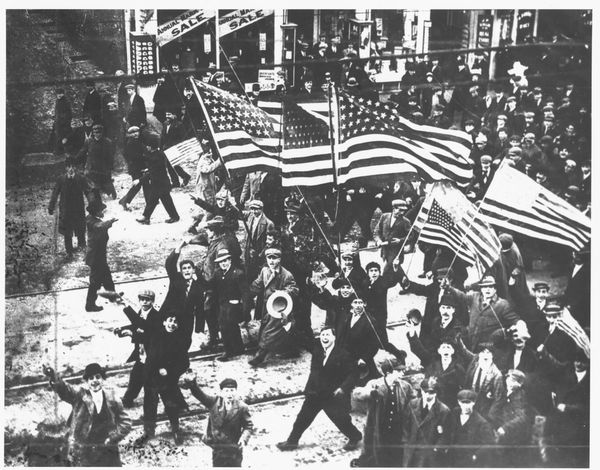
On a warm July afternoon in 1935, four thousand steel and coal workers carrying American flags gathered at a playground in Homestead, Pennsylvania to commemorate the great strike of forty-four years earlier, and to send a message to US Steel, the corporation that had run the town since the 1870s.
In the crowd that day, one could hear Slovak, Lithuanian, Italian, and heavily accented English, expressing the enormous ethnic diversity of the local steelworkers. Immigrants from Eastern and Southern Europe, arm in arm with their American-born children, were brought together by a collective commitment to assert their rights as workers—and as Americans.
US Steel founders Andrew Carnegie and J.P. Morgan had long used workers’ diversity to their advantage. They built their empire on largely uneducated immigrant labor—not only to justify low pay and brutal working conditions, but to keep the workforce divided along lines of language and nationality, so that it would be unable to organize collectively.
The high point of the rally came when union organizer Charles Scharbo took the podium to read aloud the Steel Workers’s Declaration of Independence: “We steelworkers today solemnly publish and declare our independence. We say to the world: We are Americans … We shall abolish industrial despotism. We shall make real the dreams of the pioneers who pictured America as a land where all might live in comfort and happiness.”
For the Homestead workers gathered that day, the union was more than a vehicle for asserting workplace rights. It was a means of asserting their Americanness.
The massive growth of the labor movement in the 1930s helped shift the balance of power between labor and capital and to turn once precarious jobs in industries like auto and steel into real paths to the middle class. But it also gave rise to a new creed—what labor historian Gary Gerstle calls working-class Americanism—that helped unify a culturally and ethnically fractured working class by rooting labor’s demands in a shared national identity.
“To join a union was to claim a place in America.”
For Polish steelworkers, Jewish garment workers, and Italian coal miners, unions were institutions that empowered workers to assert their citizenship and sense of belonging. To join a union was to claim a place in America.
Regardless of the ideology many left-wing organizers with the Congress of Industrial Organizations (CIO) started out with, working-class Americanism became the dominant creed of the labor movement by the height of the New Deal. This new nationalism drew heavily on the symbols of American democracy. Union newsletters featured images of George Washington and the Statue of Liberty. Organizers quoted the Founding Fathers. This creed was social-democratic, class-conscious, patriotic, and universalist. Above all, it reflected the aspirations of second- and third-generation Americans who wanted to break out of the ethnic ghettos in which they had grown up and claim their place as full and equal citizens.
This period also saw one of the first attempts to incorporate the black freedom struggle into the story of American freedom. CIO unions took concrete steps to challenge segregation, organizing across racial lines, condemning segregation, and framing demands to demolish Jim Crow and build interracial solidarity as essential to the realizing nation’s democratic promise.
Even in Communist-led unions, invocations of the Bill of Rights and American freedom took precedence over class war. While the Communist Party leadership’s rhetorical shift toward patriotism was motivated mainly by loyalty to Stalin’s foreign policy, many rank-and-file organizers embraced it for a simpler reason: It spoke to the genuine aspirations of the workers they were trying to organize.
Historian Maurice Isserman, in his recent history of the Communist Party, quotes one party member’s reflection on the change:
The very speed with which we adapted ourselves to the new line… was an indication not so much of our mercurial temper as the fact that it reflected what many of us really believed but could not articulate…we were so much happier to live with a policy that was natural, that heeded reality.
The new American ideal spoke broke with the previous ideal of “Americanism,” which excluded blacks, Catholics, Jews, and immigrants without roots in the British Isles. It was multi-ethnic, multi-faith, and multi-racial without promoting balkanization, because it was a shared faith in a common nation.
Working-class Americanism proved key to labor’s success. During the strike wave of 1919, employers exploited ethnic and racial divisions to defeat organizing drives, dividing immigrants against native and white against black. By contrast, in the 1930s, labor succeeded in organizing across ethnic and racial lines, from steel mills to meatpacking plants.
The unity wasn’t forged solely by labor’s efforts. Even before the founding of the CIO, FDR’s first presidential campaign had brought millions of second- and third-generation working-class immigrants into the Democratic Party.
Immigration policy also mattered. World War I and the Johnson-Reed Act of 1924 sharply curtailed European immigration, which meant immigrants and their descendants increasingly stopped looking back across the Atlantic and focused on making the United States their permanent home. Employers could no longer flood factories with new migrants to break strikes. Those from outside one’s ethnic enclave came to be seen not as competitors, but as potential allies. The pause in mass immigration helped create the social conditions in which a common working-class American identity could take root.
“The hunger for national belonging became readily evident to leftist labor organizers.”
The hunger for national belonging became readily evident to leftist labor organizers as the New Deal dawned. Gerstle describes the experience of Belgian socialist Joseph Schmetz, who quickly realized that his efforts to organize Rhode Island textile workers—mainly first- and second-generation Franco-Canadians—would fail if carried out under a radical anti-capitalist banner. By the mid-30s, publications of his Independent Textile Union weren’t quoting Marx but Thomas Jefferson and Abraham Lincoln to support a pro-labor, social-democratic platform.
It is not clear whether Schmetz initially recognized that the flood of the traditionally insular French-Canadians into the Democratic Party and labor unions signified their desire to be more “American.” But by mid-decade, Gerstle writes, “he had premised his entire strategy for building a successful working-class movement on that crucial fact.”
It is hard to imagine the contemporary American left following Schmetz’s model. Influenced by the 1960s New Left’s disdain for patriotism, today’s college-educated progressives tend to be wary of national pride. While 69 percent of working-class voters said that America is the greatest country in the world, only 28 percent of progressive activists agree.
“Today’s college-educated left is disconnected from working-class voters.”
And it’s not just white working-class Americans who continue to have a strong sense of national belonging. More than 60 percent of Asian Americans, 70 percent of black Americans, and 76 percent of Hispanic Americans said they were “proud to be an American,” compared with just 34 percent of progressive activists. Despite what both the MAGA right and radical left suggest, immigrants, on average, are more patriotic and prouder of American institutions than the native-born. Even a Marxist like Schmetz found much to admire in the United States regarding freedom of speech and the rule of law compared to his native Belgium.
So, the roots of working-class nationalism can’t be chalked up to xenophobia. It reflects a desire for solidarity and belonging. The populist left has an opportunity to reclaim this tradition.
President Trump is repelling many working-class Latinos and Asians—with whom he made gains in 2024—through punitive immigration policies, failure to follow through on populist policies, and a rhetorical turn toward old-school nativism. But the left can’t forge a non-MAGA, working-class coalition through national pessimism or treating members as abstracted categories separated by hierarchies of oppression. Workers, then as now, want a striving, patriotic universalism that speaks to their desire for shared citizenship and belonging.
There are plenty of bad examples of exclusionary or divisive nationalism. But the experience of CIO organizers in forging their own vision of American nationalism shows that working-class patriotism can be a tool for building multi-ethnic and multiracial solidarity without falling into tribalism. It may again fall to organized labor to rekindle this tradition.
The American labor movement has long understood that solidarity and patriotism aren’t in opposition, and that love of country wasn’t an obstacle to economic justice but its foundation. Those seeking to reconnect the working class with the left must rediscover that wisdom.