


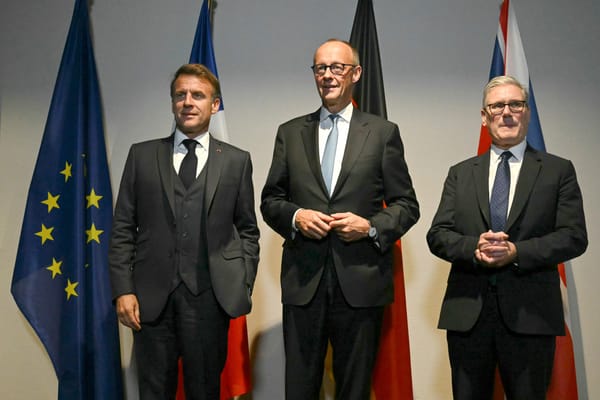
In Europe’s capitals, partisans of the old order—liberal institutionalists like Friedrich Merz, Keir Starmer, and Emmanuel Macron—have woken up to a world they did not prepare for. Russian aggression, American hostility, backlash against mass migration, and the persistence of right-wing populism have presented radical challenges to Europe’s establishment. These problems, often treated as a single threat, have placed European liberals in a state of siege.
In response, they have turned into immigration restrictionists, justifying tightened asylum policies as the price of protecting liberal values at home. They have become security hawks, spending more on defense and calling for European integration to resist Russian invasion and American needling. Many are now practitioners of what Karl Loewenstein called “militant democracy,” a resort to muscular tactics to counter what they regard as anti-democratic threats. In response to the rise of right-wing populism, liberal governments surveil, prosecute, and bar their political opponents from office, purge judges, and re-run elections.
In each case, liberal leaders have concluded this is not a time to extend liberalism—not to the foreign adversary, not to the needy of the developing world, and not even to the large parts of their own population that vote for the populist right. Instead, they have sought a governing program designed to dig in and hold out. Today, European liberalism is a liberalism of firewalls, militancy, restrictions, defense, and pragmatism. It is a project that can be preserved for its remaining adherents but has, at least for the time being, given up dreams of expansion. This is the age of Fortress Liberalism.
Just twelve years ago, a casual glance at Europe’s party politics showed a landscape that had been familiar since the Second World War. Within Europe’s largest democracies, the center-right governments of David Cameron and Angela Merkel were business-friendly, cheerleaders of the European project and the Atlantic alliance, and welcoming to immigration. Center-left leaders like Francois Hollande or Ed Miliband challenged their opponents on welfare and labor issues, but supported the European common market and NATO interventions aimed at protecting human rights. In the 2009 EU-wide elections, the center-right European People’s Party (EPP) and the center-left Socialists and Democrats combined to win 61 percent of the seats in the European Parliament. The two parties of the hard right—clusters of Euroskeptics and nationalists—won just 11 percent of the seats.
By 2024, the forces to the right of the EPP had more than doubled their share to capture 26 percent of voting seats in the European Parliament. Polls suggest that today they would capture one-third of those seats. The center-right and center-left have reacted by converging into an uncomfortable ruling coalition. Similar changes have unfolded nationally: In the United Kingdom, France, Germany, Austria, and Norway, parties to the right of the EPP consistently poll first. In Belgium, Czechia, and Italy, further-right parties have taken command of government.
A decade after Brexit and Trump, European politics are best understood as a battle between a populist, Euroskeptic, and illiberal right and those who remain committed to the liberal order. There remain differences between socialists like Spain’s Pedro Sánchez and conservatives like Friedrich Merz; there are also gaps between moderate nationalists like Italy’s Giorgia Meloni, who has committed herself to the Western alliance, and more radical figures such as Hungary’s Viktor Orbán, who embrace the mantle of illiberalism. But those divisions are now subfactional. As a video of Meloni and other right-wing leaders endorsing Orbán’s reelection campaign confirmed, the major contest for Europe’s future is between an ascendant right that is opposed to liberal institutions, and a broad camp of liberals seeking to reinvent their movement in order to save it.
The single biggest driver of change has been immigration. Asylum seekers have flooded into Europe in the past ten years. Between 1994 and 2013, the annual number of people seeking asylum in Europe never stretched north of half a million. That number ballooned to 1.3 million during the 2015-16 migration crisis, and has remained elevated: Over 900,000 first-time asylum seekers arrived in Europe in 2024. Much of the refugee surge has come from the Muslim world: Data suggest Muslims represent about 70 percent of Germany’s post-2015 refugee wave, for example.
In response, European populations have become hostile to large-scale migration. A YouGov survey at the end of last year found that across seven European countries, most respondents supported immigration moratoria and mass deportations. These views prevailed in countries where large numbers of migrants have actually arrived, like Spain, and in places where migration has been far more limited, like Poland. In all seven countries, citizens doubted whether assimilation was working: Fewer than 10 percent of respondents felt legal immigrants were being integrated “very successfully.”
These anxieties allowed the populist right to break through; research has shown that in Germany, for example, voters long expressed more restrictionist policy preferences than politicians in the CDU, Germany’s major conservative party. The populist right exploited this gap and profited: Polling suggests that voters’ views of immigrants and religious minorities have far more power to explain votes for right-wing parties today than they did in 2008.
Conspicuous displays of openness—Merkel embracing millions of Syrian refugees and declaring “wir schaffen das” (“we can do this”)—allowed the populist right to depict mainstream parties as more committed to a humanitarian ideology than to addressing voters’ anxieties.
The rhetoric of a people and continent under siege—small boats and smuggling routes, the viral spread of retrograde values, political infiltration, sexual crime, the construction of barriers and third-party processing hubs—has given rise to the term “Fortress Europe.” The basic underlying premise is that it is not practical to extend Europe’s openness to large numbers of people from the developing world. Rather than the fantasy of a rightist fringe, Fortress Europe is now a liberal concession to political reality.
Danish Prime Minister Mette Frederiksen was the first conspicuous exemplar of Fortress Liberalism. Elected in 2019, Frederiksen came from the center-left Social Democratic Party, but she shifted her party right on immigration, coming to power on a promise of a “zero refugee” policy and implementing an aggressive assimilation plan, even planning to send asylum seekers for processing in Rwanda. Frederiksen’s policies, though still controversial, have enabled her survival, with her party poised to win its third consecutive election next week.
Once an outlier, Frederiksen has now become a model. Poland’s liberals won their 2023 election by outflanking hard-right opponents on immigration. Keir Starmer and Greek Prime Minister Kyriakos Mitsotakis have both decried boats of migrants rafting through the sea; Starmer has warned of Britain becoming an “island of strangers.” Following Frederiksen’s lead, most major European politicians have articulated a new approach: For liberal values to be safe, newcomers must accept them. Europe’s mainstream now emphasizes elements of immigrant culture that are seen to threaten liberal values like gender tolerance, secularism, and non-violence.
Sweden’s center-right Deputy Prime Minister Ebba Busch sparked controversy after declaring that “Islam must adapt to Swedish values.” Merz, when pushed on his increasingly restrictive line, defended his policy by saying: “Ask your daughters.” France’s Interior Ministry warned of the Muslim Brotherhood’s infiltration of French politics, with the goal of advancing “political Islam” against French laïcité. It was long a right-wing argument that immigrants endangered secularism, non-violence, gender rights, and sexual tolerance. The mainstream has now embraced this logic.
“These approaches have stanched the bleeding for some liberal parties.”
These changes have remade Europe: Where cars once zipped between Schengen Area states, liberal leaders have reintroduced onerous inspections and queues. In December, the member states of the European Convention on Human Rights unanimously agreed to revisit expansive interpretations of humanitarian protections which have made deportations extremely difficult. In 2014, five EU and Schengen countries had physical barriers at their borders; today, nineteen do.
There are caveats. Fortress liberals largely exempt fellow Europeans—such as the four million Ukrainians now refugees in EU member states—from the migration crackdown. Liberals have also been careful to avoid coming across as racist; liberal parties have designated politicians with immigrant backgrounds as spokespeople for restrictionist policies. Starmer’s crackdown is being led by Pakistani-British Shabana Mahmood, and Frederiksen’s was led by Ethiopian-Danish Matias Tesfaye. Sweden’s Social Democrats, looking to regain power in 2026, made a Kurdish-Swede their spokesperson on the question of assimilation. The leader of Germany’s Green Party, Turkish-German Cem Özdemir, has called for asylum restriction by citing his daughter’s experience being “stared at or sexualized by men with migrant backgrounds.”
These approaches have stanched the bleeding for some liberal parties: Frederiksen has held on, Poland’s liberals remain competitive, and establishment coalitions in Germany and Austria have so far withstood a rising far right. But it has not solved all their problems.
As Europe’s liberals have adapted to a migrant surge, they have also come to grips with another invasion. We must strain to remember now how different the European security situation was in the early 2010s: Just over a decade ago, NATO held joint fighter jet exercises with Russia (then a member of the G8), European Security conferences were spent discussing the troop drawdown in Afghanistan, and the European Union spent 1.3 percent of its combined GDP on defense.
Europe bore high hopes for liberalizing trends in nearby regions. The Arab Spring had not yet come to grief, NATO and EU expansion into Eastern Europe remained fresh, and protests and dissent in Russia gave the impression that democracy might advance further still.
But by the middle of the decade, terror attacks, authoritarian retrenchment in the Middle East, Vladimir Putin’s 2014 invasion of Crimea, Brexit, and Trump dampened this optimism. Then, Russia’s full-scale invasion of Ukraine in 2022 returned war to the European continent. Trump’s return to power has left Europe beleaguered from another direction. The Oval Office confrontation with Ukraine’s Volodymyr Zelensky and the unveiling of a National Security Strategy that decried “civilizational erasure” in Europe served as prelude for January’s Greenland saga, which brought European politicians to new heights of shock and fear. Armed conflict, long unthinkable, blipped briefly into possibility. French politician Raphael Glucksmann was left to sum up the view of European liberals: “We are the free world.”
Now in military conflict with Russia, economic competition with China, and political confrontation with the United States, Europe is trying to reinvent itself. Poland’s leaders regularly refer to their country as holding up the “Eastern Front” of Europe against Russia’s onslaught; in the past two months, Poland has scrambled fighter jets and pledged to build anti-drone infrastructure on its Eastern borders. France’s government has taken the threat of imminent war seriously, distributing a “survival manual” to citizens. Germany’s Merz has declared the “Pax America” over and Europe on its own. Europe’s Defense Commissioner has called for a 100,000-strong European army.
NATO Secretary-General Mark Rutte typifies the transformation. As Dutch Prime Minister, Rutte kept his country’s defense spending minimal, calling instead for NATO to ensure the Dutch contribution was spent well. In 2025, he made almost every NATO country commit to spend 5 percent of GDP on defense—far more than the 2 percent President Trump called for in 2017.
Of the rapidly shifting political issues, defense has generated the broadest consensus within Europe. One sees the change in the army recruitment ads which now plaster bus stops in Paris and Warsaw, declines in the numbers of German, Dutch, and French visitors to US cities, and polls suggesting that half of Europeans view President Trump as an “enemy” of their continent and that 60 percent of European citizens want even greater increases in defense spending.
“The world has not yet known a liberal Europe that has no Uncle Sam to lean on.”
As long as Europe has had liberal democracies, they have had America to protect them. The world has not yet known a liberal Europe that has no Uncle Sam to lean on.
For as much time as they spend worrying about immigration and the challenges from Moscow and Washington, Europe’s liberal leaders are most concerned not to hand power to the populist right at home. Fortress liberals now filter every move through the question: How does this affect support for the populists?
Those who seek immigration restriction argue they are necessary to prevent backlash from helping the populist right, while those who seek open borders claim that restrictionism legitimates the populist narrative, rather than offering a moral alternative. Welfare cuts are condemned not for hurting the poor, but for aiding the populists. All over Europe, institutionalists cling to power while polls promise they will lose the next election. This has made government terms feel like a race against time, and justified exceptional measures.
Increasingly, attempts at persuasion have given way to forceful tactics aimed at preventing populists from taking power. Europe’s institutional leaders bear a special historical awareness of the threat of right-wing populism. Accordingly, they have embraced the concept and mechanisms of “militant democracy,” the idea that laws and institutions must sometimes restrict some political freedoms in order to protect the core of a democratic state.
In Poland, Donald Tusk’s government used the idea to justify extralegal removals of judges and charge former nationalist government officials with abuses of power (one has now received asylum in Orbán’s Hungary). Marine Le Pen, longtime leader of France’s National Rally and two-time opponent of Macron, has been banned from running for office in France’s 2027 presidential election on charges of using EU Parliament funds to boost her party. Romania’s Constitutional Court and Permanent Electoral Authority barred multiple candidates from running on charges that their pro-Russian stance would make them unable to uphold the rule of law; they did this after annulling a presidential election on charges of Russian interference. At the continental level, liberal leaders have given up trying to woo Orbán and have instead levied heavy penalties on Hungary and sought to abolish his country’s veto power.
Germany has labelled the right-wing party AfD an extremist group, justifying extensive surveillance, and continues to mull a total ban on the party. Mainstream parties erected an electoral “firewall” against the AfD, pledging not to join it in coalition governments at the national, state, or local level. Such firewalls against the right have meant increasingly unwieldy combinations within the fortress. To stop Marine Le Pen’s party from obtaining a parliamentary majority, the French Communist Party teamed up with center-right Macronists to drop out of races and urge voters to vote for candidates with whom they had no shared ideology except opposition to Le Pen. Merz’s governing agenda has found itself dependent on German leftists; in one region, his CDU formed a three-party “Blackberry coalition” with social democrats and left-wingers to keep the AfD out. The cost of this collaboration is that the unwieldy majorities disagree about policy; once they stop the right, there exists no agreed path forward.
Where firewalls have proven harder to maintain, fortress liberals have taken a two-track approach. Some once-taboo groups, like the Sweden Democrats Party or the rightist group in the European Parliament led by Giorgia Meloni, have been sufficiently tamed to become potential partners in support for NATO or Ukraine. In other places, like the Netherlands and Austria, cooperation with the right has failed dramatically, and battle lines have been clarified. A firm policy of non-cooperation, increasingly bolstered by the legal power of the state, remains the norm.
But these increasingly seem like last-ditch tactics of delay. Such moves have not reduced far-right support. No matter how clear mainstream parties make it that they will not admit populists into government, populist parties continue to gain supporters. As a result, a feeling of inevitability surrounds right-wing ascent in Europe’s biggest countries.
As European liberals have felt the walls closing in, they have drawn connections between the triple threat of immigration, Russian aggression, and rising populism. Russia and America are charged with fueling the far-right; Britain has investigated Russian influence on elections, and Romania cited Russian interference in cancelling their 2024 election. JD Vance’s Munich speech, Elon Musk’s rallying for the AfD, Trump’s endorsement of Viktor Orbán, and the National Security Strategy’s praise of “patriotic European parties” have given European institutionalists good reason to believe Trump’s America is not on their side.
“The connection between migration and Russia...has become surprisingly clear.”
The connection between migration and Russia—perhaps the most tangential of the three—has become surprisingly clear. Poland has dealt with Russia and Belarus sending poor migrants to illegally cross her borders, and new research has shown that as early as 2015, Russia was instrumentalizing migration to destabilize its borders with Norway and Finland. Poland’s liberal candidate in last year’s presidential election argued the populists would jeopardize necessary support from the European Union that was necessary for Poland to be a strong “Eastern shield,” protecting Europe’s borders from both the Russian security threat and illegal immigration.
The leader of a Dutch center-right party connected domestic populism, Islamic influence, America’s Trumpian turn, and Russia under the banner of unfreedom. “Unfree ways of thinking,” she declared, “are being spread in the Netherlands from Islamic countries, but also from the Kremlin and from American Christian groups.” She blamed these “unfree ways of thinking” for violence against women and gay couples, as well as a broader challenge to the Netherlands’s century-old liberal traditions.
Some liberal theorists have tried to find comfort in the fortress mentality. The scholar and former politician Michael Ignatieff argues that liberal societies fight better when they understand that they are in danger. Drawing on the thought of Isaiah Berlin, Ignatieff argues “it will be up to the embattled fortresses of liberal democracy, and the conviction of their peoples, if liberty is to prevail.” Illiberal threats should strengthen liberals’ resolve to make hard choices.
Early liberal theorists grappled with the limits of universalizing their own principles. Baruch Spinoza, in suggesting a liberal ethos of tolerance, demanded liberal societies restrict teachings or religions which “tend to produce obstinacy, hatred, strife or anger.” When Jean-Jacques Rousseau imagined society coming together around a civil religion, he said such a religion would only be intolerant of just one thing: intolerance. When courts restrict democracy in the name of the rule of law or liberals insist on fast-paced assimilation, they draw on a tradition which has recognized that liberalism relies on basic shared principles to work.
Yet Enlightenment-era liberals and Cold War Western Europeans shared something even the most abstractly minded liberals today do not have: a clear future project. Spinoza and Rousseau were hoping for something altogether new: secular, modern, and rational government. Nineteenth-century liberals saw growing social equality as a providential sign of a dawning universal liberal order. Cold War liberals were determined to fend off the Soviet threat, but also saw the promise of liberalism extending to new reaches of the world. The liberal institutions of 1945 (the United Nations, the Refugee Convention) and 1989 (the WTO, an expanded European Union) were premised on the idea that liberalism could work for everyone.
For all its limitations, the predecessor of fortress liberalism—the universalizing liberalism of Francis Fukuyama’s “End of History”—contained a strong aesthetic promise of the future: high-rises shooting up in Belgrade and Bucharest, McDonalds in Moscow, women, minorities, and others advancing in society, travel and cooperation between nations becoming more commonplace. The fall of Soviet communism promised the triumph of liberal democracy in the parts of the world which had been most hostile to it.
The practical strategy of reinventing liberalism as the preserve of besieged, sensible, Europeans is a difficult balancing act, because liberalism has always relied on the promise of future extension to rally its adherents. Similarly, once liberals lose confidence that their vision will inexorably spread by democratic, nonviolent means, they fall into the same “might makes right” logic as the illiberal ideologies in opposition to which they define themselves.
“Today, the stronger future project belongs to the populist right.”
Today, the stronger future project belongs to the populist right, which promises a more homogeneous, child-rearing, religious, and nationalistic Europe. While these politicians have their own foibles, their adherents share a confidence that Europe’s mainstream has sorely lacked for almost a decade. Even if largely nostalgic, the populist vision of the future speaks to the experiences of Europeans today. For those outside the establishment, it is easier to believe in than in a fortress under siege.
To be sure, there are attempts to replace the liberal siege mentality with something more expansive and forward-looking: efforts like the “abundance” idea and its adaptations in Europe, or the effort to make affordability the central promise of a populist left. But so far, these movements have not had large electoral breakthroughs, in part because they have not gone beyond the fortress liberals on fundamental questions. On defense, immigration, and the threat of the far-right, abundance liberals and populist leftists remain cadets within the fortress.
The rise of fortress liberalism makes clear that European leaders still imagine their present challenges as temporary. Our leaders and our societies have not yet internalized the possibility of a return to the constant warring or the ceaseless inter-ethnic violence that defined pre-twentieth century Europe. In the minds of the world’s most powerful liberals, their task is to survive the siege day-to-day, whatever adaptations that requires. Retreating to the fortress has deprived them of any vision of what to create next, should “normalcy” return. Practicing this lost art of imagination may make for a stronger defense than Europe’s liberals have yet been able to muster.