


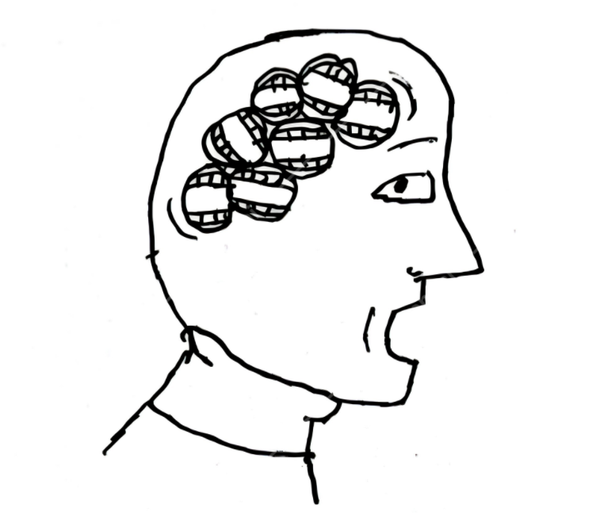
On April 30, 2026, the OECD published a new report claiming that more than one in five people across OECD and EU countries experience a mental disorder, making mental ill health “one of the most significant public health and economic challenges” of our time. For this, the report offers the usual prescriptions: We need to invest in prevention, we need to intervene more and earlier to promote mental health. Indeed, to tackle the scourge, nearly every institution and policy area needs to be refocused on mental health.
It all sounds reasonable enough. Who would say people should be mentally unwell or that a growing crisis should be ignored? The price tags attached might seem hefty, but nothing compared to future savings, as the OECD assures us. You can be forgiven for not realizing, as you turn the page, that public money would be bankrolling the very problem it is supposed to be solving. The truth is that we need to stop talking about mental health.
Everyone who tells us we need to “talk more” about mental health says it like it’s something entirely new, as if Philip Rieff didn’t already declare the Triumph of the Therapeutic back in 1966. “Let’s break the stigma and start open conversations about mental health,” urged the National Council for Mental Wellbeing during May’s Mental Health Awareness Month. Let’s make “mental health something teens can more easily talk about, celebrate and share,” says the US non-profit Ad Council. Talk more, talk endlessly, talk about nothing but mental health.
“Wave after wave of therapeutic fads have washed over our society.”
For decades, wave after wave of therapeutic fads have washed over our society: self-esteem, happiness, mindfulness, and now mental health. Each has promised to be a panacea for social ills, and yet each has left us profoundly disappointed, and somehow, feeling less happy, less well, more like something is not quite right with ourselves. Of course, those in therapeutic professions take this as evidence that we need more of the same.
Yet amid this cacophony, other voices from Thomas Szasz and Christopher Lasch in the last century to Frank Furedi in this one have warned that these treatments are not the cure, they are the disease. Human beings are not like a species of exotic plant, where you can discover the kind and label it, without ever affecting the thing itself. As Canadian philosopher Ian Hacking put it, “One might have the picture of first there being the kind of human behavior or condition, and then the knowledge. That is not the case. The kind and the knowledge grow together.” In other words, psychological labels do not merely describe us; they give us new ways of being and understanding ourselves, all while claiming to be static descriptions of the true nature of human beings, “just the way we are.”
These critiques fell on deaf ears, but psychologists are now finally “discovering” the problem. In a paper published this spring, the psychologist Nick Haslam warns that cultural practices intended to increase awareness of mental ill health “may be having ironic effects,” pathologizing human experiences, and “contributing to making us ill.”
Haslam isn’t the only researcher stumbling on this revelation. A double-blind randomized controlled trial published in 2025 found that exposure to ADHD-awareness materials made healthy young people significantly more likely to believe they had the disorder. A large Australian study found the same pattern in relation to depression: Nearly half of respondents labelled subthreshold symptoms as “depression.” Even people described as currently well were given a depression label, with labeling increasing the expectation that one should seek professional help or take medication. A 2026 review synthesizing eleven such experiments found the same pattern, with awareness materials consistently lowering the diagnostic threshold, increasing symptom-scanning, and in some cases, even increasing the severity of symptoms, with young people the most affected.
It is difficult to determine the true state of mental health in most countries. Rates of diagnosis don’t tell a complete story, and high-quality studies using population representative samples are expensive. One exception is the Dutch NEMESIS studies, which do show a rise in diagnosable disorder, at least in the Netherlands, from 17.4 per cent to 26.1 per cent between the 2007-2009 and 2019-2022 survey periods.
That increase is striking. The Netherlands has a highly developed mental-health system, a long tradition of destigmatization campaigns, and a system that increasingly favors formal diagnosis. Perhaps uncoincidentally, in 2016, right around the time of the rise in diagnosable disorder, the Dutch government initiated a nationwide mental-health awareness campaign to increase mental resilience and reduce major depressive disorders. The result? A rise in self-reported mental ill-health and an upward trend in demand for services. In other words, the Netherlands has more campaigns, more “awareness,” and more measured disorder.
This is a microcosm of where the rest of the world is headed or has already gone. In England and Wales, where mental health promotion has been in overdrive for decades, working-age claimants of incapacity and disability benefits rose from 2.9 million in May 2019 to 4.5 million in August 2025, with mental-health conditions driving the increase. Meanwhile, in the United States, young people self-diagnose from TikTok reels whose creators doubtless feel they are doing a public service. After all, they are only echoing the common sense of our time: There is no shame in seeking help; “the more awareness, the better.”
“This ship is unlikely to turn around any time soon.”
This ship is unlikely to turn around any time soon. Governments have been unwilling to let go of the mental health frame in spite of the collateral damage because it offers a handy justification for nearly any policy. Look at Britain’s new plan to bar under-sixteens from social media. Prime Minister Keir Starmer justified the policy as “marking a line in the sand” and putting “children’s wellbeing first.” But to make the plan work, platforms will need some way to verify your legal age, a level of intrusion that the UK public only recently rejected in relation to a proposed scheme for digital ID. But reframe the issue in terms of the untold harms of the internet to young people’s fragile mental health, and resistance vanishes.
Another reason government officials prefer to focus on mental health is that it suggests problems can be fixed without resolving fundamental social conflicts. For example, in its Comprehensive Approach to Mental Health, the European Union notes that “suicide rates among farmers are 20 per cent higher than the national average in certain member states.” This sad fact is why, the report continues, “support will be offered to strengthen their resilience.” One could be forgiven for forgetting that across Europe in 2023 and 2024, farmers drove tractors into capital cities protesting policies drawn up by distant EU bureaucrats that directly and severely impacted their livelihoods. The mental health framing ensures that questions like who gets what and who decides are taken out of the realm of politics and placed in the hands of technocrats. The economic world, which really governs the logic of our lives, is for the technocrats; mental life is for everyone else.
But look at that OECD report again and the Eurobarometer survey whose 46 percent figure it touted as evidence of the scale of the problem. In that same survey, people said what was more important for their “mental health” (the frame forced on them by the questionnaire) was their material conditions. Mental health promotion campaigns came dead last. In spite of decades of mental health promotion convincing us we’re sick, most people still know where the true realm of politics ought to be. That’s reason to be cheerful.