


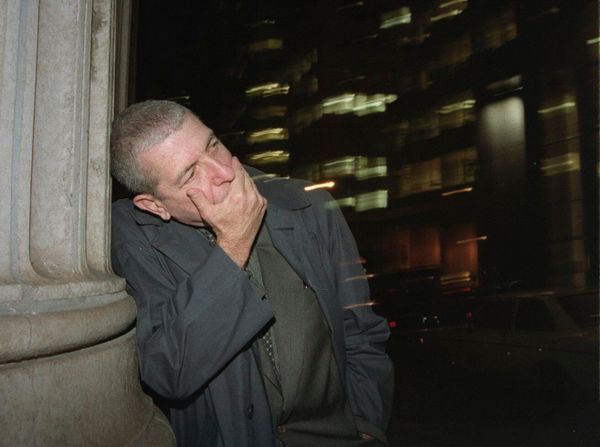
Leonard Cohen was, and remains, an enigmatic figure. In his life, he toed an unsteady line between rockstar-dom and cerebral, ascetic hermitude. His work, a shockingly coherent alloy of influences from Blake and Wordsworth to the Beat poets to Zen Buddhism and Frankian antinomianism, is shot through with a brilliance that led Bob Dylan to call him the “number one songwriter of our time,” yet he is perhaps best remembered in the popular imagination as the guy who wrote that one Shrek song, “Hallelujah.” Cohen was notoriously polygynous, a man who, at thirteen, became a master of hypnosis so as to induce the family maid to remove all of her clothing. But later in life, he renounced sex to live as a celibate for seven years in a Zen Buddhist monastery where he became an ordained monk.
Cohen had the poetic authority and the ethereal, romantic touch of a Dylan or a Paul Simon, but unlike these contemporaries, the most influential part of his career came when he was well into his seventies, forced to embark on a world tour after discovering that, while he was marinating at the Mt. Baldy Zen Center, his manager had been robbing him blind. Long before Dreamworks blockbusters, before world tours, before crowds of hundreds of thousands at the Isle of Wight, he said that he wrote for “inner- directed adolescents, lovers in all degrees of anguish, disappointed Platonists, pornography-peepers, hair-handed monks, and Popists.”
Cohen’s talent was obvious when he was still very young. As an undergraduate at McGill University in the early fifties, he was folded into a small set of writers that was composed of men like Hugh MacLennan, author of the seminal 1945 book Two Solitudes; F.R. Scott, McGill’s Dean of Law; and Irving Layton and Louis Dudek, who pioneered new strains of modernism in poetry and laid the groundwork for a revival of Canadian poetry. They constituted Montreal’s intimate literary scene, mostly meeting in each other’s homes.
F.R. Scott, a man whose interests ranged from poetry to law to civil rights, was a great extrovert and entertainer who oversaw the gestation of the Co-Operative Commonwealth Federation, Canada’s first democratic socialist party, in his living room. The poets met in his home at 451 Clarke Avenue in Westmount, a gilded suburb of Montreal. “451,” as they called it, had once been a boarding house, but its sixteen rooms were now scrubbed free of their former Victorian veneer thanks to Scott’s wife, Marian, a modernist painter who tore out the old ornate fireplace and replaced it with a block of Bauhaus concrete. A Tiffany lampshade, worth thousands of dollars, was left decomposing in the backyard, and Scott installed a large cannonball from the Plains of Abraham, where Wolfe defeated Montcalm in the Battle of Quebec, in the front yard.
It was here that Leonard came to know F.R. Scott’s son, Peter, the poet and academic best known for popularizing the term “deep state.” He also wrote prose and poetry inspired by a sweeping vision of the cultural evolution of the West. Peter is my grandfather, so my first exposure to the Leonard Cohen mythos was delivered first-hand over Chinese food on Tuesday evenings.
Leonard and Peter were two of the three junior members of this group of ten or twelve. Leonard was nineteen, Peter five years his senior, back at McGill to finish his dissertation after two years at Oxford. Much later on, Peter described the experience of being sandwiched between the eminence of his father, above him, and Leonard’s rising brilliance beneath: “above all your shadow Leonard/ you were five years my junior yet already/ envied by me for being/ a lady’s man with a car/ while completing your first book of poems/ already larger than life.
Rivalries aside, the acquaintance blossomed into a friendship. Leonard, long-time car-owner that he was, taught Peter to drive on a trip down to the states. At one point, Peter mustered up all of his 27-year-old seniority to scold Leonard for his extracurricular pursuits, saying, “you’re a serious poet—don’t waste your time down there in those nightclubs with your guitar.” Leonard declined to take the advice.
For both men, it was a time of intense work. “We really wanted to be great poets,” Leonard said in an interview with Liam Lunson. “We thought every time we met it was a summit conference. We thought it was terribly important what we were doing.” This was on the eve of Allen Ginsberg’s Howl, a period of reckoning with the horror of the holocaust and Hiroshima, as the West struggled to strangle the strange new forces that had wriggled out of the Enlightenment’s box of rationally ordered civilization. As Peter later put it, he and Leonard were “inspired by the idea that the world was a terrible mess, that they were all teaching the wrong kind of poetry in the universities, and that we with our poetry were going to change things.”
Around this time, Robert Lowell described poets as belonging to one of two camps: the “raw” and the “cooked.” The “cooked” were East Coast people who came out of Harvard; this was F.R. Scott’s camp. The “raw” were the Beats; this was Irving Layton, who became Leonard’s closest mentor. These two camps could have a rough parallel with what Peter would later call the yin and yang opposition internal to the evolution of Western culture. “Yang,” in his taxonomy, corresponds to Enlightenment rationalism, to that which is knowable and communicable, can be touched by language, and so forth; “yin” is the countervailing force of religion, mysticism, of poetic thought, proper, of that which resists propositional knowing.
Peter left Montreal for good in 1956, off to a career in the Canadian foreign service that would take him to hidden imperial loges in Viennese palaces, then to a teaching post at the University of California, Berkeley. There, he taught Dante, Virgil, and Dostoyevsky, rallied faculty members in support of the Free Speech Movement, wrote volumes detailing the CIA’s involvement in international drug wars, and struck up a friendship with the great Polish poet Czesław Miłosz.
Leonard, meanwhile, lived the life of a Bohemian troubadour; holed up on the Greek island of Hydra in a whitewashed house with a wrought-iron bed, sampling varieties of pot, speed, and acid, writing a “sexy, phantasmagoric” novel called “The Favorite Game” and poems that would later appear in a collection entitled Flowers for Hitler. While Peter moved in a set that included figures like Noam Chomsky and Daniel Ellsberg, Leonard rubbed shoulders with Patti Smith, Lou Reed, Jimi Hendrix, Janis Joplin, and, of course, Bob Dylan. “I took the yang path, and he took the yin path,” said Peter. “I joined a university and he became a rock star.”
The men lost touch after Peter first left Montreal, and for forty years, they had no contact. They finally reconnected in the late nineties, when Leonard reached out for permission to use some of Peter’s father’s work on an upcoming album. What began as a logistical interaction soon burgeoned into a full-fledged reunion, which was well underway by the turn of the millennium. When Peter published his long poem, Minding the Darkness, in the year 2000, Leonard flew to Berkeley from Los Angeles to hear him read it.
Leonard immediately took to Peter’s wife Ronna. Both of them were westward-wandering East Coast Jews with a serious interest in Buddhism. The three of them would share long meals, which Peter describes as being “very, very intense,” where “Leonard would say the sorts of things that made you wish you were taping him.” At one of those dinners, at a Greek restaurant in Los Angeles, Leonard shocked Ronna’s modern orthodox sensibilities by ordering a large plate of calamari, which he and Peter devoured while she looked away.
This period of reacquaintance took place while Leonard was touring. Peter and Ronna attended seven or eight concerts as his guest, once flying all the way to London to hear him sing. Meeting again so much later in life, after walking two very different paths, gave the renewed friendship a special quality. “By the time we knew each other again,” Peter said, “he was no longer a rock star and I was no longer an academic. We were on the same ground.”
“The yin and yang polarity resurfaced in their final exchange.”
Still, the yin and yang polarity resurfaced in their final exchange. In October of 2016, just nineteen days before his death, Leonard released his final album, You Want it Darker. It was the coup d’éclat of the man sometimes called the “godfather of gloom.” In the title track, Leonard sings “Hineini Hineini/I’m ready my Lord.” Hineini is Hebrew for “Here I am,” which is Abraham’s response to God’s demand that he sacrifice his son, Isaac. Here, Leonard, like Abraham, prepares to bend to the will of a violent power that eludes his faculties of understanding. Rolling Stone described the album as having a “realistically grim, spiritually radiant and deeply poetic worldview, generally spiked with a romantic thrum and an existential wink.”
Around the same time, Peter was finishing his own book of poetry, entitled Walking on Darkness, which he sent to Leonard via a friend. In a hurry, before handing it off, he scribbled the following note in the jacket of the book:
If you want it darker
This book is not for you
I have always wanted it lighterAnd I think God does too.
To Peter’s great surprise, Leonard answered, by email on October 3, 2016, with a poem of his own—which may be the last poem he ever wrote.
who says “i” want it darker?
who says the “you” is me?
god saved you in your harbor
while millions died at sea
you and god are buddies
you know his wishes now
here’s broken Job all bloodied
who met him brow to brow
there is a voice so powerful
so easily unheard
those that hear may hate it all
but follow every word
if you have not been asked
to squat above the dead
be happy that you’re deaf
not something worse instead
he will make it darker
he will make it light
according to his torah
which leonard did not write
The next day, Peter replied:
Who says I know God’s wishes?
I’ve not met brow to brow
never had a chance to glimpse him and never hope to now
But we who were raised in harbors
while others burned from war
have been free to choose which voices
made us what we are.
To which Leonard responded, signing off with his Hebrew name:
That was great fun.
Be well, dear friends.
Much love, Eliezer.
On November 6, a long-time friend of Leonard’s texted him a photo of Peter at breakfast with her daughter. Leonard replied with another text, quoting the Beatitudes: Blessed are the peacemakers: for they shall be called the children of God. Twenty-three hours later, he was dead.
Peter said that he has known three great men in his life: Miłosz, Daniel Ellsberg, and Leonard. (Later on, he added the poet Denise Levertov to the list.) I asked him what it was about these men that made them great. He told me that all three were able, by the intensity of their commitment to what they were doing, to put a dent in history. Ellsberg, with Watergate, was able to do so at the level of the immediate history that would show up, for instance, in The New York Times, but all three worked at a deeper level of history, the sort of history that Peter calls “ethogeny,” the history of ideas, of our cultural evolution.
Underlying the notion of ethogeny is the idea that “when something is progressing, something else is regressing.” This is the push and pull between yin and yang, between the Dark Ages and the Enlightenment. “When we get off the path as we are right now, then the dialectic kicks in and something happens to get us back on the path,” Peter says.
Leonard’s 2004 album, Dear Heather, included a track entitled A Villanelle for Our Time, which was a poem by Peter’s father, F.R. Scott, which Leonard set to music and recited. Repeated throughout are the lines:
Through bitter searching of the heart
We rise to play a greater part
F.R. Scott wrote the poem in a period of self-examination, after he had renounced his pacifist convictions to persuade his left-wing political party to support the war against Hitler in 1939. I asked Peter why he thought Leonard might have chosen this particular poem, what it was about it that spoke to him. “Leonard would like the word bitter,” he said. “There’s pain and that pain equips us to be more than we are.” This darkness, this bitterness seems to be a fundamental constituent of Leonard’s genius. Peter said that “great creativity is the right marriage of yang and yin.” It would be reductive and silly to directly equate yin/evil and yang/good—what is significant here is the generative dialectic, which existed in Leonard’s work as in Peter’s. In those long, free-ranging dinner conversations, “evil came up a lot.”
Leonard, iconoclast though he was, remained committed to the Judaism into which he was born. Peter’s religious path was more complex. Baptized into the Anglican Church and deeply interested in medieval Christianity, he began to practice Zen Buddhism in the 80s, and later entered into a serious engagement with Judaism through Ronna, adding another point of connection with Leonard. Once, when Peter and Ronna were arriving in Los Angeles, late to Sabbath, Peter left his yarmulke in the car. Leonard said, “here, take mine.” The next day, at breakfast, Peter tried to return it. Leonard said, “no, keep it.” Peter still wears it, every Sabbath.
Today, Peter describes his faith as “postsecular.” He references Thomas Merton, who maintained that the affirmation of one religious praxis did not entail the negation of the others. This refusal to be confined within the bounds of a single tradition is, perhaps, why he and Leonard were able to see eye-to-eye despite their doctrinal differences. They were both attempting to peer through the prism of praxis to the deeper, ineffable thing underneath.
Of their final exchange, Peter said that “I think part of him did want it darker. It was so permissive. If the world is so dark and there is no settled order that we need to live by, then you can live the life that Leonard lived.” Peter, on the other hand, accepts the necessary presence of darkness without giving over to it entirely. “My last word to him was that you’re talking about your reality as if it was reality,” Peter says. “I am suggesting that each of us respond to voices that shape the reality that we want to live in.”
Leonard also alluded to the quiet power of these voices when speaking to The New Yorker’s David Remnick not long before his death: “I know there’s a spiritual aspect to everybody’s life,” he said, “whether they want to cop to it or not.” He went on: “What I mean to say is that you hear the Bat Kol.’ The divine voice. ‘You hear this other deep reality singing to you all the time, and much of the time you can’t decipher it.’” Fifty years earlier, in his novel Beautiful Losers, he had written: “A saint does not dissolve the chaos…it is a kind of balance that is his glory. … Something in him so loves the world that he gives himself to the laws of gravity and chance.”
It is this interpenetration of light and dark, of good and evil, that makes Leonard’s life, work, and ethics difficult to reckon with. Yet perhaps, it is also this ability to reckon with it that equips him and the other greats to cut to the heart of the ambiguity of our time, and to speak directly to our innermost desire, as Peter says, to be more than we are.