


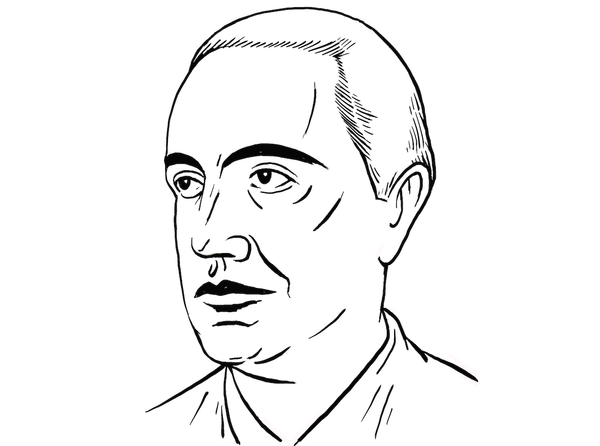
Julius Evola: An Adventurous Life
By Andrea Scarabelli
Arktos & Prav Publishing, 763 pages, $49.95
Julius Evola died in Rome in 1974, and has since become one of the most important thinkers of the global radical right. T-shirts bearing his name and a 1940s photograph with a monocle in his left eye echo those adorned with Alberto Korda’s classic 1960 image of Che Guevara. Many of the graphics incorporate the title of Evola’s 1934 book Revolt Against the Modern World. It is hard to say how many of those who associate themselves with Evola this way have actually read Revolt or any of his other works, but some of the key thinkers of the radical right certainly have.
Evola’s life can be told through some of his book titles. Revolt Against the Modern World is the most important. It was preceded in 1920 by Abstract Art, published in Italian, in the same year that Evola’s French poem, “The fiber ignites, and the pyramids (very quickly),” appeared in Dada number seven. Evola shared the avant-garde magazine’s eight pages with Tristan Tzara, Jean Cocteau, André Breton, Louis Aragon, and Ezra Pound. It was during this period that the title “Baron” somehow became attached to Evola’s name, even though his father was a railway mechanic and his mother worked in a post office. If Marcel Duchamp could make a fountain out of a urinal, could we not all be barons?
Evola’s first life as an abstract painter was followed by a second life as a political activist. This is when he published Revolt Against the Modern World. His career took a dark turn in 1941, when Evola published his Summary of Racial Doctrine in Italian, and then in German translation in 1943. In 1944, his article “On the Origins of Jewry as a Destructive Force” became the only article by a non-German ever to appear in the Nazi journal Research on the Jewish Question, published by Walter Frank’s Reich Institute for History of the New Germany.
“His two applications to join the Fascist Party were turned down.”
Walter Frank sensibly committed suicide shortly after Hitler did, but Evola moved on to yet another life with books including Riding the Tiger, published in 1961. The title refers to the classic story in which one way to avoid being eaten by a tiger is to jump on its back and ride it. Evola’s tiger was, again, the modern world. The anti-modern Evola of 1961 had more in common with the anti-modern Evola of 1937 than with the antisemitic Evola of 1941–1944. Evola was never formally a Nazi, nor a member of Mussolini’s Fascist Party, a point that was often stressed in the postwar period. It was less commonly noted that one reason for this was that his two applications to join the Fascist Party were turned down.
In his current, posthumous life, Evola came to general attention in 2017. That was the year a New York Times reporter, Jason Horowitz, noticed that Steve Bannon, who at that point held the title of White House Chief Strategist in the first Trump administration, had referred to Evola in a speech in 2014. Horowitz also made the connection between Evola and Aleksandr Dugin, a Russian political philosopher who has become ever more prominent in Western reporting on Russian politics. Dugin is another major reference for the global radical right.
Evola’s posthumous life had already started in 1983 with the first American translation of one of his books. The Metaphysics of Sex was published by Inner Traditions International, a New York publisher specializing in spirituality. It was followed by translations of Evola’s TheYoga of Power: Tantra, Shakti, and the Secret Way, of his The Doctrine of Awakening: The Attainment of Self-Mastery according to the Earliest Buddhist Texts, and then his The Hermetic Tradition: Symbols and Teachings of the Royal Art. Only then came Revolt Against the Modern World, in 1995.
An interest in sex, yoga, Tantra, and Buddhism is found in all of Evola’s lives. The books translated into English in the 1980s and 1990s were originally published in Italian between 1931 and 1943, or (in the case of The Metaphysics of Sex) in 1958. Evola’s spirituality matters more for his condemnation of modernity in Revolt Against the Modern World than his political analysis. This spirituality drew not only on his reading of Tantra and the earliest Buddhist texts but also on his reading of a French metaphysician twelve years his senior, René Guénon, whose own great work on modernity, The Crisis of the Modern World, had been published in French in 1927 (and translated into Italian by Evola ten years later). Guénon proposed that all that was truly valuable for humanity was the esoteric core of a timeless spiritual tradition that was almost entirely lost to Western modernity. The central characteristic of modernity was not what it claimed to have achieved—scientific progress, liberty, equality—but what it had lost: the esoteric tradition, and thus all that truly mattered. What was left was an empty shell, doomed to collapse.
Guénon’s “Traditionalism,” so called after his understanding of the esoteric tradition, lies at the heart of both Evola’s Revolt Against the Modern World and his Riding the Tiger. The Summary of Racial Doctrine and “On the Origins of Jewry as a Destructive Force” owe little to Guénon, who was himself neither an antisemite nor politically active in any way. Guénon spent the Second World War quietly as a Sufi mystic in Cairo, not shuttling between Mussolini’s Rome and Hitler’s Berlin as Evola did. Even so, there is a Traditionalist logic to Evola’s antisemitism: He saw secularized Jews as leaders in the construction of modernity and the destruction of tradition.
Back to the books. Again, Evola first reached the American and international public in translations published by Inner Traditions. Later translations were published by Integral Tradition Publishing, started by a Swede and a Dane and then carried forward by an American living in India, the home of the Hindu tradition that had fascinated Guénon and Evola. Integral Tradition Publishing then became Arktos, publishing under the slogan “Making Anti-Globalism Global since 2009.”
Arktos now publishes Evola, Dugin, the two leading authors in the French “New Right,” Alain de Benoist and Guillaume Faye, plus a host of other less-known authors of the same persuasion. It is the intellectual heart of the radical right. It has now published the English translation of Andrea Scarabelli’s Julius Evola: An Adventurous Life.
Scarabelli’s Julius Evola is not a critical work. It is written by an Italian who is a lifelong member of the Italian Evolian milieu, and the English translation emerges from an ideologically committed publisher. It is, however, well-documented and comprehensive—perhaps a little too comprehensive, at 753 pages. It covers Evola’s lives up to 1974, but not his posthumous life.
Scarabelli’s approach to Evola’s antisemitism indicates his general approach to his subject. He stresses that “Evolian racism… is much more complex than one might think,” and is based in Evola’s Traditionalist anti-modernism, as it indeed is. He emphasizes Evola’s respect for traditional Jewish mysticism—the Kabbalah—and highlights the differences between his understanding of race and the Nazi understanding. This divergence, he shows, led to difficulties with Fascist censors, who forced Evola to tone down his criticisms of Nazi theories in order to avoid upsetting Italy’s major ally. “Evola’s proactive interventionism led him to use the language of contemporary ‘racists’ to correct his pitch,” writes Scarabelli, which is why he adopted the term “Aryan.” Yes, indeed. But 1944 was surely a little late to try to “correct” the Nazis. Scarabelli doesn’t mention Evola’s article in Research on the Jewish Question, which the standard Italian bibliography of Evola that he probably relied on also misses.
The English translation of Scarabelli’s Julius Evola contains a foreword to the English edition by Jafe Arnold, an American Traditionalist close to Dugin, as well as a translation of the foreword to the French edition by Alain de Benoist, a leading French New Right thinker also published by Arktos. These forewords are both interesting because they tell us something about the appeal of Evola today. Arnold identifies the present as a time of “a changing of epochs in which we find ourselves thrown and yet in which we are still striving to find ourselves.” This gives Evola’s thought new relevance. “Evola’s life and works,” he goes on, “are part and parcel of our era, of our ways of coming to terms with this era, and of seeking another way onwards.” Evola and the Traditionalists show us a way to overcome “the crisis of the modern world,” “the world that is presently falling apart,” by returning to “the ancient and timeless spiritual heritage of civilisations,” to the “principles and higher callings by which the races of mankind lived and died for countless millennia.”
Whether or not the world is really presently falling apart is a matter of opinion, but there are certainly those who think it is. Many have thought the same thing in previous eras, of course. To what extent Evola’s and Guénon’s reading of the tradition, of “the ancient and timeless spiritual heritage of civilizations,” is accurate is also a matter of opinion. Mainstream contemporary scholarship tends to read things rather differently, and would not accept that spiritual heritage can ever be timeless. Yet Arnold does point to two reasons why Evola’s perceived relevance continues to grow. We find ourselves in a time in which old certainties are collapsing, and the idea that ancient and timeless principles can provide an answer appeals to many.
For his part, de Benoist tells us that “Evola has captivated the radical right primarily because of his ideological intransigence, his uncompromising critique of the modern world, and his capacity to confront triumphant modernity with a series of harsh negations.” This is also true: It isn’t just that many people sense a crisis, but that Evola’s critique of modernity is so convincing for many precisely because it is so uncompromising and so total.
“Evola’s work matters because it is read, and should be read because it matters.”
Evola’s work matters because it is read, and should be read because it matters. What of his life? There are three ways of understanding his work other than just reading it. It can be placed in the broader historical context of the twentieth century, in the narrower historical context of Evola’s personal contacts, collaborations, and conflicts, and in the broader intellectual context of responses to Western modernity, secularization, mass society, and periodic crisis. Scarabelli’s Julius Evola does the first two of these. The biography is also worth reading for the unusual light it casts on the internal workings of Fascist Italy, Nazi Germany, and the marginal politics of the postwar world. What was marginal then is becoming less marginal today.