


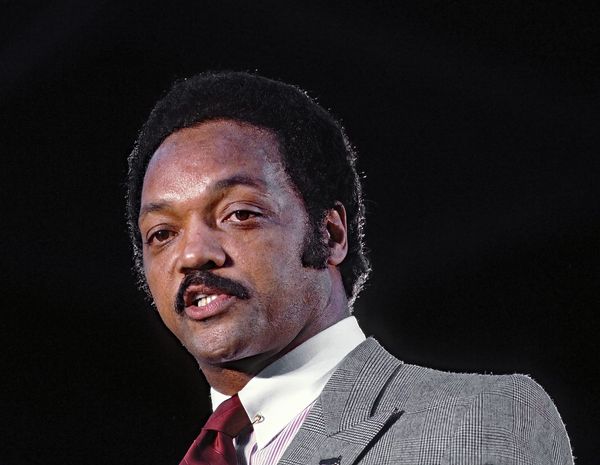
Jesse Jackson was born in South Carolina two months before Pearl Harbor, an African-American in the Jim Crow South. By the time of his birth, black voters—those who could manage to vote at least, primarily those who had migrated to northern cities for better jobs and opportunities—were already beginning to coalesce behind the Democratic Party. In hindsight, this may seem surprising; Franklin Delano Roosevelt was no champion of racial justice. A master politician, FDR’s priority was always keeping the Democratic Party coalition together, including its segregationist southern wing. Yet by 1940, two thirds of African-Americans who could vote were voting for FDR—a sharp contrast to 1932, when Herbert Hoover won the black vote two to one.
It was the New Deal, and not the Civil Rights movement, that brought African-Americans from the Party of Lincoln to the Party of FDR. It is true that many New Deal opportunities excluded them. Even so, in the midst of a Great Depression that devastated Americans of all races, FDR’s reforms improved the lot of African-Americans and thereby won their loyalty.
A child of the New Deal, Jackson focused throughout his life on questions of economic justice. He poured his efforts into the Poor People’s Campaign which MLK envisioned before his assassination. With de jure desegregation and voting rights achieved, the attention of civil rights leaders had turned to jobs, education, housing, and wages. Though African-Americans disproportionately suffered in poverty, these concerns were by no means exclusive to them. The Poor People’s campaign worked to include not just African-Americans but also Mexican-Americans, Puerto Ricans, Native Americans, and white Americans, of whom far too many were poor.
In some ways, the timing of the Poor People’s campaign couldn’t have been worse. In 1968, the New Deal coalition that had seen Democrats become the dominant force in American politics after 1932, winning all but two presidential elections in those thirty-six years, finally broke. The Solid South, as well as many white working-class ethnics in northern cities, defected in large numbers to Nixon. It would be Republicans’ turn to dominate for thirty years, winning every presidential between 1968 and 1992 save 1976. Democrats, meanwhile, had started to become what they are today: the party of minorities and the affluent college educated, wandering in the political wilderness.
It was in this bleak period that Jesse Jackson ran for president twice, in 1984 and again in 1988. Both times, he failed to win the Democratic nomination. Both times, he attempted to stitch together a “rainbow coalition” that would ultimately be based on class. He was trying to do in the electoral arena what the Poor People’s Campaign had previously attempted: build a multiracial alliance of working class people. As he put it in his speech to the 1984 Democratic Convention: “We must leave racial battle ground and come to economic common ground and moral higher ground.”
This is still good advice for Democrats today. The Democratic Party today is a cross-class coalition that simultaneously relies on billionaire donors, a highly educated activist class, and rank and file working-class voters who are disproportionately African-American and Hispanic. It is common for Democrats to observe that many Republican policies harm Republican voters, but the economic interests of the constituencies that make up today’s Democratic Party coalition are also internally contradictory.
This is why, for the Democrats as well as the Republicans, cultural concerns are the glue that hold the coalition together. Pretty much all Democrats agree that a statue of Robert E. Lee should go. But what should an Uber driver earn, and should that Uber driver have to be treated by Uber as an employee, complete with health benefits and sick leave? That would be a more controversial question at a Democratic convention today.
“How can Black Lives Matter without good jobs?”
By the late 1960s, many civil rights activists of Jackson’s generation became disillusioned with the racial progress that left economic realities entrenched. Today, similar frustrations emerge among a new generation of activists for whom identity politics proved a dead end. How can Black Lives Matter without good jobs, decent wages, affordable homes, and reliable public services? How can any life?
The tragic irony of Jesse Jackson’s life—his American Century, spanning from Franklin Roosevelt to Donald Trump—is that he spent his days fighting to expand the New Deal to include the racial minorities it originally excluded, only for the New Deal political order to come crashing down for everyone. Jesse Jackson should be remembered for his relentless fight for economic justice and mourned by working class people of all races. As he once said of a white political opponent: “His foreparents came to America on immigrant ships; my foreparents came to America on slave ships. But whatever the original ships, we’re in the same boat tonight.”