


Are we headed for war with Venezuela? Apart from other geopolitical considerations, any decision to use military force abroad must take into account its potential to create large new migration flows. Starting with our emergence as a world power with the Spanish-American War in 1898—and especially with our becoming a global hegemon after World War II—US involvement abroad has often led to significant unanticipated immigration.
“People go where they have connections.”
This has been the case whether we engaged in a full-scale invasion and occupation, a more limited intervention, or even a proxy war. And this is inevitable, because immigration takes place through networks. No one wakes up in Montevideo and says, “Today, I will move to Milwaukee!”—people go where they have connections, and our military involvements abroad are one of the main ways such networks have been created.
Consider that there are some four and half million people of full or partial Filipino descent in the United States, thirty times as many as there are Indonesians here, even though the countries are next to each other and Indonesia has twice the population. This, obviously, is because we ruled the Philippines as a colony for fifty years and had a major military presence there for decades more, creating the networks that brought immigration. The situation is similar with our other major colonial acquisition from Spain, Puerto Rico.
After World War II, Congress passed the War Brides Act to allow American servicemen to bring home women they had married in Europe outside the immigration quotas that existed at the time. With the Korean War, Congress extended it to cover war brides from that country as well, and all told, it’s estimated some 100,000 Korean women moved here with their American husbands over several decades. When the whole immigration quota system was scrapped in 1965, the specific war-bride provisions became moot, but they had created an immigrant population that then was able to grow and diversify through family chain migration.
More traumatic and wrenching was the aftermath of the war in Vietnam. There were only a small number of war brides from that country, reflecting our relatively brief tenure there. But our defeat in Indochina, exemplified by the famous photo of the helicopter on the embassy roof, resulted in the eventual flight of several million people associated with our client regime or more generally fearing the consequences of communist victory. More than 1 million were resettled in the United States, creating an immigrant community that, as with Filipinos and Koreans, would not have existed but for our foreign adventures.
Whatever other consequences of those immigration flows, they didn’t create significant security or public safety threats. Not so with our next major exercise of force abroad, this time indirect—the civil wars in Central America.
Our backing of the governments in El Salvador and Guatemala against communist rebels in the 1980s (and the rebels against the communist government in Nicaragua), caused the number of Central Americans in the United States to triple from 1980 to 1990. This didn’t happen because of networks created by our military establishment, but rather through networks created by American sympathizers with the communist rebels. The Sanctuary Movement (a precursor of sorts to today’s sanctuary cities) facilitated the illegal immigration of Central Americans and worked to embed them here, attracting even more.
By the time the wars in Central America were over, 1 million had moved here. Those immigrant communities incubated transnational criminal organizations like MS-13 and the 18th Street Gang, which remain significant public safety threats in the United States and throughout Central America to this day.
That brings us to the more recent immigration flows created by our military adventures: Somalia in the 1990s and Afghanistan and Iraq after 9/11. In the case of Somalia, President George H.W. Bush sent troops to provide security for a humanitarian mission, which was expanded under President Clinton and morphed into a doomed effort at nation-building. While the foolhardy mission in Somalia ended after the “Black Hawk Down” fiasco, we nonetheless admitted some 100,000 Somali refugees, creating a new immigrant community that has continued to grow through family chain migration, much to the chagrin of Minnesota taxpayers.
Our involvements in Iraq and Afghanistan played out somewhat differently, but the migration results were similar—huge new immigrant communities, the seeds of which were planted by Special Immigrant Visas and other means of providing access to the United States to local “allies.” These supposed allies included not only the small number of people who assisted US troops in the field as translators, but also secretaries, construction workers, kitchen help, and even locals who worked for Western media and NGOs.
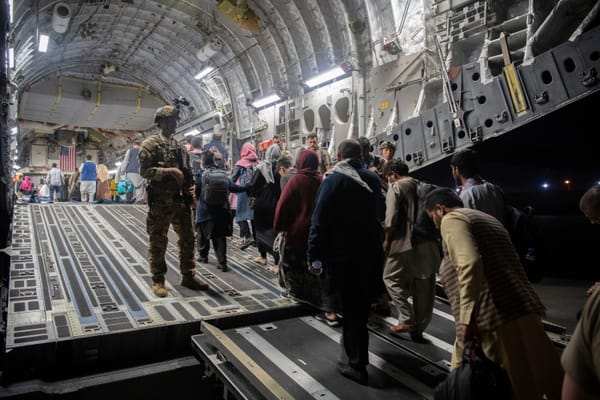
Our chaotic evacuation from Afghanistan, with escapees clinging to the wheels of transport planes, saw us bring in roughly 80,000 Afghan nationals. An even larger number have come since through various other means. And to this day, groups like AfghanEvac push for the admission of ever more immigrants with the goal of “honoring the promise we made to our Afghan friends and allies.”
If we get involved in Venezuela, maybe it’ll be different. Supporters of intervention assure us that migrants will actually return to the country following a regime-change operation.
Maybe. But assurances that we’ll be greeted as liberators and the boys will be home by Christmas have seldom panned out. Any number of things could go wrong following the removal of the current Maduro regime, including guerrilla war by supporters of the old regime. Even if nothing like that occurs, increased immigration from Venezuela is bound to result.
None of this means the United States should never project power abroad. But it does suggest that when considering the potential costs of a foreign intervention, a simple tally of blood and treasure is insufficient. We also need to consider that, win or lose, large numbers of people from the country in question will end up moving here. Efforts to transform other societies end up remaking our own.