


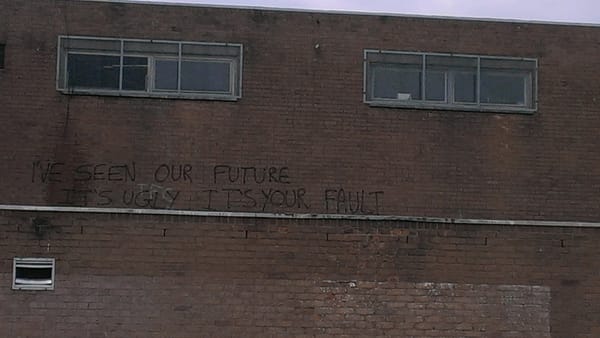
When I first watched Bernard Rose’s 1992 film Candyman, it affected me deeply. I saw it with my then-boyfriend and two other friends who sneered at its baroque tone; one of them jokingly intoned “Candyman” five times, as if to puncture the film’s central ritual. I was uncharacteristically furious at their ridicule. They exchanged furtive glances as if to say, “What’s up with her?” In truth, I wouldn’t have been able to answer them. The story was about the crime of slavery and the legacy it left behind, but there was also something else at work, something that resonated uncomfortably. I returned to the film a few times over the years, and again when it was remade in 2021, trying to understand what it was that held me there.
It was only when I became aware of Clive Barker’s “The Forbidden,” the short story upon which Candyman was based, that something clicked. While Rose’s film, and Nia DaCosta’s 2021 remake, focused on black urban life on the South Side of Chicago and the history of racial terror in America, the original story took place among poor whites in 1980s Britain. What had changed, I came to realize, wasn’t just the setting, but the kind of suffering that setting allowed us to see.
“The Forbidden” was set not in Chicago’s projects but in Liverpool. This was not surprising on one level: Barker grew up in Merseyside and studied English and Philosophy at the University of Liverpool. On another level, it was startling. The film version was American gothic, with racism as the central motor driving its horror. The relocation of the story to the projects of Chicago intrigued me. What had been left behind in that translation? What had been painted over?
“Here the horror is not racism, but abandonment.”
Candyman tells the story of a young anthropology doctoral student researching the urban legend of Candyman, a spectral figure believed to terrorize the residents of the Cabrini-Green housing projects. Gradually, she discovers that Candyman is real, the ghost of a son of a slave who was lynched on the eventual site of the projects for his relationship with a white woman. The clear message is that the wound of slavery remains open, festering, demanding recognition.
Barker’s story likewise features a graduate researcher—based in the University of Liverpool’s sociology department, where I now work—who enters a deprived housing estate to photograph urban graffiti and encounters the monstrous Candyman. The setting is a late-1970s council estate in the neighborhood of Merseyside, which Barker calls Spector Street. The people who live there are poor white folk: single mothers, old women, pensioned men who are no longer able to defend themselves. It is a story about class shame—about people left behind not only by progress, but by the aftermath of progress, and slowly taught to believe that their condition is their own fault. Here the horror is not racism, but abandonment. Today, white working-class boys remain the most educationally disadvantaged group in Britain, including in Liverpool. But this fact is difficult to name inside institutions committed to other moral hierarchies of suffering.
When Barker wrote “The Forbidden” in 1985, post-industrial Britain was already a ghost of itself. Liverpool had entered the long aftermath of managed decline. Council estates were abandoned by the state and demonized by the media. Sociology departments like mine were flourishing while the objects of study—far removed from the lives of most academics who taught there—rotted nearby.
Barker’s prose is understated and unembellished. He was writing before the Americanization of British class discourse and before identity frameworks came to structure almost every account of injustice. What he gives us is a stark account of people left behind not once, but repeatedly, as history’s wheels shuddered forward, leaving no trace of the violence that ground them down.
In the urine-soaked, graffiti-covered corridors, in the burnt-out flats, in the women, old men, and children who barricade themselves inside their homes for fear of marauding young thugs, we see the end point of a long historical movement: nineteenth-century ancestors who worked twelve-hour shifts in mines and mills; twentieth-century men sent to die in the mud at the command of elites; post-war families who lost their fragile grip on community life—through chronic illness, chronic unemployment, and gentrification—and were sent to live here, often for one small reason or another. Spector Street is the right name for where they live. They are ghosts, unmoored from community and identity, separated from one another by shame. They were not the people unions organized around, whose dignity came from labor and shared purpose. Post-industrial Britain produced a population severed from work, from role, from mutual recognition. They learned to read their failure as personal and individual.
“They learned to read their failure as personal and individual.”
I left a place like Spector Street in 1984 to go to university. But it waited for me every time I went home during the vacations, and it followed me long after that. Candyman, once a victim, is now indeed a monster: He invites you to surrender, to stop fighting against the forces ranged against you, to accept hopelessness as fate. Even when you escape, get an education, build a life far from that world, the shame lingers; the forces are still there, lurking as much inside as out. You learn to suppress it, swallow it, carry it silently.
As a child, I recognized myself not in organized or skilled labour, or heroic class narratives of strikes and speeches, but in figures of absolute precarity and exposure—children without protection, without voice, without collective power. The fairy tales of Hans Christian Andersen spoke to me, especially The Little Match Girl. As a high-school history student, looking for my lineage, I learned to read the oral histories of child miners and felt that my own ancestors were talking to me.
One of the things that poor people do not have, that those with more cultural capital do, is their stories. During my breaks from the university, I would often stay in friends’ family homes where oil portraits of ancestors hung on the walls. I didn’t know who my ancestors were beyond my grandmother, the only one of my grandparents still alive when I was a child, and who died when I was seven. She came from a sprawling family in London that never owned property. The street she was born in was rebuilt as part of slum clearance. When I grew up and wanted to find out more about her it was like trying to map the individual trees of a forest that had been cut down to make way for urban development. I know that she left school at twelve, that she worked in service and in a munitions factory during the First World War, and that in the Second World War, she lost both her husband and her son. That was about all I knew. Families like mine don’t leave written records.
Some years ago, I organized a public discussion group associated with the research center I founded, which was focused on inequalities in aging. The discussion aimed at identifying issues that mattered to the local community of older people. When organizing the inaugural event, I chose to partner with a particular charity because of the history of the building we were using, which was the site of Liverpool’s first school for girls. A representative of the charity told me she would like to give a welcome. She was polished, cosmopolitan, wearing Doc Martens, an expensive haircut and statement jewellery. Her remarks quickly turned into a lecture about how the building had been funded from the profits of transatlantic slavery, and how we must see past its beauty to this underlying crime, and never forget it.
I scanned the faces of the older people sitting quietly in the room, huddled in thin anoraks, their shopping bags against their knees. There was little enthusiasm. Some looked irritated; others sagged with weary resignation. I was silently furious. Slavery played a role in Liverpool’s wealth, and that fact, and the suffering it entailed, should be remembered. But when the city’s history is bent entirely around that single narrative, the effect is to silence the histories of the majority of Liverpudlians—including most of the people in that room. When those who wield this story invoke “white privilege” as a mystical essence possessed even by the city’s poorest pensioners, with their bus passes, Primark coats, and meager incomes, they make it harder, not easier, to see who is actually suffering. I had invited them to the group to hear their stories, but this so-called welcoming address encouraged them instead to be silent.
When a society comes to see itself as a source of injustice, it teaches its own dispossessed citizens that their suffering is illegitimate.
Liverpool, as a city and a university, has agonized over its history in recent years. In 2021, Gladstone Hall was renamed Dorothy Kuya Hall after student complaints about the Gladstone family’s links to slavery. Staff were told that the decision had already been taken and were then invited to participate in a “democratic” process limited to proposing alternative names that spoke explicitly to racial equality.
This disappointed me at the time. At high school, William Gladstone had struck me as a deeply principled figure: committed to equality before the law, opposed to aristocratic privilege, and animated by a restless moral energy. He was one of the reasons I aspired to study history at university. But when the moment came, no one was interested in my views—or in why figures like Gladstone had mattered to people like me.
Replacing the name of Gladstone with that of Dorothy Kuya, a black communist leader born in Liverpool, was not a cost-free choice. Mobilizing around race as the overriding moral category has come to mean that the suffering of the great majority of Liverpool’s poor—white communities shaped by industrial injury, mass unemployment, and social collapse—is erased and replaced by shame. Their stories do not count. Indeed, they are recast as oppressors in a story that foregrounds other victims.
The journey from Gladstone Hall to Dorothy Kuya Hall involves distortions as well as erasures. In a 2023 collection exploring the destruction of statues and other monuments, a chapter on Gladstone depicts the four-time prime minister as a man who colonized African lands, exploited its people and enslaved millions of other Africans. The distinction between him and his plantation-owner father is collapsed to nothing. In the same text, the Liverpudlians of the eighteenth and nineteenth centuries are described as “white,” a term that homogenizes a society comprising Irish famine migrants, laborers from England, Scotland, and Wales, sailors of all ethnicities and women and children living in industrial poverty. The chapter suggests that Liverpool’s imperial trade, post-abolition, was simply a continuation of racial exploitation by any other means, one that goes right up to the present systemic racism of the city. Four rhetorical moves instate race here at the top of the hierarchy of suffering. The account of trade becomes one of exploitation; exploitation is described as primarily racial exploitation; that in turn is described in terms of black suffering. Black suffering, appalling as it was, then becomes the sole motor of Liverpool’s growth.
The International Slavery Museum, which first opened its doors on the city’s Albert Dock in 2008, is full of similar elisions and distortions. Considering the absence of any broader context for the emergence of the slave trade, the quarter of a million school children who have visited it since it opened its doors are likely to have taken home the message that no other slavery existed in the world. Britain’s role in abolishing Atlantic chattel slavery is downplayed—ironically, given that the museum was opened to commemorate the bicentenary of this fact.
Another example: Last summer, one of my university’s anti-colonial working groups highlighted its shameful involvement in eugenics research in the 1920s, mentioning work on so-called “mixed race” children. What was left out was that this research was also deeply concerned with purported links between white poverty and mental deficiency. In this way, the great mass of the poor, the marginal, the vulnerable of Liverpool disappear.
“The great mass of the poor, the marginal, the vulnerable of Liverpool disappear.”
As I cleared up after the event at the former girls school, it was as if Candyman was there again, in the room with me. When Liverpool’s history is recast as a story of slavery and nothing else, I sense his sickly yet comforting presence. Don’t fight it, he whispers. Forget. Allow a moral language that excludes you, the people who lived and worked and suffered here for generations. What do you expect anyway? Resistance is too hard. You lose: again.
This is what happens when a single interpretive framework becomes authoritative. Other histories—of industrial injury, unemployment, community collapse, elite betrayal, post-industrial meaninglessness—are crowded out. When institutions teach monocausal history, Candyman waits patiently in the dark, ready to claim those whose stories no longer count.