


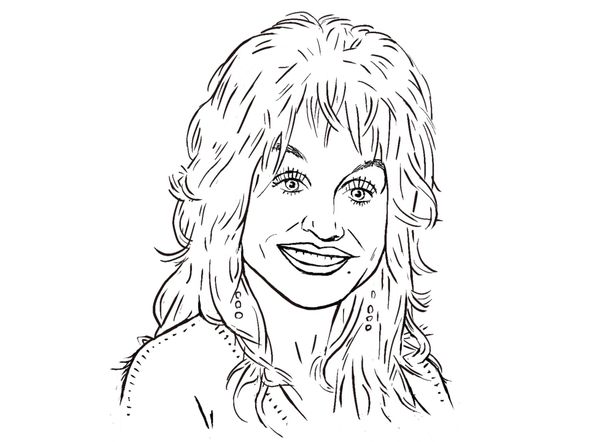
Dolly Parton, the last surviving First Lady of Country Music, has died. Like the other first ladies Tammy Wynette, Loretta Lynn and Patsy Cline, Dolly will forever be known by her first name. She rose from obscurity (the fourth of twelve children) to reach the heights of that most American genre.
Her big break came in 1967, when she won the audition to be the “girl singer” on the Porter Wagoner Show. Dolly sang occasional duets with Wagoner, who was then the bigger name. After several years playing second fiddle, Dolly had success as a solo artist. Her early songs had strong lyrics and evoked a polished version of the mountain music of her Tennessee home. Her first country number one, the playful “Joshua” (1971), was an uptempo song about how an apparently mean, vicious man living alone in a run down shack could warm up when exposed to the smile of a friendly woman. Most country fans felt the same way about Dolly as Joshua did.
After Loretta’s success singing about her upbringing in Kentucky’s Butcher Hollow in “Coal Miner’s Daughter,” Dolly penned a paean to a dying world of homemade clothes and family Bible readings in “Coat of Many Colors” (1971). Her mama sewed the jacket together from worn out rags. Some laughed at the threadbare coat, but Dolly had learned to cherish the maternal love it signified. Her 1973 album Tennessee Mountain Home (1973) also pays tribute to her home. The album’s title celebrates the beauty of the hills and “walking home from church on a Sunday with the one you love,” while “In the Good Old Days (When Times Were Bad)” makes clear that Dolly loved the lessons of poverty, but didn’t want to return to it. She would not be.
In danger of being typecast, Dolly decided to go solo. She told Wagoner privately about her intentions by singing him “I Will Always Love You,” arguably her most lasting, popular song. Dolly broached the topic of leaving the show with Wagoner before, but he resisted. Dolly meant to convey her gratitude for Wagoner, but also her need to go out on her own. At times the song has an “It’s not you, it’s me” feel: “If I should stay/ I would only be in your way.” But the overall sense is deep appreciation, and gratitude makes this the classiest break-up song. Later adaptations, especially Whitney Houston’s even more famous cover from the early 1990s, grasp the great subtlety of “I Will Always Love You.”
Porter agreed to her leaving if he could produce her next album. That album, “Jolene” (1974), contains both the title track and “I Will Always Love You.” “Jolene” marked Dolly’s entry into the great country cheatin’ song sweepstakes. Tammy stood by her adulterous man. Loretta threatened and put down the homewreckers for tempting her man. Dolly begs Jolene not to take her man, though she understands why he might love Jolene (her beauty is beyond compare). Eventually, modern country singers would settle on keying his car, burning his stuff, or killing him.
“In these early hits, love was always a serious concern.”
In these early hits, love was always a serious concern. It was central to happiness and best embodied in marriage. It could be found in unexpected places. The world today, in which men and women are suspicious of one another, needs poets to help heal the breach. Dolly’s “Bargain Store” (1975), a song about a woman with a low reputation who promises to be a gem of a wife, may be just such a song. The song’s simple arrangement supports lyrics that promise confession, forgiveness and healing: “My life is like unto a bargain store/ And I may have just what you’re looking for/ if you don’t mind the fact that all the merchandise is used/But with a little mending it could be as good as new.”
Later, Dolly would be a movie star. She would have a series of great cross over hits starting in the late 1970s, including duets with Kenny Rogers, Ricky Van Shelton, and Brad Paisley. She would operate a theme park, Dollywood. She was the consummate entertainer. Her cheap wig and her trashy look are themselves the stuff of song. “It costs a lot of money to look this cheap” would, she joked, probably be an epitaph on her tombstone. Later in life she referred to her trademark breasts as “shock and awe.” Nothing, however, matches the beauty and depths of her old American stories.
Dolly, by all appearances, was happily married in 1966. Her marriage of fifty-nine years ended in 2025, when her husband, Carl Thomas Dean, died. According to legend, Dean only watched her perform a few times in their long marriage. He missed out. And now we will all miss out watching Dolly sing too. RIP.