


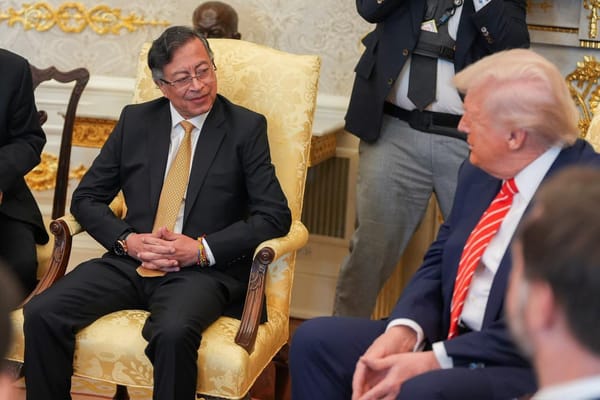
On Tuesday, President Trump held a state visit with his Colombian counterpart, the former left-wing guerrilla Gustavo Petro. The meeting was a welcome rapprochement between two leaders who have repeatedly clashed. After Trump recklessly threatened regime change in Bogotá following the kidnapping of former dictator Nicolás Maduro, the White House has evidently realized that Colombia has a role to play in the future of Venezuela. The administration now appears poised to drop sanctions against the Colombian president, who in turn seems willing to deepen cooperation on security with Washington.
Petro is term-limited and will leave office in August after upcoming elections. At a time when the Latin American right is ascendant, the leftist firebrand seemed all but certain to hand over power to a conservative—that is, until Trump returned to office. After falling to 29 percent in 2024, Petro’s average approval rating has risen into the low-to-mid 40s, far higher than those of his recent predecessors at this point in their terms. On my visits to Bogotá over the past year, I found a marked turnaround among residents’ attitudes to the incumbent and the Colombian left. Iván Cepeda, the candidate from Petro’s party, currently leads most polls, although a run-off against conservative lawyer Abelardo de la Espriella will likely be competitive. Trump and his “Donroe Doctrine” are making Petro great again.
“Trump and his ‘Donroe Doctrine’ are making Petro great again.”
Just days into Trump’s second presidency, the White House threatened to slap Colombia with 25 percent tariffs over Petro’s refusal to accept two repatriation flights of Colombian deportees. Petro later caved, and held a televised cabinet meeting replete with telenovela-esque intrigues and identitarian virtue signaling. It was—as I said a year ago—the nadir of an unpopular presidency.
After his initial standoff, Petro began doubling down on antagonizing Washington. Like his US counterpart, the Colombian leader pursues a flood-the-zone approach, particularly on the X platform where he philosophizes at length about the issues of the day. Meanwhile, Petro has deepened ties with Beijing, with trade between China and Colombia rising to a record $7 billion in the first four months of 2025. Last May, Colombia joined the Belt and Road initiative, in defiance of Washington. Colombia has since avoided further tariff threats despite its president’s continued diatribes against US foreign policy. All this went over well with the public.
Recordings emerged last June suggesting that Petro’s former minister of foreign affairs, Álvaro Leyva, and other prominent politicians sought to depose the president with the help of the Trump administration. Leyva had been suspended from office in 2024 and reportedly contacted Secretary of State Marco Rubio, arguing that Petro should be removed from office due to his rumored cocaine addiction. The Trump administration wisely demurred, and the affair proved to be a boon for Petro as figures from across the political spectrum condemned the plot.
Around this time, Petro finally succeeded in passing a major labor reform. Having repeatedly failed to secure majority support from a fractured congress, the administration threatened to mobilize supporters in favor of a referendum, and the legislature acquiesced. Workers now receive overtime worth an additional 35 percent of wages after 7 p.m. as opposed to 9 p.m., in addition to 90 percent overtime on weekends and holidays in 2026 and 100 percent in 2027.
In September, the Trump administration began bombing alleged drug runners, including in Colombian waters. Petro has taken up the banner of Colombian fishermen whose families deny involvement in the drug trade. Members of the country’s Trump-friendly opposition have struggled to respond to the repeated killings of their countrymen. Conservative presidential candidate de la Espriella celebrated the first boat strike, but has kept a strategic silence since.
The same month, the White House decertified Colombia as a partner in international counternarcotics citing record cocaine production under Petro; the Colombian leader was likewise sanctioned after urging US soldiers to disobey illegal orders during a visit to New York City for the UN General Assembly. Nonetheless, Petro has continued to cooperate with the DEA, extraditing traffickers to the United States and seizing record amounts of cocaine. In Bogotá, Carlos, a maintenance worker and fan of El Salvador’s Nayib Bukele, told me he respected Petro for questioning Washington’s hypocrisy over addressing domestic drug consumption.
Post-pandemic stagflation also appears to have subsided. In 2025, Colombian GDP growth rose to 2.5 percent, up from 0.5 percent in 2023, while inflation has fallen from 11 to 5 percent during the same period. The president also hiked the country’s minimum wage for 2026 by a historic 23 percent, stoking outrage from media and corporate elites. While middle- and upper-class Colombians grouse about the added cost of employing domestic servants, the measure has buoyed the left’s popularity with workers. In October, the ruling party’s presidential primary saw a record two million Colombians take to the polls to nominate Cepeda, a senator.
Petro’s pro-worker reforms stand in contrast with decades of conservative rule. Since 2022, the country’s minimum wage has risen 75 percent, the biggest increase in the past 30 years. One service worker told me she couldn’t bear to go back to right-wing rule and expressed contempt towards former president Álvaro Uribe for slashing overtime and calling Colombians lazy.
As with Chile’s Gabriel Boric, it is difficult to say whether Petro’s turnaround will overcompensate for his many shortcomings. For one, the president’s climate-conscious sabotage of the state firm Ecopetrol and ban on new oil exploration likely contributed to soaring energy costs. Petro and Cepeda have cited the example of Mexico’s AMLO and Claudia Sheinbaum as models for left-wing governance, but they ignore the fact that both leaders have championed fossil fuels. The national homicide rate under Petro has hovered around a brutal—but low by historical standards—rate of 25 per 100,000, but kidnappings have soared. Despite that, the Colombian leader has flirted with fashionable progressive criminal justice policies like reduced sentences.
But Trump’s intervention in Venezuela may be a gift to the Colombian left. Petro and Cepeda have attempted to balance the near-universal contempt of Colombians towards Maduro with a defense of sovereignty. Despite condemning US aggression toward Venezuela throughout his presidency, Petro also refused to recognize Maduro’s 2024 reelection and accused Caracas of sponsoring guerrillas like the ELN. It’s an open question whether the president can succeed in exploiting ongoing events east of the border in his favor. But Venezuela also poses challenges for the Colombian right. If the neighboring country ultimately descends into chaos, a renewed torrent of Venezuelan emigration may empower left-wing critics of Maduro’s ouster.
Petro has suggested that the cooperation between Washington, Bogotá, and Caracas to combat the binational ELN and boost oil production in Venezuela stands to benefit all parties. After their surprisingly friendly meeting, Petro asked his followers on X to translate a message from Trump, who inscribed “You Are Great” on a copy of The Art Of The Deal. The fact that the White House’s actions have provided a boost to Petro and his left-wing allies shows that the Donroe Doctrine has its limits.