


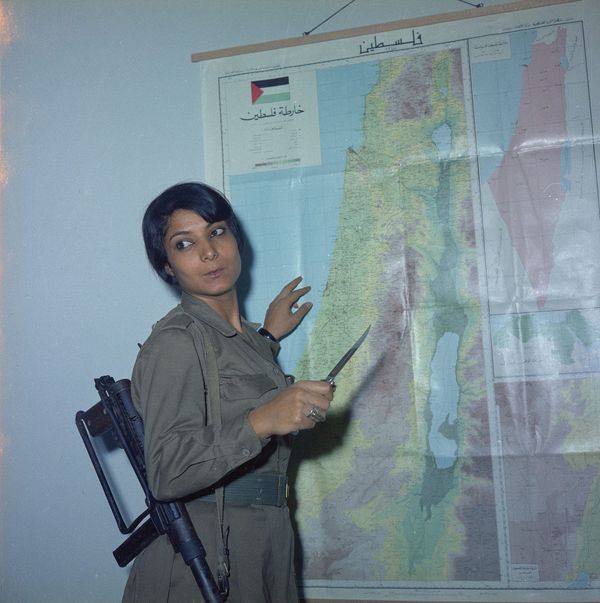
The Revolutionists: The Story of the Extremists Who Hijacked the 1970s
By Jason Burke
Knopf, 768 pages, $40
In 2006, in a public discussion of Israel’s assault on Lebanon, the feminist scholar Judith Butler characterized Hamas and Hezbollah as “part of the global left.” Butler’s remarks provoked a scandal at the time, but after the October 7 attacks, it became common to hear Western leftist protesters chanting slogans like “long live Hamas!” How did Middle Eastern terrorist groups rooted in radical Islamic ideology come to occupy such a central place in otherwise secular left-wing politics? In The Revolutionists: The Story of the Extremists Who Hijacked the 1970s, journalist Jason Burke takes up this question, exploring the historical roots of the Palestinian national movement and situating its rise within the transition from 1970s left-wing radicalism to the emergence of radical Islamism, which reshaped global politics in the 1980s.
Burke’s account brings to life the central figures of this transnational revolutionary movement: Leila Khaled of the Popular Front for the Liberation of Palestine (PFLP), Fusako Shigenobu of the Japanese Red Army, Ulrike Meinhof from the German Red Army Faction, and “Carlos the Jackal,” the nom de guerre of the sociopathic Venezuelan-born gun for hire Ilich Ramírez Sánchez. These leftist militants moved fluidly across borders, traveling from sympathetic regimes in the Middle East to hubs of revolutionary fervor, most notably the PLO’s refugee camps in Lebanon and Jordan. They hijacked airplanes and marched with Kalashnikovs in the desert. Inspired by the revolutionary tracts of Frantz Fanon, Régis Debray, Che Guevara, and Mao Zedong, they forged a transnational network of anti-colonial insurgency and solidarity.
These left-wing radicals took Mao’s dictum that “political power grows out of the barrel of a gun” to heart and concluded that electoral politics and peaceful protest were insufficient for taking on the global forces of capitalism, imperialism, and colonialism. But this analysis also created its own problems. The enemy these militants fought was not a single politician, national government, or corporation, but a vast, complex global political and economic system, so it was always unclear how a small number of assassinations and kidnappings could defeat it.
“This is part of why Israel became their primary target.”
This is part of why Israel became their primary target. The radicals of the era viewed the Jewish state as the most egregious manifestation of capitalist decadence and settler colonialism, but also as small and weak enough to be brought down through violent direct action. By doing so, they believed they could hasten the inevitable collapse of a rotten Euro-American imperial system.
The ideological current underpinning this radical global project was internationalism. Building on Marx’s dictum that class conflict had no national boundaries, these radicals traveled the world for training, combat, and refuge. From the street cafes of Paris to the Arab communist enclave of Aden, the revolutionaries searched for hideout spots and friendly governments in far-flung parts of the world. For example, “Carlos the Jackal,” settled in the People’s Democratic Republic of Yemen after fleeing authorities in Europe.
Burke offers a compellingly detailed picture of these radicals’ delusions of grandeur and the many comical contradictions that hampered their efforts. For example, a group of British Trotskyists drank alcohol in a PLO training camp and got into a fist fight with British Maoists as well as with the Palestinian guards who tried to confiscate their bottles. The German Red Army Faction mistakenly incorporated a submachine gun used by West German security forces into their logo, instead of the Kalashnikov, the weapon most associated with anti-colonial resistance. German radicals were so repulsed by the dirtiness of a PFLP office in Yemen that they went on a blitzkrieg-style cleaning spree. These militants romanticized the life of the revolutionary and were convinced they were forging a more just world, but they were constantly undermined by their own incompetence, poor planning, bad tempers, and cultural cluelessness.
Burke’s book is especially valuable for its emphasis on the shift in terrorism. In the 1960s and early 1970s, radical leftists of various Marxian stripes—Maoists, Stalinists, Leninists, Fidelists—were the primary orchestrators of terrorist attacks. Although committed to the revolutionary cause, they did not view the afterlife as paradise or martyrdom as the desired end goal of armed struggle. Like most diehard communists, these terrorists were atheists.
However, a simmering brew of religious fervor was beginning to boil in the Middle East. Sayyid Qutb, a radical Egyptian preacher and member of the Muslim Brotherhood, published a short book, Milestones, in 1964. Calling for Muslims to violently resist apostate regimes and the institutions of “World Jewry,” Qutb’s teachings became the intellectual cornerstone of the modern Islamist movement. Tapping into the anti-colonial rhetoric that resonated with left-wing radicals and Palestinian activists, Qutb’s conspiratorial theories jumpstarted a violent religious movement that would have long-lasting implications for the modern world.
Frustrated with Israel’s growing power in the region and the “apostasy” of US-aligned Arab governments, Middle Eastern radicals in the mid- to late 1970s abandoned the imported European ideology of Marxism in favor of homegrown Islamic teachings, such as Qutb’s works. Instead of reading the works of Mao and Che, they read Milestones and studied the Koran. Most of them became adherents of the most puritanical interpretations of Sunnism and Shiism. Although still full of revolutionary zeal, these extremists dropped communism for Islamism.
“Instead of reading the works of Mao and Che, they read Milestones and studied the Koran.”
The Islamic Revolution in Iran demonstrated the revolutionary potential of Islam and its remarkable ability to transform a society overnight. Although a prominent religious figure by the mid-1970s, Khomeini spoke in terms familiar to many leftists: revolution, class, and the plight of the poor. The broad appeal of this blend of left-wing populist messaging with anti-Semitism and fundamentalist Shiism turned Khomeini into a national leader in waiting. Exiled by the Shah, Khomeini triumphantly returned to Tehran in 1979 and established the Islamic Republic of Iran.
While Burke’s 700-page book at times feels like an endless series of skirmishes involving alphabet soup revolutionary groups and intelligence services, its central thread reveals the globalized, relentless force of the anti-Israel movement that emerged in this era and became the unifying mission of a wide array of disparate groups. Burke also demonstrates the remarkable tenacity of Mossad and prowess of the IDF in countering these threats. Despite their immense, concerted efforts, violent communists and Islamists failed to destroy the Jewish state. While Israel’s response to October 7 has drawn widespread condemnation, the book provides a firm reminder that Israel has long faced intense opposition. It would always have to be on guard, and it has proven equal to the task.
The regime established by Khomeini staked its legitimacy on the idea that, unlike the secular Middle Eastern governments and left-wing radicals that tried and failed to bring down the Jewish state, it was strong and unified enough to pose a genuine threat to Israel’s regional preeminence. But the Israeli decimation of Iran’s proxies in Syria, Lebanon, and Gaza has left the Islamic Republic weaker and more embattled than ever before. Today, the US government seems poised for a potential attack on Iran, in an attempt to take advantage of this weakness. Burke’s book contains an implicit warning for regime change planners. The ideological landscape of the Middle East changed entirely between the 1960s and the 1980s, but violent hostility to the United States and Israel, and the accompanying threat of terrorism, remained constant. Likewise, removing the ayatollahs from power isn’t at all guaranteed to bring peace or stability.