


I remember where I was sitting when Adolph Reed Jr. and Walter Benn Michaels told the left that it was making a historic mistake. It was a fall day in 2016, at a bookstore on the University of Chicago campus—a room dense with graduate students, academics, and a few journalists, the kind of crowd that fancies itself the intellectual vanguard of a revolution that never quite arrives.
Reed, the political science professor and democratic socialist, and Michaels, the literary scholar who had spent a decade skewering diversity politics, were there to argue that the political left could not simultaneously prioritize race and class. It had to choose. That had been the thesis of Michaels’s 2006 polemic The Trouble With Diversity: The more you emphasize the disproportionate suffering of particular groups, he argued there, the more you end up with a politics that accepts inequality as long as it is properly distributed: a rainbow-hued C-suite presiding over a Dickensian shop floor. In a society where the top 10 percent includes people of every background, anti-racism becomes compatible with, even useful to, the concentration of wealth. Class, meanwhile, disappears.
Progressives denounced The Trouble With Diversity as racist blasphemy, something like The Bell Curve for Marxists. Unsurprisingly, some members of the audience in Chicago, including an editor at Jacobin, pushed back. You can have both, the argument went. Identity and material conditions aren’t in tension; they’re inseparable.
I left that bookstore thinking that Reed and Michaels were probably correct, but too pessimistic about where things were headed. A decade later, they look like prophets.
The intellectual battle in that room at a Chicago bookstore wasn’t just a niche matter for academic Marxists. It was being fought out in the open in the 2016 Democratic primary between Hillary Clinton and Bernie Sanders. That mid-aughts version of Bernie entered the race as the closest thing American electoral politics had seen to a class-first candidate since the late Jesse Jackson’s Rainbow Coalition in the ’80s.
Bernie’s pitch was simple and consistent: Wealth and income inequality were the defining crisis of American life, and every other social problem—including racial disparities—flowed from that central fact and had to be addressed through it. This wasn’t a popular take among the progressive activist class and the media, especially considering that—disingenuously or not—Donald Trump had conquered the GOP with a right-wing version of some of the same arguments: The system is rigged, the elites have abandoned you, someone needs to fight back. Both campaigns were responding to the same underlying reality: Decades of bipartisan neoliberalism had gutted the working-class communities that once formed the backbone of American democracy.
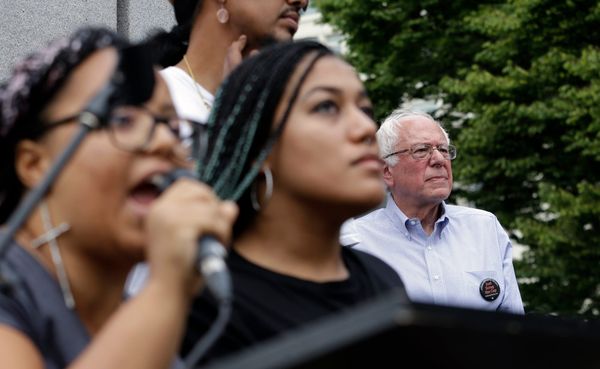
Meanwhile, America’s professional-managerial class (PMC) was quickly adopting the tenets of race-and-gender-first identity politics. When Black Lives Matter protesters confronted Sanders on multiple occasions during his first presidential campaign, demanding he speak specifically to anti-black violence and racism, he responded by talking about transforming the economy, making public colleges tuition-free, raising the minimum wage, and overhauling trade policy. When one protester pressed him directly on what he would do about racial injustice, he said he would create millions of decent-paying jobs.
Clinton saw her opening. “There are some who say, ‘Well, racism is a result of economic inequality,’” she said. “I don’t believe that.” She went further, inverting Sanders’s causal logic entirely. Income inequality, in her framing, was “in large measure a symptom of underlying racism.” You couldn’t solve racial injustice by creating jobs and expanding opportunity, Clinton argued. Racism came first; it was structural and irreducible; and a politics that folded race into class was, at best, inadequate and, at worst, a dodge.
A hashtag—#BernieSoBlack—went viral among Black Lives Matter activists, mocking the way he invoked his civil rights record while declining to engage in a more explicit racial politics. Some prominent liberal media figures, like New York Times opinion columnist Charles Blow, began criticizing Bernie like it was a full-time job.
“When Sanders lost to Clinton, it wasn’t merely a political defeat.”
So when Sanders lost to Clinton, it wasn’t merely a political defeat. The war of ideas had been won, and it foreclosed certain questions before they could be seriously asked. Obsession with identity and dismissal of class would govern the party’s activist infrastructure, its media, its donor class, and its self-understanding for the next decade.
The anti-Trump #Resistance that emerged after 2016 was an online-driven movement made up primarily of credentialed professionals. Their central question was not who owns what or who works for whom, but who is being harmed, erased, or insufficiently recognized. The economy that mattered most in progressive politics was the attention economy. Even when mainstream leftists talked about capitalism, they did so in the language of corporate HR and therapeutic harm reduction. The critique was not that American elites had presided over deindustrialization, asset inflation, monopolization, financialization, and the shredding of the welfare state. It was that those elites were too white, too male, too straight, too culturally insensitive, and insufficiently “aware of their privilege.”
After Trump won the 2016 election, I interviewed Walter Benn Michaels for the Chicago Reader, and he described the shortcomings of this identity-driven politics with characteristic bluntness: You can have a Black CEO and a Latina senator and a queer cabinet secretary and still have an economy in which the bottom half of earners own almost nothing. Diversity is perfectly compatible with plutocracy.
But after Trump got elected, liberals weren’t content with symbolic diversity; they became militant about expanding its logic into all aspects of life. As if to underscore that point, after my interview was published, it prompted a revolt among the Reader’s staff, many of whom have refused to talk to me since. Soon, there was a big push for greater racial diversity among staff. A day after the Reader’s parent company, the Chicago Sun-Times, told our staff that more diversity would have to wait until an opening occurred because there was no new hiring, someone filed a bogus and vague #MeToo claim against me, alleging that I was “making a woman feel uncomfortable.” I was suspended without pay until that claim was investigated, with the Sun-Times editor telling me, “In this political climate, we have to.” The message was clear: diversity was sacrosanct.
A few years later, Reed was scheduled to give a talk to New York City DSA, but the event was cancelled amid backlash to his insistence that the disproportionate effects of Covid on black Americans could not be understood apart from poverty and the health care system. Reed had warned for years that identity politics would not supplement class politics, but supplant it. In 2020, the left made his point for him by treating a black lifelong socialist as a “problematic” obstacle to progress. “The DSA thing,” he later said in an interview, “that was a bunch of stupid kids.”
The stupid kids kept winning in 2020, the year that identity politics triumphed. After the killing of George Floyd, an enormous outpouring of protest swept the country. Corporate America embraced it—not, of course, with sectoral bargaining or wealth redistribution, but with DEI departments, reading lists, and a fresh flood of foundation money. Above all, it was about changing the conversation—and making sure it was about race, not class.
In 2016, when Nancy Isenberg published White Trash, a rigorous history of American class stratification, it was a brief blip. In contrast, The 1619 Project, which arrived three years later, enjoyed the institutional backing of The New York Times and was recognized with a Pulitzer. Both were ambitious and challenging works, but only the race-reductionist version was allowed to reorganize Americans’ understanding of their past.
The 2024 election capped off a decade of ascendant identity politics with crushing irony. The coalition the Democrats had built on the premise that young, non-white voters would be a bulwark against “fascism” cracked wide open along the diploma divide. Highly educated whites voted more Democratic than ever, while multi-racial working class defectors helped Trump win the popular vote. Despite all the efforts to make it go away, class reasserted itself.
The present should be the left’s moment. Trump’s approval ratings have tanked amidst an unpopular war and tepid economy. The top 10 percent of income earners now account for nearly half of all consumer spending. Meanwhile, the costs of housing, childcare, health care, and education have turned middle-class stability into a period piece.
But the left is perceived by many, not without reason, as nothing more than a vehicle for the interests of highly educated progressives who see the United States as a global service provider—one big USAID—while viewing the actual inhabitants of the country with a mix of pity and suspicion. For this class, the attachments that anchor working-class life—stability, family, community, the quiet dignity of work—are treated as artifacts of a backwards age, if not outright “problematic.”
There are those who argue organized labor can still provide direction to the left, but the outlook is so bleak for the movement that a writer for Jacobin recently described unions as in a “death spiral,” with private-sector union density down to just 5.9 percent of the workforce, and projected that, without radical change, the labor movement could “effectively cease to matter.” The tragedy of the modern left is that it did not build the institutions it needed to matter in 2026. The No Kings marches are a sign of liberal discontent, but not much more.
“There are, perhaps, small signs of a correction.”
There are, perhaps, small signs of a correction. The affordability politics of New York City mayor Zohran Mamdani suggest one possible path forward. The newly inaugurated mayor of New York City campaigned on affordability, rent, transit, and wages. In his early months in office, he expanded free childcare, targeted predatory junk fees, and pushed for deregulation to build affordable housing. These steps are promising, but they are not the whole of his record.
Mamdani has also established the first-ever Mayor’s Office of LGBTQIA+ Affairs in New York City history, appointed the first openly transgender director of a city office, and, on Trans Day of Visibility, posted that trans lives are “not a political issue” while making it clear that they actually are. None of this is hypocritical; Mamdani is a sincere progressive, and these are things he genuinely believes. But they are also exactly the kind of pieties that the professional activist class requires as the price of coalition membership.
At the bookstore in Hyde Park a decade ago, Reed and Michaels were accused of forcing a false choice between race and class. But the last decade suggests that the falsehood ran in the other direction: The American left kept insisting that it could center both, and what it actually centered was neither. It got anti-racist corporate HR, therapeutic activist discourse, a thousand prestige battles over language and representation, and a working class, multiracial, fragmented, downwardly mobile, increasingly cynical, left to fend for itself in a country of rising rents, weak unions, and algorithmic upheaval. In the end, class is—once again—dismissed.
For his part, Michaels is relatively unsympathetic to a left which did not heed his warnings in 2006 and again in 2016. Never one to mince words, he told me last month over email: “My current view is fuck ‘em all.”