


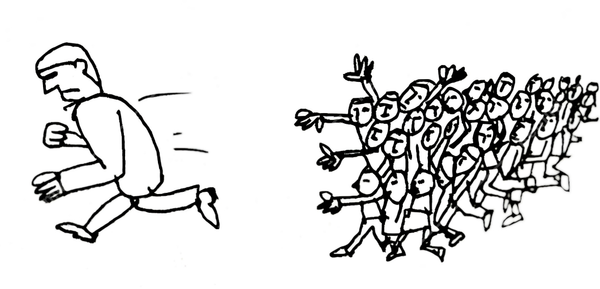
In Yanomamö villages, rules aren’t enforced by courts or police. In these small-scale communities in the Amazon rainforest, when someone violates a norm—refusing to share food from a hunt, calling someone a coward, having sex with someone else’s wife—accusations are aired publicly in the shabono, the tribe’s central communal space, in front of an audience where everyone knows everyone. Conformity is maintained because, here, your reputation is everything. Insults must be answered decisively. Rumors need to be defused immediately. Social rejection is as much a threat to survival as mistaking a snake for a stick.
Small-scale societies with high levels of inter-village hostility exert intense pressure to conform. Internal divisions have to be resolved quickly. Violating norms and signaling disloyalty threaten the tribe’s survival. Communities use gossip, public shaming, and the threat of exclusion to police these infractions. To be on the inside is to have standing, marriage prospects, and allies; to be on the outside is to be exposed and vulnerable.
My postdoctoral advisor, the late Napoleon Chagnon—whose fieldwork with the Yanomamö informs much of what we know about their social life—recounted an incident in which a man named Rerebawä became enraged after learning that a girl he had been promised as a second wife was having an affair with another man, Bäkotawä. Rerebawä challenged Bäkotawä to a “club fight”—a public face-off in the center of the village in which the two men would confront each other with large wooden clubs—hurling insults and trying to goad him into escalation. Eventually Bäkotawä backed down. That all this occurred in front of the rest of the community was the point. Without witnesses, the conflict would have been pointless.
For most of our history, humans have lived in small groups under similar conditions. Conformity is so deeply embedded in our psychology that we fail to notice it or mistake it for reality itself. When people feel watched, vulnerable, or at risk of exclusion, they become more willing to fall in line—and to punish anyone who won’t.
But as societies transitioned from kin-based bands of a few dozen to nations numbering in the tens of millions, the old enforcement mechanisms weakened. Anonymity became possible, audiences fragmented, and people could move between social worlds that didn’t speak to each other. The loss of constant surveillance didn’t make people less tribal, but it did create room to dissent—and in America, one of the most geographically mobile societies on earth, much of modern life through the end of the twentieth century was a golden age for heretics.
This wasn’t a historical accident. James Madison and the other American founders had an intuitive understanding of tribal psychology and worried as much about social tyranny as political tyranny. In Federalist 10, Madison warned about the dangers of factions and explained that the Constitution was designed to disrupt herd behavior. A healthy republic, he believed, required citizens willing to speak plainly, withstand disapproval, and risk social punishment.
For a while, rising group size, anonymity, and mobility combined with these principles to expand the space for dissent. But human nature never changed. So when technology restored the social architecture of our ancestors, the conformity instincts of the traditional village returned. By making social approval measurable, turning conflicts into public displays, and creating a permanent record of social strife, the internet has recreated village life on a planetary scale. This was what the media theorist Marshall McLuhan meant when he declared that “an electronic world re-tribalizes men.”
However, the new technological environment revives the old patterns of collective life in a space still defined by the anonymity, atomization, and massive scale of modern societies. Online, remarks can be detached from context, resurfaced years later, and judged by a new audience with no relationship to the speaker. In the old world, reputational enforcement was local, and so escapable. In the new world, it is global and enduring—a person in New York can police the norms of strangers in Missouri over something said a decade ago.
“We are all watching each other, and being watched by each other, all the time.”
What McLuhan called the “global village” is a universal panopticon: We are all watching each other, and being watched by each other, all the time. You are never just catching up with a friend online. You’re also performing in front of a crowd of friends, enemies, and strangers.
The new village arrived at the worst possible time. By the end of the twentieth century, offline life had already begun to sort people into like-minded communities and hollow out the institutions that used to buffer people from ideological dependence—neighbors, churches, unions, bowling leagues, extended family. As bridging social capital (ties that cut across background, class, religion, and party) weakened, our worst tribal instincts were reawakened.
My research has shown that when these buffers disappeared, the need for community didn’t go away; it found a new outlet in what social psychologists call identity fusion, when the boundary between self and group dissolves. But identity fusion has strict terms—and nothing has been more conducive to the conversion of loneliness into tribal identity than a sea of lonely, disconnected individuals searching for a tribe.
“These dynamics accelerated as more social life moved online.”
These dynamics accelerated as more social life moved online. Pew’s polling tracks these trends. Between 1994 and 2017, partisan sorting intensified: The parties pulled farther apart, the shared middle thinned, and people grew more loyal—and more conformist within their own political party. In that environment, the social penalties for dissent tightened—first with the moralized orthodoxy of woke culture after 2014, and then with the MAGA backlash.
The modern village offers connection and the comfort of belonging, but reneges on its promise by asking identity and politics to carry the weight of meaning, friendship, and faith—burdens they cannot bear. It offers constant contact without real companionship and then monetizes our loneliness. Over time, it turns our interactions into a branding exercise, and the mask begins to eat the face.
After a heated Oval Office clash with Volodymyr Zelensky last year, Donald Trump revealed his intuitive grasp of the new state of affairs when he turned to the cameras and said: “This is going to be great television.” In the global digital shabono, nothing matters if it isn’t performed in front of an audience; if nobody was watching, it didn’t happen.